Power Is Taken: What They Said, What They’ve Done, and What Comes Next
Politics
Power Is Taken: What They Said, What They’ve Done, and What Comes Next
By Don Jackson | Prodigal Breaking News | prodigalbreakingnews.com
October 14, 2026
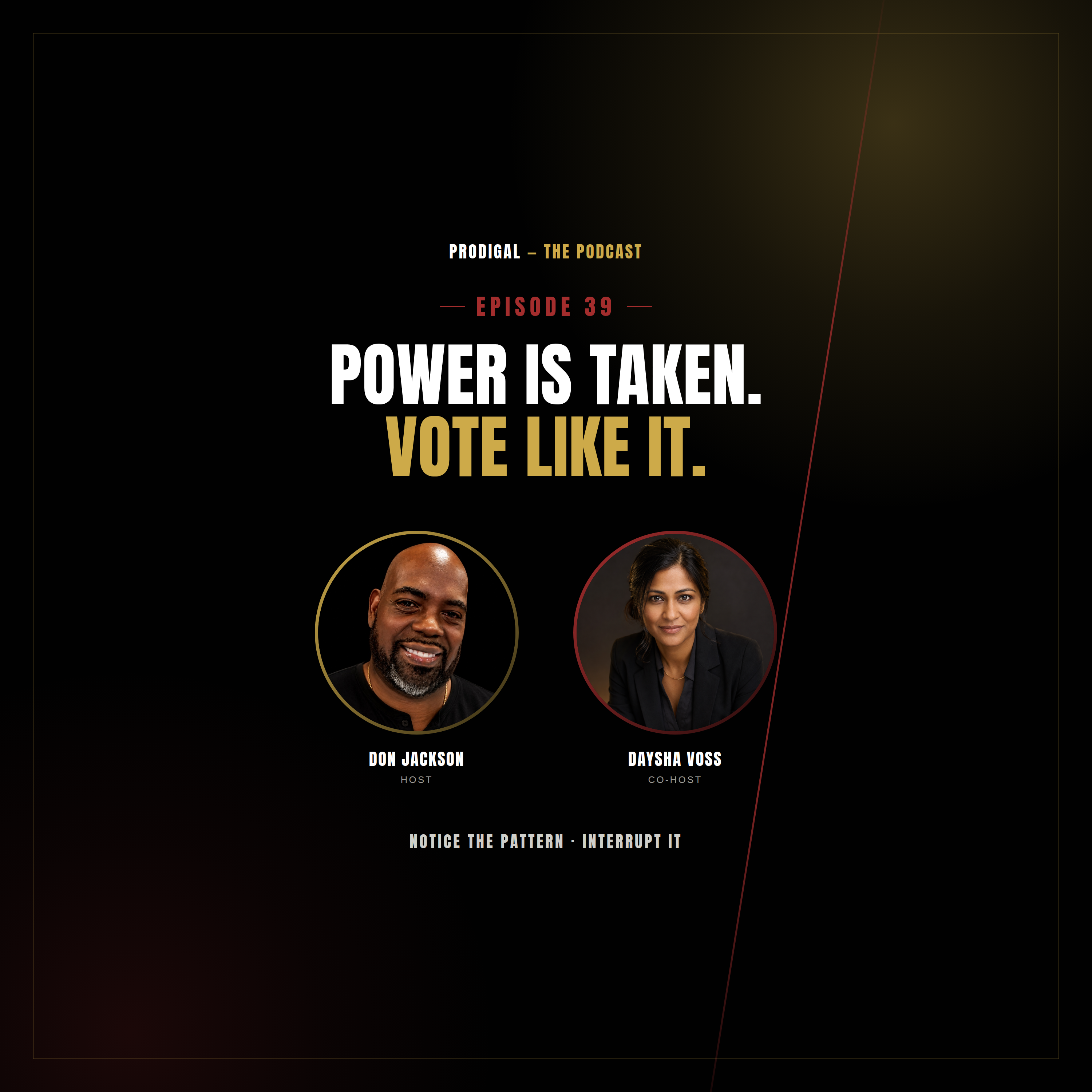
Early voting is open, the election is less than three weeks away, and the people around the president have said out loud what they are willing to consider if the vote goes the wrong way. Don Jackson and Daysha Voss lay out what we know, what they said they’d do, and what we think, with every claim labeled. They walk through the Time interview, the draft emergency order, the searches and subpoenas, what the Insurrection Act can and cannot do, what “civil war” actually means, and what to do before November 3. Power is taken. Vote like it.
Less than three weeks from now, Americans vote in the midterm elections. Early voting is already open. And the people closest to the president have spent months telling us, out loud, what they are willing to consider if the vote goes the wrong way for them.
I'm not saying that to scare you. I'm saying it because they told us. This piece is the written version of Episode 39 of Prodigal, the podcast, and it's built around one discipline: three labels, used every time. What we know: documented, with who said it. What they said they'd do: their own words. What we think: our inference, and we'll tell you when it's ours. The minute those blur together, you stop trusting us, and you should.
Proof is in the pudding, so before we start: I already voted. California sent the ballots out, mine came, I took the time to fill it out, and I dropped it off at the post office this morning, right before we started writing this episode. When I tell you to vote early, I'm not telling you something I haven't done myself.
The one line I'm not blurring: power is taken. It is never handed over because somebody asked nicely. Frederick Douglass said it in 1857: "Power concedes nothing without a demand. It never did and it never will."
Where We Are
The midterm election is Tuesday, November 3. Early in-person voting began in Virginia on September 18, and it has been rolling out state by state. Many of you have a mail ballot in your mailbox right now.
Do I think a blue wave is coming? I do. But that is a feeling, and a poll is not a vote, so it goes under what we think. Here is what goes under what we know: when a president who has spent six years telling his people that elections are rigged expects to lose, that nervousness has to go somewhere. This piece is about where.
What We Know, and What They Said
The president won't rule it out. In an interview with Time conducted September 28 and published October 1, Trump was asked whether he would rule out a state of emergency before the midterms. He said, "I don't rule anything out or in. We'll see." Asked about the Insurrection Act, he said, "I've never used it. I could use it. A lot of people think I should use it sometimes." His supporters read that as a man who doesn't close doors. That's a fair reading. It is also fair to note that the one answer he did not give was "I rule it out."
A draft emergency order has circulated. In February, a 17-page draft executive order began circulating that would declare a national emergency over elections. Reporting says it was pushed by pro-Trump activists including Peter Ticktin, the Florida lawyer who represents Tina Peters, and that it would let the president ban mail ballots and voting machines. Asked about it, Trump said he had "never heard of it." The people circulating it say they are coordinating with the White House; a White House official said speculation about the president's actions was just that. It is not an official White House document.
Allies are saying the quiet part. In June, on a podcast, Ticktin said the president should declare martial law to stop Democrats winning Congress: "And I mean martial law." On the same show, Jerome Corsi said, "All the evidence I have and can see is that Donald Trump is setting the stage for an election emergency declaration." Those are opinions of private citizens, not announcements by the White House. But it is one ecosystem saying the same thing in the same month.
ICE at the polls. In February, Steve Bannon said on his show, "You're damn right, we're gonna have ICE surround the polls come November." Asked about it, White House press secretary Karoline Leavitt said she hadn't heard the president discuss formal plans to put ICE outside polling locations, then added, "I can't guarantee that an ICE agent won't be around a polling location in November." When a PBS NewsHour reporter asked Trump whether he would send the National Guard or ICE to voting locations, he answered, "I'd do anything necessary to make sure we have honest elections."
Federal monitors. The Justice Department's civil rights chief, Harmeet Dhillon, has promised up to 1,000 federal election monitors for November, according to the Campaign Legal Center. That group documented problems in the primaries: in Wyoming, monitors improperly sought access to voting machines; in Minnesota, the department sent a monitor who had previously been convicted of hacking state and local election websites. A monitor can observe and document. A monitor cannot intimidate voters or run a polling place.
And this week's Six Beats connect to all of it. Trump created a three-member White House panel to decide whether to fire Federal Reserve Governor Lisa Cook, with a closed hearing set for November 5; she denies the mortgage accusation and has not been charged, and the Supreme Court let her stay in June because she was not given notice and a chance to respond. A federal judge, Sparkle Sooknanan, ruled the Justice Department's voter-roll project unlawful in a 78-page opinion, writing that Congress left that authority with the states. And Tina Peters' lawyer described a plan to take control of ballots after the machine count and run a second count; a former Justice Department attorney says she met the president about it, the White House won't confirm, and no agency has acted. That last one rests on a single account, and we've said so wherever we've reported it.
Courts are slowing the plan down. On August 11, Judge Indira Talwani blocked an executive order that would have barred the Postal Service from delivering mail ballots to people not on a federal list. "The executive branch has no authority to regulate elections," she wrote. That's a receipt too.
What the Institutions Say
The fair ledger has two sides. On August 31, General Dan Caine, chairman of the Joint Chiefs, wrote to Senator Elissa Slotkin that the military has no plans to send troops or federalized National Guard members to polling places in 2026, and no plans to use them to seize ballots or voting machines. He wrote: "I have neither received nor anticipate receiving any unlawful order." Federal law bars armed federal forces from election locations unless it is "necessary to repel armed enemies of the United States."
That is real, and we say so. The caveat is that the letter speaks to plans, and plans can change. The Secretary of Defense had not answered the same senator's letter when the news broke; in April he called her question about seizing ballots a "gotcha hypothetical" and said, "I've never been ordered to do anything illegal, and I won't."
What We Think: The Playbook
Everything in this section is us. It is pattern recognition, not a news report. If we're wrong, we will be the happiest people in America.
Start with what is already on the record from 2020, because that isn't an opinion. The "it's rigged" story was out before the votes were counted. Dozens of lawsuits followed and the courts threw them out. There was pressure on state officials, including a phone call to Georgia asking for votes to be "found." There were alternate slates of electors no state had certified. There was January 6. And in January 2025 came sweeping pardons for the January 6 defendants. We are not inventing a sequel. We are reading the first draft.
Here is how we think the sequel could go:
- Tell the base before the election that the other side will cheat. We're already there.
- Build the paperwork for an emergency. The draft order. "I don't rule anything out." The Insurrection Act talk. You write the document before you need it.
- Show up in force where it will keep people home. Federal agents near polling places in blue cities, not to change a vote but to make a grandmother decide to vote "later."
- Call it fraud fast. When the first returns are bad, say so before anything is counted, challenge the count where it matters, and ask for a "second count." That is the phrase Peters' lawyer used this week.
- Take custody of ballots after the machine count. This is the one that scares us and the one we can't prove. Ticktin described taking control of ballots after tabulation. He didn't say who would do it, and we can't tell you who. The generals say the military has no plans. We'd still want to know who is holding the ballots at every step.
Every one of those has an answer. For 1 and 4: turn out so big that nobody can call it close. For 2: judges, who have been blocking these moves. For 3: show up anyway. For 5: witnesses, millions of them, with phones.
The Prosecutions: Search, Subpoena, Indictment, Talk
Ilhan Omar was not arrested. On Monday, October 12, Homeland Security Investigations agents searched the Washington-area home of Rep. Ilhan Omar under a court-authorized warrant. The Justice Department said it was part of an ongoing federal criminal investigation and gave no other detail. Fox News, citing unnamed sources, reported it was linked to alleged immigration fraud involving paperwork her late father submitted when she was a child; she has denied immigration-fraud allegations in the past. As of this writing, no one has been arrested or charged. A search is not an arrest, and an arrest is not a conviction. Investigate crimes, yes. And also notice the timing, three weeks before an election.
James Comey has been indicted twice. The first indictment, in September 2025, was dismissed over concerns about whether the prosecutor had been properly appointed. The second, announced April 28, 2026, concerns an Instagram photo of "86 47" spelled in seashells, which the Justice Department calls a threat; Comey said he hadn't realized some people read it that way and took it down. After the first indictment the president said, "Frankly, I hope there are others, because you can't let this happen to a country."
The Florida grand conspiracy. A grand jury in Fort Pierce is examining what the Justice Department's allies call a "grand conspiracy" against Trump, stretching from the 2016 Russia investigation to the Mar-a-Lago search. John Brennan, the former CIA director, is subpoenaed to appear Thursday, October 15; his lawyer disclosed it in a court filing, and he is described as a subject of the probe. Comey was subpoenaed in March, and one source puts the number of subpoenas above 130.
Obama and Hillary Clinton. No reporting we could read says prosecutors have named either as a target. Last fall, Trump ally Mike Davis listed them, along with Biden and others, when discussing who the probe might reach, and a former prosecutor said Obama "could potentially be" a subject if the evidence points that way. That is talk, not a charge, and reporting says whether prosecutors can tie 2016-era decisions to events in 2022 into one criminal agreement "remains to be seen." The talk is the point: you don't need the indictment, only the headline, and the headline says be careful who you stand next to. Don't let it scare you away from the ballot box.
Mike and Denzel
On October 9, Mike Tyson was in the White House briefing room, then flew to New York with the president and went on stage at a rally for Bruce Blakeman, the Republican running for governor. "I'm just happy to be up here with my president, President Trump," he said. Asked how Republicans would do in November, he said, "I think Donald Trump will win." Trump is not on any ballot this November; at that same rally he asked voters to "pretend I'm on the freaking ballot."
On Sunday, October 11, Trump's Truth Social account shared a screenshot from an X account called Red Eagle Updates showing a quote attributed to Denzel Washington calling Trump a "great friend and an even better president." Snopes had debunked the quote on October 10, and the same quote had previously been attributed to Matthew McConaughey and Mick Jagger. Washington's representatives hadn't responded to Newsweek's request for comment.
This is the same pattern as our Tim Scott episode. If the real support isn't there, you manufacture the look of it: a Black face next to power to tell the rest of us it's okay, and when you can't get the face, you fake the quote. A picture is not power. It's a prop.
The Words "Civil War"
People say "civil war" and mean five different things.
- The movie version: two armies, territory, front lines. We don't think that's coming.
- Low-grade political violence: threats, shootings, attacks on officials. That isn't coming; it's here. Minnesota lawmaker Melissa Hortman and her husband were murdered at home in June 2025. Charlie Kirk was shot dead that September. It did not come from one political side.
- A constitutional crisis: competing institutions each claiming to be the real government; a president ignoring a judge; federal agents in a city whose mayor says no.
- A legitimacy collapse: half the country decides the election wasn't real. That needs no shots fired. Just a lie half the country wants to believe and a leader who won't say "I lost."
- Mass refusal: tens of millions of people peacefully saying "not this," in the streets, in every city, until holding on costs more than letting go.
Is some kind of rupture coming? I believe so. Whether it becomes the movie version isn't written, and that's a prediction, so it goes under what we think. Political scientist Barbara Walter, in How Civil Wars Start, argues that countries in the middle, neither full democracy nor full autocracy, are the most dangerous. What swings it is what ordinary people do over the next three weeks.
If They Invoke the Insurrection Act
Here is my read, and it's mine, so it goes under what we think: I believe that if this election goes the wrong way for them, they will invoke the Insurrection Act, and they will do it on a false pretense. A riot nobody can find. A "threat" nobody can document. An "emergency" that shows up right on time. The man has pulled down every guardrail he could reach, and he has told us he could use that law. Prepare as if it is happening. The cost of preparing for nothing is zero.
So here is what the law actually says, from people who study it.
What the Act is. Sections 251 through 253 of Title 10 let a president use the military inside the country in limited situations: when a state asks for help with an insurrection, when courts cannot enforce federal law because of obstruction, or when violence is denying people their constitutional rights. It is a real power, and it has been abused.
What it does not do. The Brennan Center at NYU writes that no emergency power lets a president cancel or rerun an election: a national emergency declaration is only a procedural step that unlocks other statutory powers, and none of those cancel an election. The Insurrection Act does not suspend Congress, the courts or the state legislatures, and it does not let a president change an outcome. States run elections, states own the voting machines, and states certify the results. The League of Women Voters notes that the United States has never canceled a midterm, not during the Civil War and not during either World War.
The ban on troops at the polls. Title 18, section 592, makes it a crime for a federal officer to bring troops or armed men to a place where an election is held, unless it is "necessary to repel armed enemies of the United States." Penalties include prison and disqualification from federal office. Legal scholars writing in Lawfare argue the Insurrection Act does not override that ban. We want to be straight about the limit of that: it is one reading, no court has settled it, and a 1968 Justice Department opinion went the other way.
The catch. A law is a piece of paper. It works only if someone makes the people holding power follow it: a judge, a governor, a county clerk, a poll worker, and millions of ordinary people with their eyes open. That is why we are not asking you to trust the paper. We are asking you to be the people who enforce it.
The date doesn't move. A presidential term ends at noon on January 20; the Constitution has no exception for "I didn't like the count." But this is a midterm, and for a midterm the question is who controls Congress and the state governments that run elections afterward. They do not have to cancel anything. They only have to make the result impossible to trust. So: vote early, so a disruption on Election Day cannot touch your ballot. Become a poll worker, a poll watcher or an observer. Watch the counting and the certification, because that is where the fights happen. And be ready to make noise, legally and peacefully, the second someone breaks a rule.
What You Do
- Check your registration today. Your state has a lookup site. It takes two minutes.
- Mail ballot? Fill it out the day you get it. Follow the instructions to the letter, sign where it says sign, and return it by mail or at an official drop box as early as you can. Deadlines and postmark rules differ by state, so check yours. Then track it until it says counted. (I returned mine this morning, and I'm tracking it too.)
- Or vote early, in person. Fewer lines, more time to fix a problem.
- Become a poll worker or an observer. Your local League of Women Voters, your county board of elections and your party can all tell you how. Poll workers are witnesses. Observers at the counting and the certification are witnesses. That's where this gets won or lost.
- Bring two people. The goal is a margin too big to call close.
- Know your rights. Nobody can make you say who you voted for. If anyone tries to stop or intimidate you, call the nonpartisan Election Protection Hotline: 866-687-8683 (866-OUR-VOTE).
- Document. If you see uniformed agents near a polling place, stay calm, keep your distance, film what you can legally film, and report it.
- If it comes to it, show up, peacefully. If the worst happens and an election is stolen, we want millions of people in Washington. Two million. More. Not as a stunt, as a demand and a wall of witnesses. Disciplined, organized, with permits, marshals, medics and lawyers on call, a buddy for every person. We aren't telling anyone to bring anything but their ID and their neighbors. Every person has a legal right to protect themselves, and you should talk to your own lawyer about what that means where you live. But a crowd with weapons in it hands the other side the one thing they are praying for: a reason, a photograph, a justification for the emergency order. If the evidence is on your side, don't hand your opponent the pretext. Discipline is the strategy. Numbers are the strategy.
The Landing
This was never really about one election. Every time the system tightens, we look up: to the courts, to the generals, to the next person in a suit to save us. Some of them will. Some already have. But if your whole sense of safety lives outside of you, any person with a title can move it.
The people who say they own it all are waves too. Loud ones, big ones. But the wave isn't the ocean. The ocean is us: the people who grow the food, clean the buildings, count the votes, teach the kids, answer the hotline. When we move together, nothing on the surface can stand against it. That's not mysticism. That's arithmetic. We vote not because we think a politician is a savior, but because we know we are the power. We organize not because we expect them to be fair, but because we know what we're worth. And we keep our hands open and our discipline tight, because the people who want chaos need us to give it to them.
In three weeks, someone is going to say it was rigged. Someone is going to say the count isn't over. Someone is going to say stay home. Remember that you were told. Remember that you voted. Remember that two million people can stand in one place and not throw a single punch.
Notice the pattern. Interrupt it. Vote like power depends on it, because it does. We are Source. Ashay.
Sources and notes:
- Trump on the Insurrection Act and a national emergency: Time interview conducted Sept. 28 and published Oct. 1, 2026, as reported by Political.org. We have not checked the quotes against the Time original.
- 17-page draft "national emergency" election order: Washington Post (Feb. 26, 2026) and Straight Arrow News (Feb. 28, 2026); Trump's "never heard of it" response (Feb. 27). The draft is not an official White House document.
- Ticktin ("martial law") and Corsi ("election emergency declaration"), podcast appearances in late June 2026: Democracy Docket.
- Bannon on ICE and the polls (Feb. 2026): Mediaite. Leavitt's response (Feb. 5, 2026): Reuters. Trump's "I'd do anything necessary to make sure we have honest elections": PBS NewsHour question, as reported by Talking Points Memo (date not confirmed).
- DOJ election monitors (up to 1,000; Wyoming and Minnesota primary incidents): Campaign Legal Center.
- Gen. Dan Caine's letter to Sen. Elissa Slotkin (Aug. 31, 2026): PBS NewsHour / Associated Press. Federal law on armed forces at polling places as described in that report.
- Judge Indira Talwani's mail-ballot order injunction (Aug. 11, 2026): Fox 9.
- Judge Sparkle Sooknanan's voter-roll ruling (Oct. 9, 2026), Lisa Cook committee of inquiry (Oct. 9, 2026), Tina Peters / Ticktin ballot plan reporting: see the Prodigal Breaking News Six Beats stories of Oct. 12, 2026. The Peters account is single-sourced.
- Ilhan Omar home search (Oct. 12, 2026): Associated Press via MPR News and Al Jazeera. Fox News report on the alleged basis cites unnamed sources.
- Comey second indictment (April 28, 2026): ABC News. First indictment dismissal and Trump's "I hope there are others" (Sept. 2025): PBS NewsHour.
- Florida "grand conspiracy" probe, Brennan subpoena (appearance Oct. 15): CBS News; Comey subpoena (March 2026): CBS News and Axios; Mike Davis's comments and the legal theory: Washington Examiner (Oct. 2025) and April 2026 update. Neither Obama nor Hillary Clinton is named as a target in the reporting we read.
- Mike Tyson at the White House and the New York rally (Oct. 9-10, 2026): BizPacReview and Reality Tea. These are two outlets and we could not open larger mainstream reports.
- Fake Denzel Washington quote (shared Oct. 11, 2026; Snopes debunk Oct. 10): Newsweek. Washington Post headline of Oct. 12 confirms the story but we could not open the article.
- Insurrection Act and election limits: Brennan Center for Justice, "There Are No Extraordinary Powers a President Can Use to Reverse an Election"; Lawfare (Voss and Orpett), "The Insurrection Act Is No Exception to the Troops-at-Polls Ban" (an argued reading, not a court holding; 18 U.S.C. 592); League of Women Voters, "Midterm Fears and How to Fight Them." That the Act will be invoked on a false pretense is Don Jackson's own prediction, not reporting.
- Barbara F. Walter, How Civil Wars Start (2022).
- Frederick Douglass, speech on West India Emancipation (Aug. 3, 1857): "Power concedes nothing without a demand."
- "Blue wave," "a rupture is coming," the five-step playbook and "the civil war" breakdown are Don Jackson's own predictions and framing, not reporting.
- Election Protection Hotline: 866-OUR-VOTE (866-687-8683). Mail deadlines and postmark rules vary by state; check your state election office.
Ask Prodigal about this story
Got a question about what you just read? Ask, and get an answer drawn from this story.
5 free questions left today. Answers come only from this story and can be imperfect.
Want to go deeper? Open the companion guideProcess This Deeper
Prodigal AI's Story Companion Guide explores the institutional pattern, consciousness framework, community insights, transformation practices, and action opportunities related to this story.
Open the Companion Guide