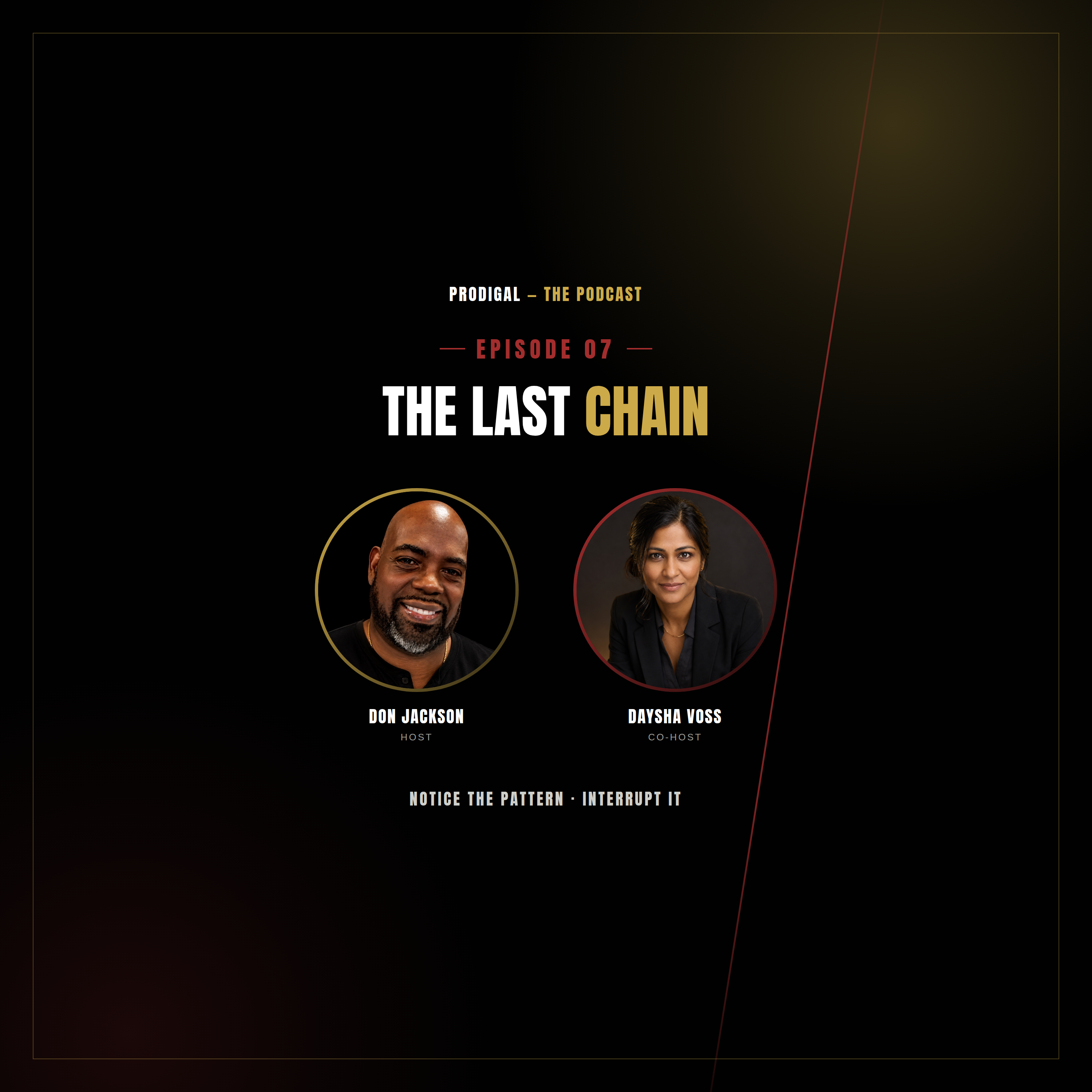
THE LAST CHAIN
Religion & Power
The Last Chain: How They Engineered a Religion to Keep You Obedient — and the Source It Could Never Erase
By Don Jackson | Prodigal Breaking News | prodigalbreakingnews.com
September 9, 2026
A Prodigal Breaking News Deep Dive — companion piece to Episode 7 of Prodigal — The Podcast
🎧 Listen to the full episode on Substack: The Last Chain — Episode 7
There's a version of history most of us were never given the tools to see clearly: what happened to enslaved Africans wasn't just the theft of land, labor, and bodies. It was the deliberate construction of a belief system — engineered, edited, and enforced — designed to survive long after the chains on the wrists came off. And it worked exactly as intended for a long time. This is the story of how that system was built, what it actually erased, why it still runs in the background of Black America's mind today, and what it means that it's the last chain still standing.
The System Was Engineered, Not Inherited
In 1807, a version of the Bible was printed specifically for distribution to enslaved people in the British Caribbean. It's on permanent display now at the Museum of the Bible, and it tells you everything: entire books were removed. The Exodus story — Moses, the plagues, "let my people go" — gone. What stayed in were the passages instructing servants to obey their masters. This wasn't an accident of printing costs. It was curated. Someone sat down and decided which parts of a 66-book text a human being enslaved by force was and wasn't allowed to read.
Alongside the edited scripture came an invented theology to make the whole arrangement feel divinely ordered — the claim that Africans were the cursed descendants of Ham from Genesis 9, condemned to servitude. Historian Mark Noll has been direct about this: the Ham interpretation was, in his words, "made up of whole cloth in the 15th century," constructed right as Europeans began colonizing Africa, with no real grounding in the text it claimed to come from. Segregated worship reinforced it physically — enslaved congregants seated in the back or the balcony, present in the room but positioned as lesser inside the very theology built to control them.
This is what "the system" actually means when people say it in the abstract: a specific, documented, edited belief architecture, built by specific people, for a specific purpose — obedience, not salvation.
What a Few Generations Can Actually Erase
Part of why that architecture held is what it was built on top of: a deliberate rupture in cultural transmission. Slaveholders banned enslaved people from speaking their native languages, forcing English, Spanish, Portuguese, or French instead. Oral traditions that had carried language, cosmology, and ancestral knowledge for generations were cut off mid-transmission — disrupted before they could be passed all the way down. Families were broken apart specifically to prevent the kind of continuity that lets a people hold onto who they were.
Anyone who has watched a language or a family tradition thin out over two or three generations in ordinary life — no violence involved, just distance and disruption — has felt a small version of how fast inherited knowledge can go quiet when nothing is actively protecting it. Now imagine that process accelerated on purpose, backed by law and force, for the specific goal of making sure no one could compare the new belief system against what came before it. That's not a metaphor. That's the documented mechanism.
The Trick Didn't Fully Work
Here's what the architects of that system didn't plan for: the moment enslaved and newly-free Black people could read the text themselves, they didn't read it the way it was designed to be read. Howard University's divinity dean, Yolanda Pierce, put it plainly: "Literally as soon as black people took pen to paper, we are arguing for our own liberation." The same book that was edited to produce obedience got read cover to cover, Exodus included, and became instead a language of freedom — the same book, doing the opposite of its intended job.
That thread runs in a straight line to Black liberation theology, most associated with theologian James Cone, which flips the entire premise: if God takes the side of the oppressed anywhere in scripture, then God is not neutral in this story, and the Gospel itself is a liberation document, not a leash. That's a real, serious theological tradition — not a fringe reinterpretation. It's the same source material the system tried to weaponize, reclaimed and redirected.
So the fair version of this history isn't "the Black church is the colonizer's trap." It's sharper than that: the control mechanism was real and documented, and Black Americans broke a piece of it from the inside before the physical chains were even gone. Both things are true at once.
The Last Chain Still Standing
But here's the part that doesn't get finished: even inside the liberation reading, the basic structure of the original architecture is still standing in a lot of places — an external authority you answer to, a savior located outside yourself, a pastor positioned between you and whatever you're seeking. Freedom got redirected inside that structure. It didn't fully dismantle the structure itself.
That's the last chain. Not a physical one, not even, at this point, mostly a doctrinal one — a mental one. The habit of looking outside yourself for permission, for rescue, for the final word on what's true. And it doesn't stay contained to religion. It's the same architecture underneath a boss you can't question, a system you assume knows better than you do, a story about your own life that someone else gets to author. Break the habit of looking outside yourself for the answer, and every other version of that same habit gets easier to see and to interrupt.
You Are Source
Different traditions, arriving from different directions, have been pointing at the same thing for a very long time: that the deepest layer of you isn't waiting on approval from outside — it already carries what you've been taught to go looking for elsewhere. Not a master to obey. Not a figure positioned between you and truth. A source you go within to reach, because it was never actually anywhere else.
That reframes the hardest question anyone asks about a broken world — why did this happen, why does harm keep happening — without flinching from it. At the deepest layer, that question doesn't require an outside authority's permission to answer, because there isn't one waiting to grant it. What gets allowed, at the level of a community, a country, a world, is what we collectively decide to allow. Nothing about that erases the real, historical, documented harm this piece just walked through. It just relocates where the authority to change what happens next actually lives — and it was never anywhere but here.
Notice the Pattern
The pattern is the same one this season keeps naming in different clothes: something real gets engineered for control, survives past the moment it was built for, and the way out isn't rejecting everything it touched — it's seeing the architecture clearly enough to keep what's true and let the control mechanism go. That was true of the Bible handed to enslaved people. It's true of the mental habit still running underneath a lot of what looks like freedom today.
The Actualization
Naming the last chain isn't the same as breaking it. That takes the same thing every chain in this season has taken: not just feeling the truth of it, but doing something with it — building the discipline of going within instead of outside for the answer, and building it in community, not just in private realization. On one accord, because a mental chain doesn't break individually and stay broken; it breaks when enough people stop looking outside themselves at the same time.
Notice the pattern. Interrupt it. You were never waiting on permission. You were always Source.
Sources
- The Slave Bible: Let the Story Be Told — Museum of the Bible
- The Bible was used to justify slavery. Then Africans made Christianity their path to freedom. — The Washington Post
- How Slavery Erased Home Languages — Karibani
- A Black Theology of Liberation — James H. Cone
- James Hal Cone: Humble Giant in the Movement for Black Liberation — Union Theological Seminary
Process This Deeper
Prodigal AI's Story Companion Guide explores the institutional pattern, consciousness framework, community insights, transformation practices, and action opportunities related to this story.
Open the Companion Guide