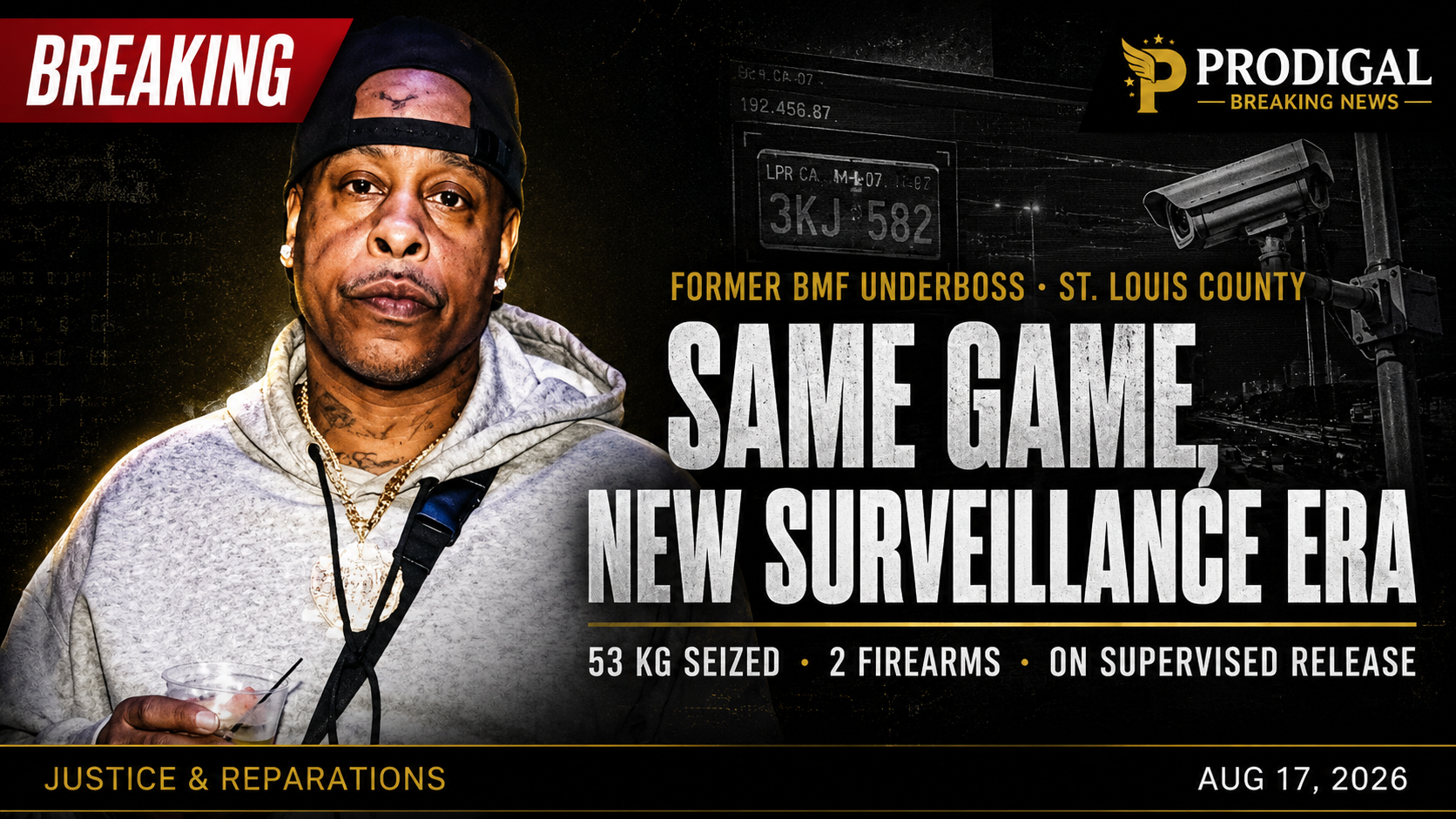
CHAD "J-BO" BROWN: THE SAME GAME, TWO DECADES LATER, IN A CITY BUILT TO CATCH IT
Justice & Reparations
CHAD "J-BO" BROWN: THE SAME GAME, TWO DECADES LATER, IN A CITY BUILT TO CATCH IT
By Grant Keller — Investigative Anchor
August 17, 2026
Chad "J-Bo" Brown — former underboss of the Black Mafia Family, who already served 11 years for racketeering — was arrested again August 14 after DEA agents found 53 kilograms of cocaine and two firearms in a St. Louis County stash house. He was still on federal supervised release from a 2024 PPP-fraud guilty plea when it happened. Charges are pending; the DOJ's own release notes a complaint "does not constitute proof of guilt."
WHAT HAPPENED
On August 14, 2026, DEA agents arrested Chad "J-Bo" Brown in St. Louis County after finding 53 kilograms of cocaine and two firearms in a stash house. Brown is the former underboss of the Black Mafia Family — the Detroit-born drug organization that built a national distribution network in the early 2000s before being dismantled by federal prosecutors. He already served 11 years in federal prison for racketeering as part of the original BMF takedown. He was on federal supervised release at the time of this arrest, having pleaded guilty in 2024 to PPP (Paycheck Protection Program) fraud. Charges in the new case are pending. The DOJ's own press release notes that a complaint "does not constitute proof of guilt" and that the defendant is presumed innocent unless and until proven guilty.
The arrest was not the product of traditional investigative work. It was the product of a surveillance architecture that did not exist when Brown was first convicted two decades ago. According to the affidavit, the case was built on Flock Safety license-plate-reader cameras — automated, networked devices that photograph and log every vehicle that passes, retain the data for weeks or months, and allow police to search a car's location history by plate, partial plate, or vehicle type. The stash house was identified, in part, because the vehicles associated with it were tracked across the county's Flock camera network. The old BMF was brought down by wiretaps, informants, and years of human surveillance. This case was brought, in significant part, by a camera on a pole that reads every plate that goes by.
THE PATTERN
This is a story about the same game in a different era — and about what it means that the same game, run by the same person, in the same city, is now caught by a different machine.
Notice the structure. Two decades ago, the Black Mafia Family ran a national cocaine distribution network. The federal government spent years investigating it. The investigation used wiretaps, confidential informants, undercover operations, financial tracking, and human surveillance. It was expensive, slow, and labor-intensive. It required dozens of agents, years of work, and the cooperation of multiple federal agencies. It produced, eventually, the indictments that dismantled the organization. Chad Brown was one of the people indicted. He served 11 years. He got out. And then, in 2024, he pleaded guilty to PPP fraud — a different kind of crime, in a different kind of economy, but the same pattern: a person who had been inside the system, who had been caught by the system, who had served time in the system, and who, on release, returned to a version of the same game.
And notice what changed between the two eras. The game did not change. The person did not change. The city did not change. What changed was the machine that catches the game. The first BMF investigation required a human apparatus — wiretaps that had to be applied for and approved, informants who had to be recruited and managed, surveillance that had to be conducted by people who could lose the target. The new case was built, in significant part, on a camera that never loses the target, because the camera reads every plate that passes and keeps the record. The Flock camera does not need to follow the car. The Flock camera is on the pole. The car comes to the camera. And the camera remembers.
This is the pattern of the surveillance-era recidivism case: a person who was caught once by an expensive, human, slow system, who returns to the same game after release, and who is caught again — not because the game got riskier, but because the catching got cheaper. The cost of surveillance has collapsed. The cost of tracking a car across a county has gone from thousands of agent-hours to a query that takes seconds. The cost of identifying a stash house has gone from weeks of physical surveillance to a search of a plate-reader database. And when the cost of catching collapses, the number of people caught rises — not because more people are playing the game, but because the game that was always being played is now being caught at a rate the old system could never sustain.
And notice the specific role of the supervised-release condition. Brown was on federal supervised release when he was arrested. Supervised release is the post-prison regime in which a person is monitored, restricted, and subject to warrantless search. It is, in theory, a system designed to support reentry. In practice, in a surveillance era, it functions as a permanent net: the person on supervised release is not only monitored by a human officer, but is now also monitored by the plate-reader network, the data broker, the algorithm. The condition that was meant to be a bridge back into society becomes, in the surveillance era, a thread that runs from the person back to the system that caught them the first time — so that the moment the person returns to the game, the system is already watching, and the catch is already cheap.
WHAT THIS REVEALS
This story reveals the mechanism by which the same game produces a different catch in a different era: not because the game changed, but because the cost of catching the game collapsed.
It reveals the specific danger of the cheap catch. When catching a case required wiretaps and informants and years of work, the system caught the cases it could afford to catch. The BMF investigation was a choice — a choice to spend years and millions of dollars on a single organization. The J-Bo Brown case is not that kind of choice. The J-Bo Brown case is a byproduct of a system that is always on, that always records, that always searches — a system in which the catch is so cheap that the system does not have to choose. And a system that does not have to choose is a system that catches everyone it can see, regardless of whether catching them is the best use of the system's attention. The cheap catch does not replace the expensive catch. It adds to it. And the people who are caught by the cheap catch are the people who were already in the system — the people on supervised release, the people on probation, the people whose plates are already in the database, the people who are already watched. The cheap catch is not distributed evenly. It is distributed to the people the system was already watching.
And it reveals the cost of the reentry trap. Brown served 11 years. He got out. He was on supervised release. He returned to a version of the same game. And the moment he returned, the system that was already watching him — the plate readers, the data brokers, the algorithm — caught him at a cost the old system could never have spent. The story is not that Brown returned to the game. The story is that the system was waiting for him to return to the game, at a cost so low that it did not have to decide whether to wait. The reentry system, in the surveillance era, is not a bridge. It is a net. And the net is cheap, and the net is always on, and the net catches the people who were already in it.
NOTICE THE PATTERN
Prodigal does not cover this story to tell you that Chad Brown is innocent or guilty. The DOJ's own release says a complaint is not proof of guilt. We cover it to show you the structure: the same game, the same person, the same city, and a different machine — a machine that catches the game at a cost the old machine could never sustain.
Notice the pattern. The first BMF case was an expensive catch. The J-Bo Brown case is a cheap catch. The difference between them is not the game. The difference is the cost of the catching. And when the cost of the catching collapses, the number of people caught rises — not because more people are playing, but because the game that was always being played is now being caught at a rate the old system could never sustain.
Notice who the cheap catch catches. It catches the people who were already in the system — the people on supervised release, the people whose plates are already in the database, the people who are already watched. The cheap catch is not a new kind of justice. It is the old kind of justice, applied to a new kind of surveillance, at a price that means the system does not have to choose.
Notice the reentry trap. A person serves their time. They get out. They are on supervised release. They return to a version of the same game. And the system that was already watching them catches them at a cost so low that it did not have to decide whether to watch. The reentry system, in the surveillance era, is not a bridge back into society. It is a net that waits for the person to step back into the game — and the net is cheap, and the net is always on.
Notice the pattern. The game did not change. The person did not change. The city did not change. The machine changed. And the machine catches everyone it can see — at a price the old machine could never afford.
— Grant Keller, Investigative Anchor, Prodigal Breaking News
Process This Deeper
Prodigal AI's Story Companion Guide explores the institutional pattern, consciousness framework, community insights, transformation practices, and action opportunities related to this story.
Open the Companion Guide