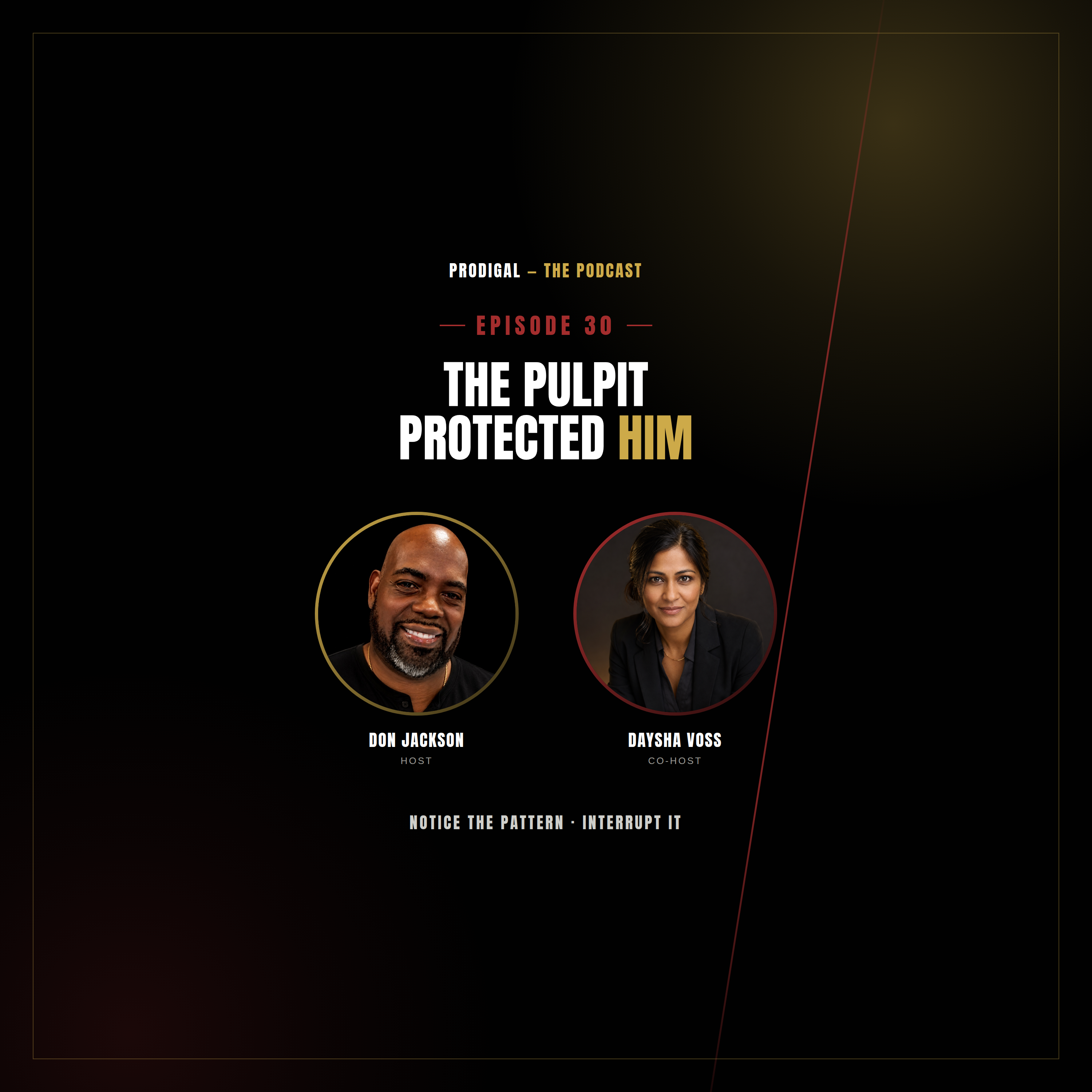
THE PULPIT PROTECTED HIM
EPISODE 30 — PRODIGAL: THE PODCAST
The Pulpit Protected Him
By Don Jackson | Prodigal Breaking News | prodigalbreakingnews.com
September 29, 2026
A registered sex offender was one signature away from a major denominational promotion. Here's how the system let him get that far — and what actually has to change.
I'm not going to ease into this one. Timothy Price III pleaded guilty in 2007 and 2008 to sexually assaulting a 12-year-old girl while he was a music director at a church in Baltimore. That's not the part of this story I'm here to relitigate. That's the established fact underneath everything else I'm about to say.
Here's what should stop you: decades later, that same man was pastoring First Baptist Church City of St. Louis — the oldest Black church west of the Mississippi, a congregation spoken of in the same breath as Ebenezer Baptist in Atlanta. And this month, he was days away from being installed as Missouri's state overseer for the Full Gospel Baptist Church Fellowship, a national network of Black Baptist churches. A promotion. Denominational authority over other pastors, other congregations, other children.
That's not a story about one man slipping through a crack. That's a story about how wide the crack actually is.
Identify The Problem.
Let's name it plainly, because vague language is how institutions protect themselves. A known, registered sex offender rose to pastor one of the most historically significant Black churches in the country, and then nearly rose again — to a position with authority over an entire state's worth of churches in a national fellowship. Nobody inside that structure stopped it. The appointment was only halted after independent abuse-survivor advocates did the research the institution should have already done, and made it public.
Once it was public, the presiding bishop moved fast — within 24 hours — to force Price's resignation from every leadership position and bar him from ever holding one again. He said, correctly, that "redemption through Christ does not erase consequence." I believe he meant that. I also need you to notice the timing. The speed only showed up after the exposure. Not before it.
Notice The Pattern.
Here's the part I need you to sit with, because it's bigger than one pastor and one church: this isn't a story about a bad man who fooled good people. It's a story about a structure that was never built to catch him in the first place.
There is no standardized, denomination-wide requirement that a pastor's background gets checked before he's installed, and checked again before he's promoted. What exists instead is a network of personal relationships, reputations, and recommendations — the same informal trust economy that built the Black church into one of the most powerful institutions in this country, now working against the very people it's supposed to protect. Redemption theology, real and legitimate on its own terms, gets used as a bypass instead of what it's supposed to be: something that sits alongside accountability, not something that replaces it.
And notice who actually caught this. Not the presiding body. Not a background-check policy. Not an internal audit. Independent advocates, entirely outside the institution, did the work that should have been standard practice, and forced a 24-hour reversal that could have — should have — happened years earlier, at the first installation, not the second.
That's the pattern. The system doesn't fail to protect itself. It protects itself extremely well. What it fails to do, every time, is protect the people in the pews until it's forced to.
Change It.
I'm not interested in a segment that just makes you angry and lets you go home. Identify the problem. Notice the pattern. Change it — that's not a slogan for us, that's the whole point of doing this.
So here's what actually has to change, plainly:
Every national and state-level denominational network needs a standardized, mandatory background-check requirement — not just at initial ordination, but at every promotion, every reassignment, every expansion of authority. One clean record ten years ago does not clear a man for more power today; the check has to happen again, every time the stakes go up.
Survivor-centered reporting channels have to exist independent of the church's own leadership chain — a place a survivor or a concerned member can go that isn't run by the same structure that has every incentive to protect its own reputation first.
And redemption has to mean something real: a person can be forgiven and still be permanently barred from a position of unsupervised authority over children and congregants. Those are not contradictory. Grace and consequence were never supposed to be opposites.
None of that happens on its own. It happens because members ask their own churches, plainly, whether these policies exist — and don't accept "we trust our leadership" as the answer, because trust was exactly the mechanism that failed here.
We are Source. That means we don't just witness a system protecting itself and call it business as usual. Notice the pattern. Interrupt it. Then go build the structure that makes sure it can't happen again — not to the next congregation, and not to the next child.
Ashay.
Source:
- Daily Kos: dailykos.com
Process This Deeper
Prodigal AI's Story Companion Guide explores the institutional pattern, consciousness framework, community insights, transformation practices, and action opportunities related to this story.
Open the Companion Guide