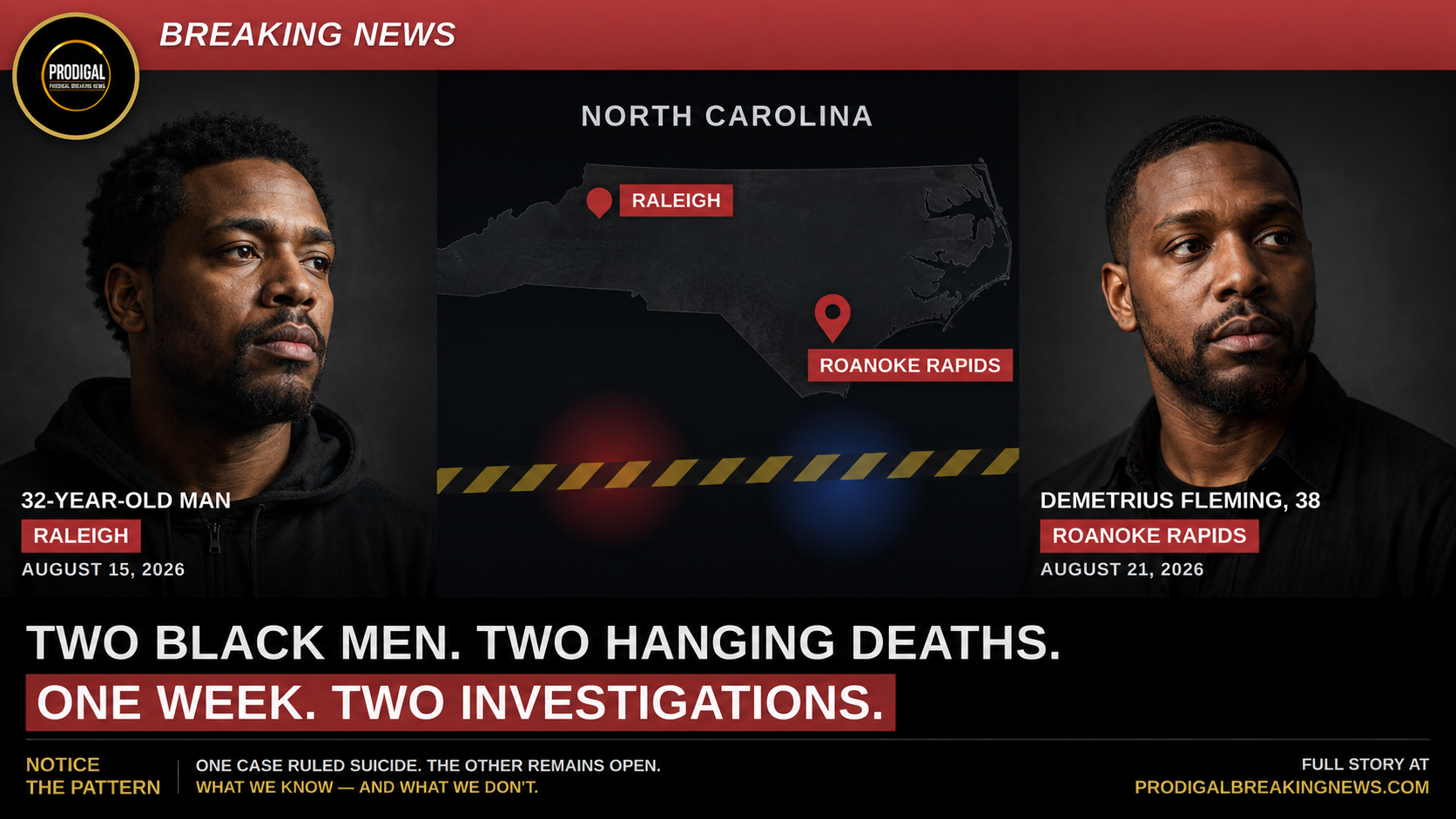
TWO BLACK MEN. TWO HANGING DEATHS. ONE WEEK. TWO INVESTIGATIONS.
ONE CASE RULED SUICIDE. THE OTHER REMAINS OPEN. WHAT WE KNOW — AND WHAT WE DON'T.
Two Black Men. Two Hanging Deaths. Six Days Apart. One Case Is Closed. One Isn't — And That Difference Is the Whole Story.
By GRANT KELLER — Investigative Anchor
August 22, 2026
Two Black men were found hanging in North Carolina six days apart in August 2026. Raleigh police, backed by video evidence, ruled the first death a suicide. The second case, involving 38-year-old Demetrius Fleming in Roanoke Rapids, remains open and unresolved — and the police chief has directly acknowledged the racial history at stake without claiming the two cases are connected.
Two Black Men. Two Hanging Deaths. Six Days Apart.
The Surface Story
In August 2026, two Black men were found hanging in North Carolina, six days apart.
The first was a 32-year-old man found in Raleigh on August 15. Raleigh police released video evidence and ruled the death a suicide. The case is closed.
The second was 38-year-old Demetrius Fleming, found in Roanoke Rapids on August 21. That case remains open and unresolved. The Roanoke Rapids police chief has directly acknowledged the racial history at stake — without claiming the two deaths are connected.
That is the whole story, and the whole problem: one case closed, one case open, and a chief willing to name the history without pretending he has answers he doesn't have.
The Pattern
This is the pattern Black communities have carried for generations: a Black man found hanging, and a system that moves quickly to call it suicide — or moves slowly to call it anything at all. Either way, the pattern is the same. The speed of the conclusion, not the conclusion itself, is what tells you which version you're getting.
In Raleigh, the conclusion came fast, and it came with video. In Roanoke Rapids, the conclusion hasn't come at all. Those are not contradictory responses — they are the two faces of the same institutional reflex. Close it quick, or leave it open. Both avoid the harder question: what does it mean when Black men keep being found this way, and the country keeps treating each one like a surprise?
The chief in Roanoke Rapids did something rare: he named the history out loud. He didn't say the cases were connected. He didn't say they weren't. He said the racial history is real, and it is in the room whether anyone invites it or not. That kind of honesty is not a conclusion. It's a precondition for one.
What This Reveals
The difference between the two cases is not the facts. It's the posture.
Raleigh had video, and used it to close. Roanoke Rapids doesn't have video, and hasn't closed. But the deeper difference is that one department treated the public's suspicion as a problem to manage, and the other treated it as a history to acknowledge. The first approach ends the conversation. The second one starts it.
What this reveals is that the public doesn't actually need the police to agree with them. They need the police to stop pretending the history isn't there. A closed case with video can still leave a community cold if it's delivered like a press release. An open case with no answers can still build trust if it's delivered like a human being who understands what hanging means in this country.
The pattern is not the deaths. The pattern is the silence around them — and who gets to break it, and what happens when someone finally does.
The Movement Sign-Off
Two Black men. Two hanging deaths. Six days apart. One case closed, one case open. The difference is not the tragedy — the tragedy is identical. The difference is whether the institution can say the word "history" out loud.
The Roanoke Rapids chief said it. That doesn't make the case solved. It makes the conversation possible. And in a country that has spent centuries refusing to have this conversation, possible is not nothing.
Notice the pattern. Then notice who's willing to name it.
Process This Deeper
Prodigal AI's Story Companion Guide explores the institutional pattern, consciousness framework, community insights, transformation practices, and action opportunities related to this story.
Open the Companion Guide