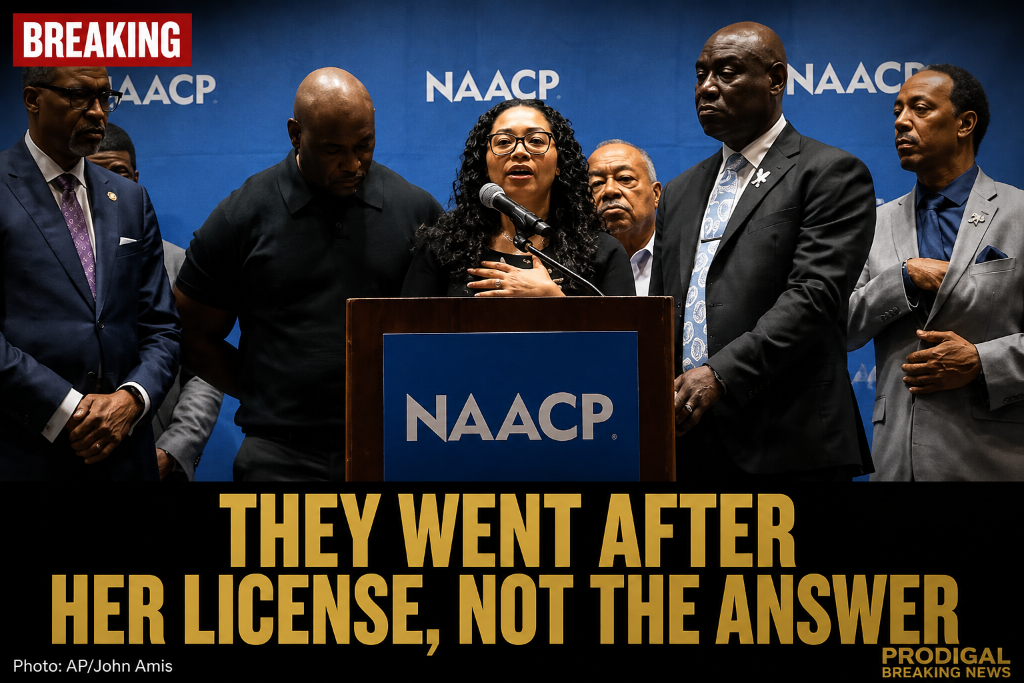
THEY CAN'T TELL HER HOW HER SON DIED. SO SOMEONE WENT AFTER HER NURSING LICENSE INSTEAD.
Justice & Reparations
THEY CAN'T TELL HER HOW HER SON DIED. SO SOMEONE WENT AFTER HER NURSING LICENSE INSTEAD.
By Grant Keller — Investigative Anchor
August 5, 2026
One month after her 18-year-old son Nolan Wells was found dead on Horn Island, family nurse practitioner Christine Wells Wonsley learned the Mississippi Board of Nursing opened a professional-misconduct investigation against her — based on an anonymous complaint filed after she began publicly demanding answers about her son's death. Her attorney, Ben Crump, calls it a "warning shot" designed to intimidate and silence her. Wonsley has practiced in Mississippi for years without a single prior complaint to the Board.
THE SURFACE STORY
On August 5, 2026 — one month to the day after her 18-year-old son Nolan Wells was found dead on Horn Island — Christine Wells Wonsley learned that the Mississippi Board of Nursing had opened a professional-misconduct investigation against her. The complaint was anonymous. It was filed after she began publicly demanding answers about her son's death. And it was, according to her attorney Ben Crump, a "warning shot" — the first institutional move against a mother who had refused to stop asking how her son died.
Christine Wells Wonsley is a family nurse practitioner. She has practiced in Mississippi for years. She has never, in that entire time, had a single complaint filed against her with the Board of Nursing. The complaint that opened the investigation did not allege a clinical error. It did not allege a patient harm. It alleged, in substance, that she had used her professional standing in a way the complainant found inappropriate — a complaint that arrived only after she began speaking publicly about her son's death, and that was filed anonymously, through the Board's public intake system, in the weeks after her press conferences began.
The timing is the story. Christine Wells Wonsley had been a nurse practitioner in good standing for years. The Board of Nursing had no reason to investigate her. She gave the Board a reason to investigate her only by doing something that is not a nursing issue — by standing in front of cameras, with Ben Crump, and demanding that the authorities who have her son's case tell her how he died. The complaint that opened the investigation did not come from a patient. It did not come from a colleague. It did not come from anyone who would have to put their name behind the allegation. It came from someone who, under Mississippi's nursing-board rules, did not have to.
This is the continuation of the Nolan Wells series. Nolan was found dead on Horn Island on July 5, 2026, in a case that the local authorities initially described as a drowning and that the family has, from the beginning, described as a death with questions the authorities have not answered. The family has asked for the autopsy. The family has asked for the 911 calls. The family has asked for the body-worn camera footage from the first responders. The family has asked, in public, for the basic records that would tell a mother how her son died. And the authorities have, at every step, declined to provide them — or provided them in a form that raised more questions than it answered.
And now, one month in, the first institutional response to that public demand is not an answer. It is a complaint against the mother's nursing license.
THE PATTERN
This is not a story about a nursing board. This is a story about what happens to a person who asks a question the institutions around her do not want to answer — and about the specific mechanism by which a complaint like this works.
Notice the structure. A mother asks a question: how did my son die? The institutions that have the answer — the coroner, the sheriff's office, the island's managing authority — do not provide it. The mother asks the question publicly, with a lawyer, because the private asking did not work. And then, within weeks of the public asking, an anonymous complaint is filed against her professional license — not her person, not her liberty, but the specific credential that allows her to do the work she does for a living. The complaint does not have to be true. The complaint does not have to be specific. The complaint does not have to come from anyone with knowledge of her practice. The complaint only has to exist — because the existence of a complaint, under the structure of a professional licensing board, is enough to open an investigation, and the existence of an investigation is enough to do what the complaint was filed to do.
This is the pattern of institutional retaliation against a person who asks a question: you do not arrest the person. You do not sue the person. You do not, in most cases, even identify the person. You file a complaint — through a public intake system that allows anonymity, against a professional license that the person needs to earn a living, on a basis that is broad enough to cover almost anything the complainant wants to allege. And then the institution does the rest. The board opens the investigation. The investigation becomes a matter of public record. The public record becomes a cost — a professional cost, a reputational cost, a psychological cost — that the person has to bear for as long as the investigation is open, which is, in most cases, as long as the institution wants it to be open.
And notice the specific mechanism of the anonymous complaint. The anonymous complaint is the instrument of institutional retaliation because it is the complaint that has no author. A complaint with an author can be challenged — the author can be questioned, the motive can be examined, the basis can be tested. A complaint without an author cannot be challenged on its merits, because there is no one to challenge. It can only be challenged on its existence — which is to say, on the question of whether the board should have opened an investigation at all. And that question, in most jurisdictions, is a question the board itself answers. The institution that opens the investigation is the institution that decides whether the investigation should have been opened. The complainant is invisible. The board is unaccountable. And the person whose license is under investigation bears the cost.
This is what Ben Crump means by a "warning shot." A warning shot is not the bullet. A warning shot is the shot fired near the person to tell the person that the next shot could be at the person. The complaint against Christine Wells Wonsley's nursing license is a shot fired near her. It tells her that the institutions that can reach her — her licensing board, her professional standing, her ability to earn a living — are willing to be used. It tells her that the asking of the question has a cost. And it tells her that the cost can be made higher. The next complaint can be about something else. The next investigation can be about something larger. The next shot can be closer. The warning shot is the message that the asking has a price, and that the price is not yet fully paid.
WHAT THIS REVEALS
This story reveals the mechanism by which a professional license becomes a lever against the person who holds it. A nursing license is not just a credential. It is the legal permission to do the work that pays for the life. To threaten a nursing license is to threaten the ability to earn a living — and to threaten the ability to earn a living is to threaten the ability to keep asking the question. The mother who has to hire a lawyer to defend her license is the mother who has less time, less money, and less capacity to demand answers about her son. The complaint does not have to succeed. The complaint only has to cost. And the cost of defending a professional license, in time and money and fear, is a cost that most people cannot bear for long — which is the point.
It also reveals the specific vulnerability of the health professional who becomes a public figure in a case like this. A nurse practitioner is a person whose professional standing is, by design, subject to public review — to a board, to a complaint system, to a process that allows any member of the public to raise a concern. That public review is, in normal circumstances, a protection: it is the mechanism by which the profession polices itself. But in a case like this, the same mechanism becomes a weapon. The public intake system that allows an anonymous complaint is the system that allows the complaint to be filed by someone whose interest is not in the nursing practice but in the public asking. The system that protects the profession becomes the system that can be turned against the professional who speaks.
And it reveals the deeper pattern of the Nolan Wells case itself. A young man is found dead on an island. His family asks how he died. The authorities do not answer. The family asks publicly. A complaint is filed against the mother's license. This is not a sequence of unrelated events. This is a sequence of events in which each step — the unanswered question, the public asking, the complaint — is a step in a single process: the process of making the asking of the question cost more than the family can bear. The question is not answered. The question is made expensive. And the expense is the answer the institutions are giving — which is that the asking will not be free.
MOVEMENT SIGN-OFF
Prodigal does not cover this story to tell you that the complaint against Christine Wells Wonsley's nursing license is retaliation. That is what her attorney says. That is what the timing suggests. That is what the pattern shows. But the Board of Nursing has not concluded its investigation, and the complainant has not been identified, and the process — as it is designed to do — is still running. We cover it to show you the mechanism: a mother asks how her son died, the institutions that have the answer do not provide it, and the first institutional response to her asking is a complaint against the credential she needs to earn a living.
Notice the pattern. The question is not answered. The question is made expensive. The complaint does not have to be true. The complaint does not have to have an author. The complaint only has to exist — and the existence of the complaint is the warning shot, and the warning shot is the message that the asking has a price.
This is the continuation of the Nolan Wells series because it is the continuation of the same pattern. A young man dies on an island. His family asks how. The institutions do not answer. And then the institutions begin, quietly, to make the asking cost. The complaint against a nursing license is the first cost. It will not, if the pattern holds, be the last.
Notice the pattern. Then notice who was investigated after the death — and who was not.
— Grant Keller, Investigative Anchor, Prodigal Breaking News
Process This Deeper
Prodigal AI's Story Companion Guide explores the institutional pattern, consciousness framework, community insights, transformation practices, and action opportunities related to this story.
Open the Companion Guide