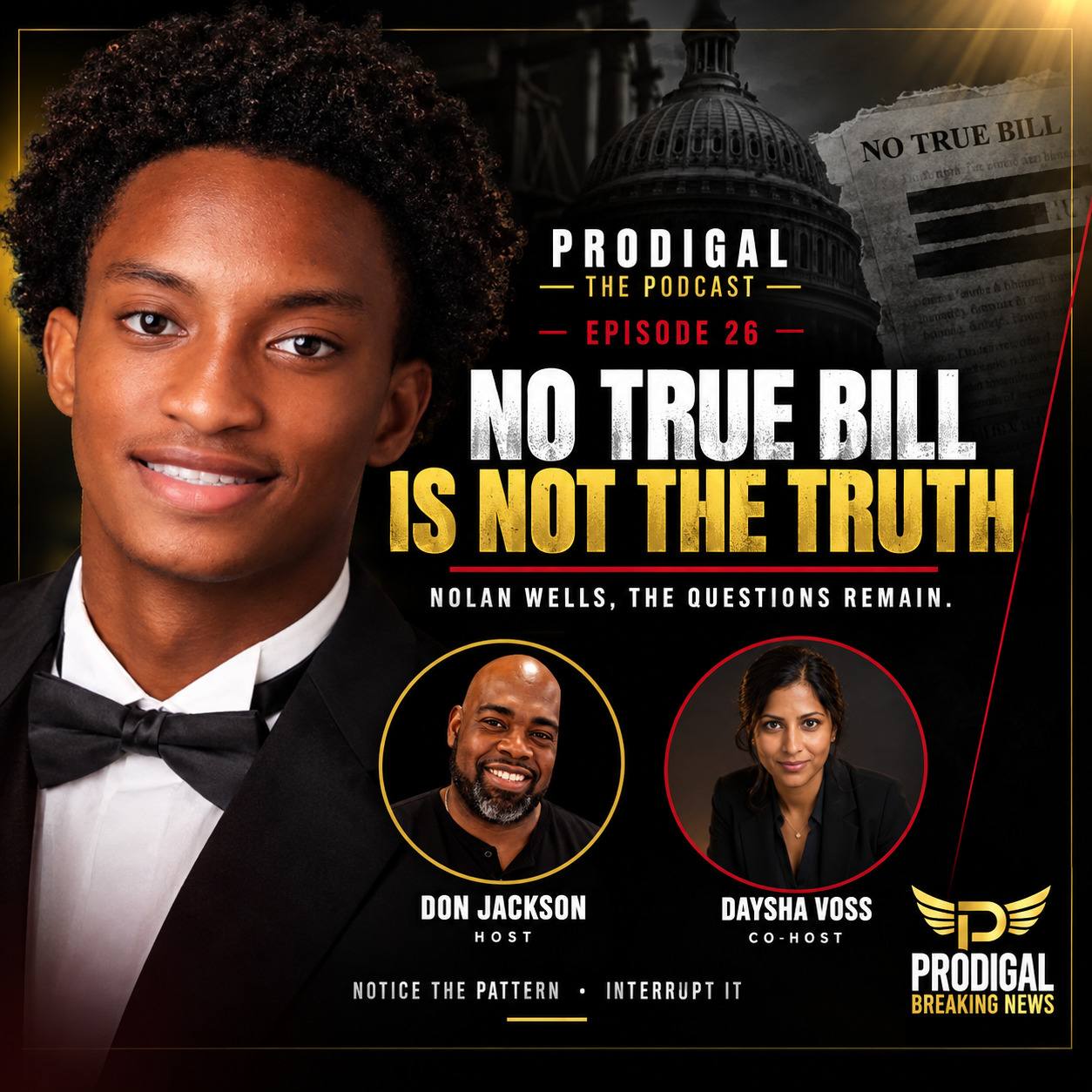
NO TRUE BILL IS NOT THE TRUTH
Nolan Wells · The Questions Remain
No True Bill Is Not the Truth: The Nolan Wells Case and Mississippi's Oldest Verdict
By Don Jackson | Prodigal Breaking News | prodigalbreakingnews.com
September 22, 2026
A Prodigal Breaking News Deep Dive — companion piece to Episode 26 of Prodigal — The Podcast
🎧 Listen to the full episode on Substack: No True Bill Is Not the Truth — The Nolan Wells Case and Mississippi's Oldest Verdict
Eighteen years old. That's the whole sentence. That's all you need to know before anything else about Nolan Wells, and it's the sentence Mississippi has managed to talk around for eleven weeks.
On July 4, 2026, Nolan Wells went out on a boat with friends to Horn Island, off the Mississippi Gulf Coast. He was the only Black member of that friend group. He was the only one who didn't come home. His friends left the island on a boat that later had engine trouble; he stayed behind. Two days later, on July 6, his body was found on that beach. On September 21, a Jackson County grand jury returned what's called a "no true bill" — no charges, against anyone, for anything.
The district attorney who announced it, Angel Myers McIlrath, a Republican elected to run the DA's office for Mississippi's 19th Circuit Court District, didn't stop at the legal finding. She went further. In her own words, in a recorded statement: "There is absolutely no evidence to support the allegations that Nolan's disappearance and death were racially motivated. Nolan's friends loved Nolan and Nolan loved them." She called the family's own legal team's concerns — that autopsy findings were withheld, that phone data disappeared — "false narratives" and "lies."
Sit with that for a second. A prosecutor's job is to tell you what the evidence does and doesn't support. "No credible evidence of a crime" is a finding. "Nolan loved them" is not a finding. That's a character reference, delivered by the one public official in the state whose job was to investigate, not to vouch. She wasn't in the room. She doesn't know what was in that boy's heart any more than we do. What she does know — because her own office said so — is that her investigators subpoenaed 132 people, heard from 43 witnesses in some form, and invited exactly seven of them to actually testify in front of the grand jury in person. Seven. Out of everyone who was out on that water, on those docks, in that friend group, on Horn Island that day — seven people sat in a room and told twenty-three strangers what happened. The rest of what the grand jury "heard" wasn't heard at all. It was read to them, summarized to them, handed to them by the same office that later stood up and told the public there was nothing to see here.
And still — still — with all of that control over what got presented and how, the independent autopsy the family commissioned found something the state's own medical examiner didn't even bother to photograph: unexplained blunt-force injuries to the back of Nolan's head and his back, separate from an earlier, non-fatal slip off the boat earlier that day. Nobody — not the grand jury, not the DA, not one document in this entire process — has explained how those injuries got there. "Undetermined" is the official word for his cause of death. Undetermined is not innocent. Undetermined is not solved. Undetermined is the box Mississippi checks when it would rather move on than find out.
This is not new. This is not shocking. This is Tuesday in Mississippi.
In 1955, an all-white, all-male jury deliberated for sixty-seven minutes before acquitting the two men who lynched fourteen-year-old Emmett Till and threw his body in the Tallahatchie River, thirty miles from where Nolan Wells' body would wash up seventy-one years later. One juror told a reporter they wouldn't have taken that long "if they hadn't stopped to drink a Coke." Months after they walked free, both men confessed to the murder in a magazine interview, because double jeopardy meant they could never be tried again. In 1963, Medgar Evers was shot dead in his own driveway in Jackson, Mississippi. Two all-white juries deadlocked rather than convict the man who did it. It took thirty-one years, a reopened case, and a new generation willing to look at old evidence honestly before Byron De La Beckwith was finally convicted, in 1994. Mississippi has no statute of limitations on homicide. We know that because the state told us so, almost as a footnote, in the same documents that closed Nolan's case for now. They know how this story ends too. They've written this ending before.
So no — a no true bill is not an answer. It's a pause button, dressed up as a period. Reverend Al Sharpton said it plainly the day the decision came down: "A no true bill is not an answer to how eighteen-year-old Nolan Xavier Wells left for an outing with friends and never came home." NAACP General Counsel Kristen Clarke called it what it is — a report that "leaves more questions than answers." Attorney Ben Crump, standing with the family, said Mississippi was trying to close a chapter it never actually finished writing.
Here's what we're not going to do: we're not going to stand here and tell you we know exactly what happened on that island, because we weren't there and neither was the DA who's suddenly so sure. What we are going to say, forcefully, is that "we didn't indict" and "we know what's in your hearts" are two very different sentences, and only one of them is a prosecutor's job to say. What we're going to say is that a system that subpoenas 132 people and only lets seven of them speak, that fails to photograph the wound on the back of a dead Black teenager's head, that has a DA calling the grieving family's lawyer a liar on camera — that system does not get to also tell us the case is closed and expect us to just believe it, on faith, in the same state that has done this exact thing, in exactly this order, for seventy years running.
Nolan Wells' life matters whether or not a grand jury in Jackson County, Mississippi decided a crime could be proven against a specific person in a room. Those are not the same question. Mississippi has never been in a hurry to answer either one honestly the first time. History says they eventually do. History also says it takes decades, and a family that refuses to stop.
We're not stopping either.
Sources: NPR · NBC News · TMZ · Mississippi Free Press · WLOX · WSB-TV · Action News 5 · Black Information Network · Mississippi Today · History.com
Process This Deeper
Prodigal AI's Story Companion Guide explores the institutional pattern, consciousness framework, community insights, transformation practices, and action opportunities related to this story.
Open the Companion Guide