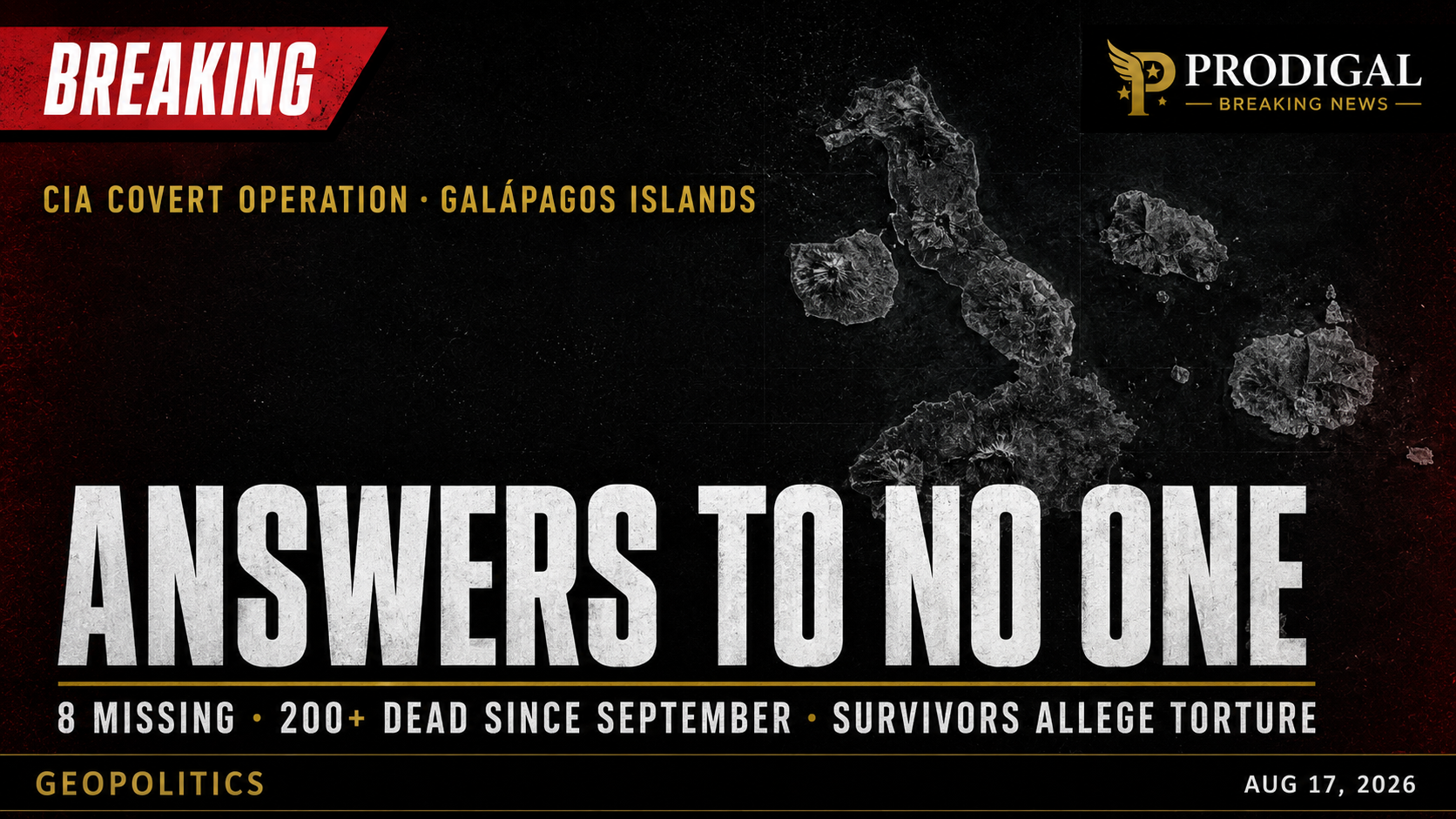
THE GALÁPAGOS STRIKES: WHEN INSTITUTIONS KILL IN SECRET AND ANSWER TO NO ONE
Geopolitics
THE GALÁPAGOS STRIKES: WHEN INSTITUTIONS KILL IN SECRET AND ANSWER TO NO ONE
By Elena Cross — Investigative Correspondent
August 17, 2026
A Washington Post investigation, corroborated by the New York Times and survivor interviews from Drop Site News, found the CIA ran a secret strike campaign against fishing boats off Ecuador's Galápagos Islands — separate from the administration's publicly declared boat-strike operation. Eight crew members vanished in January and are now UN-presumed dead; survivors from March strikes describe being seized, hooded, and tortured by American personnel before being dumped in El Salvador. No U.S. agency has acknowledged responsibility.
THE SURFACE STORY
On August 15, 2026, the Washington Post published the results of a months-long investigation: the Central Intelligence Agency ran a secret, parallel strike campaign against fishing boats off the Galápagos Islands — separate from the publicly declared boat-strike operation the administration had announced. The Post's findings were corroborated by reporting from the New York Times and by survivor interviews published by Drop Site News. The picture that emerged was of an unacknowledged covert operation in which the United States government, through its intelligence agencies, killed and disappeared people at sea and answered to no one for it.
In January 2026, eight crew members from a fishing boat vanished in the waters off the Galápagos. They are now presumed dead by the United Nations. In March, survivors of separate strikes described being seized, hooded, and tortured by American personnel before being dumped in El Salvador. Since September 2025, more than 200 people have been killed in boat strikes in the region. No U.S. agency has acknowledged responsibility for the covert campaign. No public official has been held to account for it. The operation — which the Post identifies as a CIA-run parallel to the administration's stated operation, sometimes referenced in reporting as Operation Southern Spear — was not disclosed to the public, not authorized by any known congressional debate, and not subject to any known review.
The Galápagos Islands are a UNESCO World Heritage site. The waters around them are among the most protected marine environments on earth. The idea that a covert lethal operation was run in those waters — against fishing boats, against crews whose names are now on a UN presumed-dead list — and that no agency has acknowledged it, is the story. The story is not the strike. The story is the silence after the strike.
THE PATTERN
This is a story about the specific form of institutional power that operates when an institution can kill in secret and answer to no one. It is not a story about a single operation. It is a story about the structure that makes a single operation possible — and that makes the next one possible, and the one after that.
Notice the structure. A covert operation is authorized somewhere, by someone, under some legal framework that is not public. The operation is carried out. People die. People disappear. The operation is not acknowledged. The deaths are not counted in any public record that the agency responsible is willing to put its name to. The disappearances are not investigated by any body that has the authority to compel the agency to answer. And then, when the operation is exposed — when a newspaper, after months of work, documents what happened — the institution does not confess. The institution does not account. The institution goes quiet. The silence is not an accident. The silence is the strategy. The strategy is to outlast the news cycle, to outlast the outrage, to outlast the attention of the public, until the operation becomes a thing that happened, rather than a thing that anyone was held to account for.
And notice the specific role of the parallel structure. The administration had a publicly declared boat-strike operation. That operation was debated, disclosed, and subject to at least the formal architecture of oversight. The CIA ran a separate operation alongside it — one that was not declared, not debated, and not subject to the same oversight. This is the pattern of plausible deniability by structure: when an institution wants to do a thing it does not want to be accountable for, it builds a parallel channel through which to do that thing, and it keeps the public channel clean. The public channel is the story the institution tells about itself. The parallel channel is the story the institution does not tell. And the people who die in the parallel channel die in a space that, formally, does not exist — and so their deaths do not exist in any record the institution is required to keep.
This is the pattern of unaccountable lethal power: the institution kills, the institution does not acknowledge, the institution does not count, the institution does not investigate itself, and the institution waits for the public to move on. The eight crew members who vanished in January are on a UN presumed-dead list because the United Nations, which is not the agency that killed them, is the only body that has been willing to say their names into a record. The 200-plus dead since September are not on any U.S. list, because the U.S. agency responsible has not acknowledged that the campaign that killed them was a campaign it ran. The survivors who describe being tortured were not, in any public process, heard by the agency that the process would have been meant to hold to account. The structure is designed so that the answer to every question — who authorized this, who carried it out, who is responsible — is silence.
WHAT THIS REVEALS
This story reveals the mechanism by which an institution can kill in secret and answer to no one: not through a single decision, but through a structure in which the killing is done in a channel that does not officially exist, the dead are not counted in any record the institution keeps, the survivors are not heard in any process the institution runs, and the exposure of the operation is met with silence rather than accounting.
It reveals the specific danger of the parallel channel. The publicly declared operation is the story the public is allowed to debate. The parallel operation is the story the public is not allowed to know. And because the parallel operation is not declared, it is not bound by the rules that bind the declared one — not by the congressional notification requirements, not by the reporting requirements, not by the oversight architecture that, however imperfect, exists for the declared channel. The parallel channel is the space in which an institution does what it cannot do in the open. And the people who die in that space die outside the protection of any law the institution is willing to name.
And it reveals the cost of the silence. The cost is not only the dead. The cost is the next operation. An institution that can run a covert lethal campaign, kill and disappear people at sea, and answer to no one when it is exposed is an institution that has learned that it can do it again. The silence is not only a refusal to account for the past. It is a permission for the future. The eight crew members on the UN presumed-dead list are not the end of a pattern. They are a point in a pattern — a pattern in which the institution has learned that exposure does not produce accountability, and that the public will move on, and that the operation can continue, in a new form, under a new name, in a new channel, because the structure that made it possible has not been dismantled.
MOVEMENT SIGN-OFF
Prodigal does not cover this story to tell you that the CIA killed eight people off the Galápagos. We cover it to show you the structure: an institution that kills in a channel it does not acknowledge, that does not count the dead in any record it keeps, that does not hear the survivors in any process it runs, and that meets exposure with silence. That structure is the story. The strike is a point in the structure.
Notice the pattern. The declared operation is the story you are allowed to debate. The parallel operation is the story you are not allowed to know. The dead in the parallel operation die in a space that, formally, does not exist. The survivors of the parallel operation are heard by the United Nations, because the United Nations is the only body willing to hear them — and the agency that would have been meant to answer is silent.
The question is not whether the CIA ran a covert campaign off the Galápagos. The Washington Post, the New York Times, and Drop Site News have documented that it did. The question is whether an institution that can kill in secret and answer to no one is an institution that should be allowed to continue to operate in secret. The 200-plus dead since September are not a statistic. They are a count of the cost of a structure that has not been dismantled. The eight crew members presumed dead by the UN are not a footnote. They are a record kept by the only body willing to keep it — because the body that should have kept it did not.
Notice the pattern. Then notice who was killed — and who was not counted. Notice who was tortured — and who was not heard. Notice who was authorized — and who was not named. Notice the declared operation — and the parallel one beside it.
— Elena Cross, Investigative Correspondent, Prodigal Breaking News
Process This Deeper
Prodigal AI's Story Companion Guide explores the institutional pattern, consciousness framework, community insights, transformation practices, and action opportunities related to this story.
Open the Companion Guide