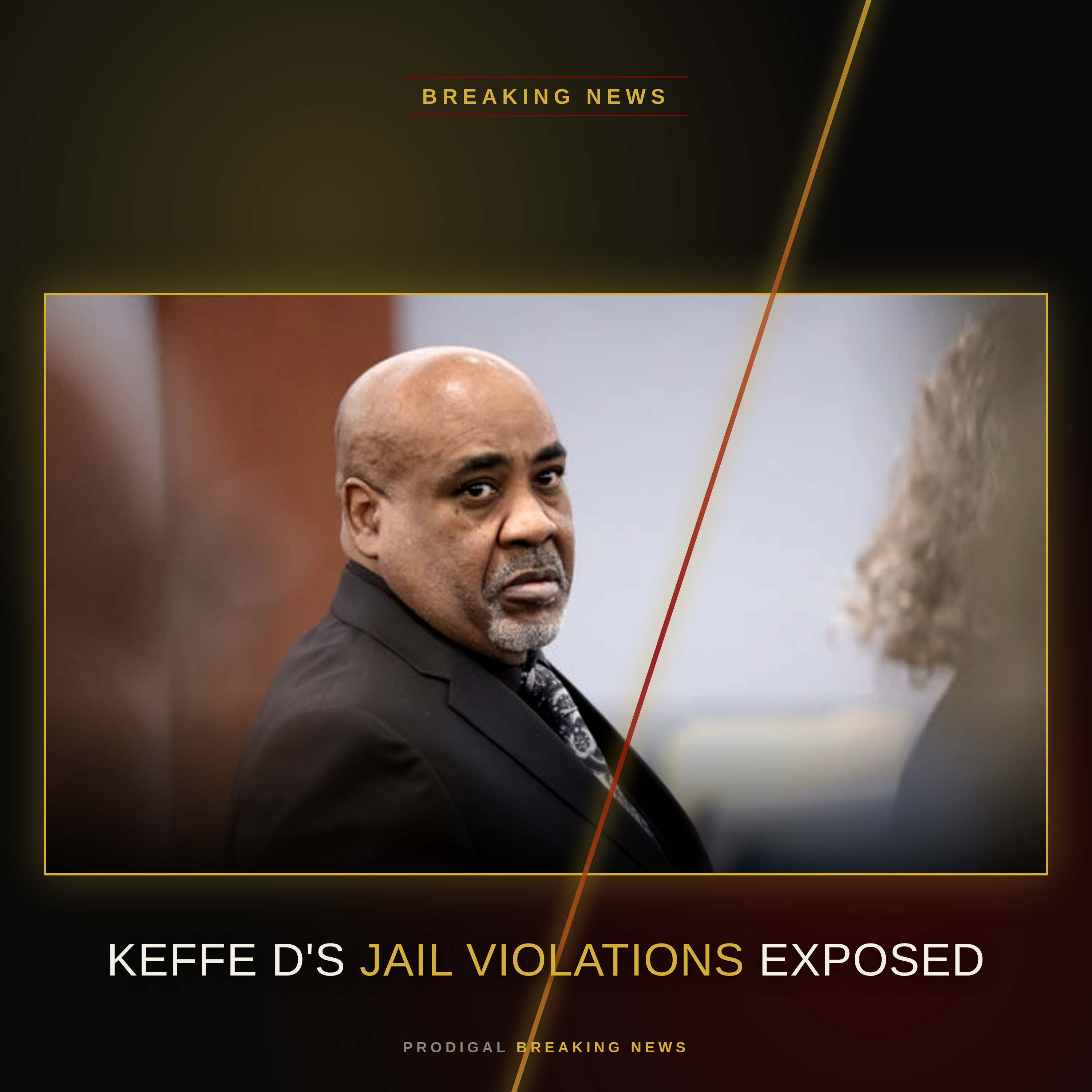
KEFFE D'S JAIL VIOLATIONS EXPOSED
Tupac Killer Keffe D · Jail Violations
Convicted Tupac Killer Keffe D Racked Up Serious Jail Violations While Awaiting Trial
By Don Jackson | Prodigal Breaking News | prodigalbreakingnews.com
September 14, 2026
Jail records reveal repeated disciplinary write-ups during Duane Davis's nearly three years in custody before his August 2026 murder conviction.
🎧 Read the full breakdown on Substack: Convicted Tupac Killer Keffe D Racked Up Serious Jail Violations While Awaiting Trial
Duane "Keffe D" Davis was already fighting for his freedom from inside a Las Vegas jail cell. New records reported today show he was also fighting — literally — with the people guarding him.
TMZ reported September 14 that jail records from the Clark County Detention Center document a string of disciplinary write-ups against Davis during the nearly three years he spent in custody awaiting trial for the 1996 murder of Tupac Shakur — a stretch that ended August 31 with a jury finding him guilty of first-degree murder.
What the Records Show
According to TMZ, the violations span Davis's time at CCDC following his September 29, 2023 arrest and include:
- A physical altercation with another inmate in the jail's dayroom, broken up when officers used pepper spray to separate the two men.
- A heated confrontation with a corrections officer over the timing of a cell exit, during which Davis allegedly threatened to punch the officer and told him, "I have been doing this s--t since before you were born."
- An outburst over restricted phone privileges — Davis wanted extra call time to handle bail-related matters — in which he allegedly cursed at officers and kicked his cell door, resulting in a 24-hour lockdown.
- A physical struggle when officers moved to remove an unauthorized second mattress from his cell; an officer's knuckle was reportedly scratched in the scuffle before Davis was handcuffed.
- A minor write-up for passing an unauthorized note to another inmate through the jail's commissary system.
TMZ frames the pattern as evidence Davis was a persistent disciplinary problem behind bars, even as he prepared to stand trial for one of the most notorious unsolved murders in music history.
A note on the record: Davis's time at CCDC also includes a separate, well-documented incident — a December 23, 2024 fight with fellow inmate Rochlon Hamilton that resulted in its own criminal case. Davis was convicted of battery by a prisoner in that matter and was sentenced in September 2025 to 16 to 40 months in prison, to be served alongside his murder case custody. He maintained at the time that he was acting in self-defense. Readers should note that incident was already public record before today's report; TMZ's new disciplinary write-ups are additional violations documented separately in his jail file.
The Bigger Picture: A Guilty Verdict After 30 Years
The jail record adds a footnote to a case that closed out a three-decade mystery. On August 31, 2026, a Clark County jury convicted Davis of first-degree murder with use of a deadly weapon in the September 7, 1996 drive-by shooting that killed Tupac Shakur in Las Vegas. Jurors deliberated for less than two hours before reaching their verdict.
Prosecutors Marc DiGiacomo and Binu Palal argued Davis orchestrated the shooting in retaliation after Shakur's entourage — working with Death Row Records founder Suge Knight — beat Davis's nephew, Orlando "Baby Lane" Anderson, in the MGM Grand lobby earlier that night. According to the state's theory, Davis supplied the gun and directed the attack from a white Cadillac, even though he didn't fire the shots himself. Anderson, long alleged to be the actual shooter, was never charged and died in 1998.
Remarkably, prosecutors built their case almost entirely on Davis's own words. He spent years publicly describing his role in the killing — in his 2019 memoir Compton Street Legend, in television interviews, and in police interviews conducted with LAPD in 2008 and 2009. District Attorney Steve Wolfson put it bluntly after the verdict: "Had he decided to never write the book, he would not, probably, have ever been prosecuted for the crime."
Davis, a former leader of the South Side Compton Crips, declined to testify in his own defense. His attorney, Michael Sanft, argued prosecutors had no physical evidence — no surveillance footage, no phone records — placing Davis in Las Vegas that night, and attacked the memoir as an inconsistent, ghostwritten account produced to sell books rather than a confession.
Tupac's sister, Sekyiwa "Set" Shakur, wept in the courtroom when the verdict was read. The family later released a statement calling themselves "elated and relieved" and invoking their mother, Afeni Shakur: "We honor Afeni Shakur — a mother whose strength and unshakable belief in her son's truth carried this fight long before any of us knew where it would lead."
What's Next
Davis is scheduled to be sentenced October 13, 2026. He faces a potential life sentence under Nevada law — with parole eligibility after 20 years at the earliest — plus an additional 1 to 20 years from the deadly-weapon enhancement attached to his conviction.
His defense has already signaled it will appeal, arguing the jury's rapid deliberation shows they didn't seriously weigh the evidence, that decades of pretrial publicity made an impartial jury impossible to seat, and that prejudicial evidence — including Davis once being floated as a person of interest in the murder of Christopher "Notorious B.I.G." Wallace — should never have reached jurors. Wolfson's office says it's ready: "We feel confident in the strength of our case. We expect an appeal, and we will defend that appeal."
For now, the jail violations reported today are a small but telling coda — a reminder that the man finally held accountable for Tupac Shakur's murder spent his last years of freedom, and his years awaiting judgment, still living by the same volatile code that put him at the center of the case in the first place.
Sources
- TMZ, "Convicted Tupac Killer Keffe D Racked Up Serious Jail Violations Before Murder Trial," Sept. 14, 2026
- Fox5 Vegas, DA Steve Wolfson post-verdict remarks, Sept. 1, 2026
- Fox5 Vegas, defense attorney Michael Sanft on appeal plans, Sept. 2, 2026
- Rolling Stone, Shakur family statement and appeal coverage
- 8 News Now, Shakur family statement
- 8 News Now, sentencing coverage of December 2024 jailhouse fight case
- ABC News, battery charge coverage for December 2024 fight
- CBS News / Time / NPR, verdict coverage, Aug. 31–Sept. 1, 2026
- Biography.com, Keffe D Davis background and memoir details
Process This Deeper
Prodigal AI's Story Companion Guide explores the institutional pattern, consciousness framework, community insights, transformation practices, and action opportunities related to this story.
Open the Companion Guide