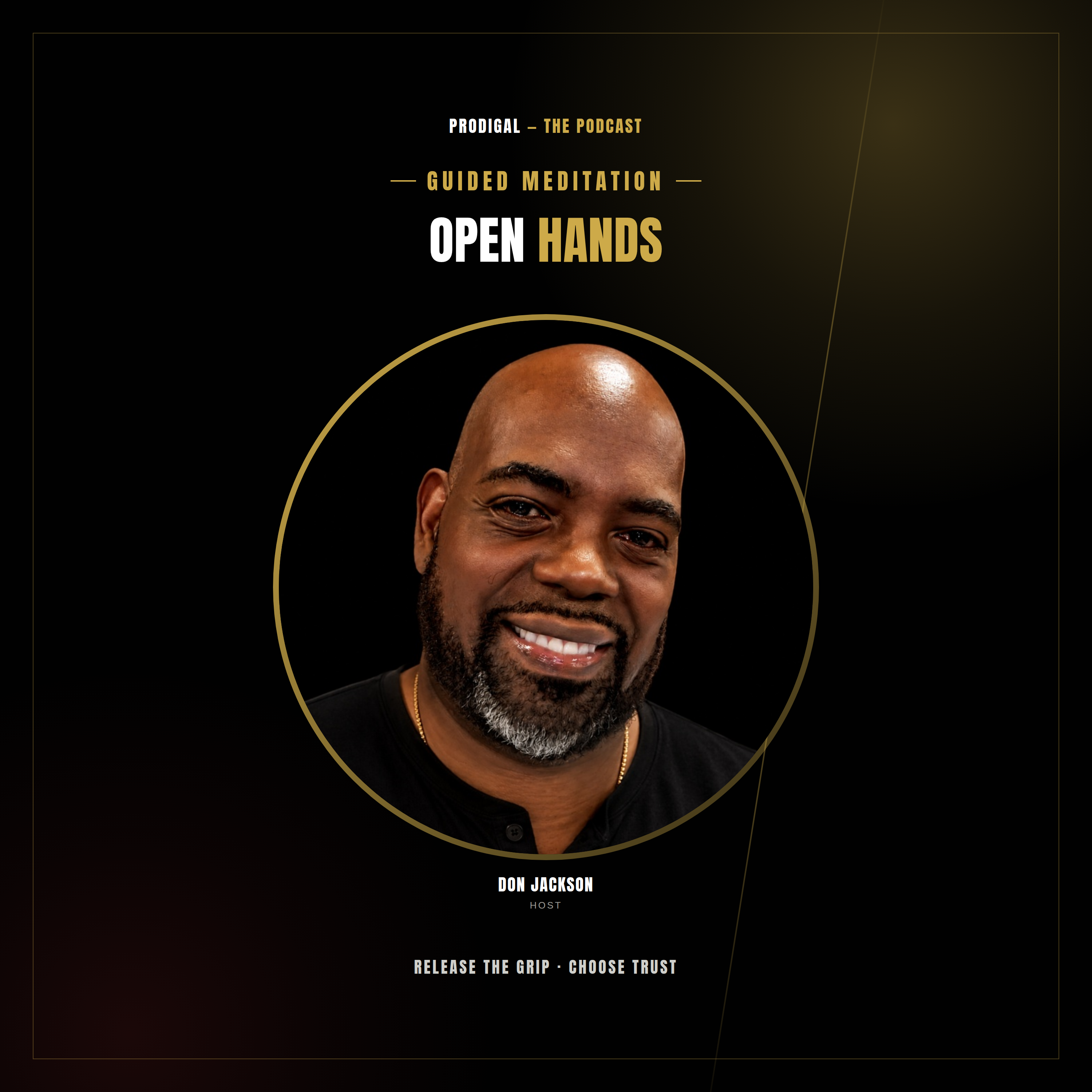
OPEN HANDS
A Prodigal Guided Meditation
Open Hands: The Grip Was Never Keeping You Safe
By Don Jackson | Prodigal Breaking News | prodigalbreakingnews.com
September 27, 2026
A Prodigal deep dive on why letting go of control is the stronger choice, not the weaker one — companion piece to the "Open Hands" guided meditation.
🎧 Listen to the Open Hands Meditation on Substack: Open Hands — The Grip Was Never Keeping You Safe
Family, I want you to do something before you read another word. Look down at your hands right now. Are they open, or are they holding something that isn't even physically there?
Most of us are gripping. All day. A schedule. An outcome. A person who hasn't texted back yet. A version of tomorrow we've already written in our heads and now we're white-knuckling to make sure it comes true exactly like we scripted it. And here's the part nobody tells you — the grip doesn't feel like fear. It feels like responsibility. It feels like control. It feels like if I just hold on tighter, I can keep this from falling apart.
I'm here to tell you that's a lie your nervous system has been selling you your whole life, and it's time we look at it in the light.
The Grip Feels Like Safety. It Isn't.
Here's what's actually happening in the body when you're gripping: your jaw tightens. Your shoulders climb up toward your ears. Your breath gets shallow and rationed, like you're saving it for later. That's not focus. That's not discipline. That's your body running a low-grade emergency response to a threat that, most of the time, is a story you're telling yourself about the future.
And the tricky part is, gripping feels like it's working. It feels like the vigilance is what's holding your life together. But a 2025 study out of Translational Psychiatry looked at exactly this — how the feeling of being in control affects the body under stress — and what they found should stop you in your tracks. People who felt a higher sense of control weren't less stressed because their lives were easier. They were more resilient because their nervous systems were more flexible. Their brains showed reduced activation in the stress centers, their stress hormones were organized instead of chaotic, and they had fewer physical symptoms of holding it all in. The effect wasn't small either — it was large.
But notice what the study is actually pointing to. It's not "grip harder and you'll be fine." It's the difference between a felt sense of trust and a white-knuckle grip on outcomes. Those are two completely different nervous system states, and only one of them is sustainable.
What the Old Wisdom Already Knew
Long before anybody ran a study on it, the people doing the deepest healing work already knew this in their bones. Marsha Linehan, the psychologist who developed Dialectical Behavior Therapy, built an entire practice around something she called radical acceptance — the willingness to stop fighting reality as it is, right now, without slapping a "good" or "bad" label on it first. Not resignation. Not giving up. Just... releasing the extra layer of suffering that comes from refusing to accept what's already true.
Tara Brach put it in a formula so simple it's almost embarrassing how much it explains: pain plus non-acceptance equals suffering. The pain is real. Life brings pain, that's not up for debate. But the suffering — the part that eats you alive at 2 a.m. — that's usually the resistance, not the situation itself.
And Carl Jung said it even sharper: what you resist, persists. The tighter you grip something to control it, the more power you actually give it over you.
Y'all, this is the same thing your grandmother was telling you when she said "let go and let God." She wasn't being passive. She was handing you a nervous-system technology that took modern psychology a hundred years to catch up to.
The Stoics Called It Two Thousand Years Ago
Go back even further, and Epictetus — a man who was literally born enslaved and still found a way to be free in his mind — built his whole philosophy around one dividing line: some things are up to you, and some things are not. Your effort, your integrity, your response — that's yours. The outcome, other people's choices, the timing of things — never was, never will be.
Epictetus wasn't telling people not to care. He was telling them to stop spending their one life gripping the doorknob of a room they were never given the key to.
That's the whole game right there. Most of our exhaustion isn't from carrying real weight. It's from gripping things that were never ours to hold in the first place.
Open Hands Is Not Surrender
I need to be crystal clear about something, because I know how this can get twisted: opening your hands is not the same as giving up. It is not passivity. It is not "que sera sera, whatever happens happens, I don't care anymore."
It's the opposite. It takes more courage to open your hands than to keep clenching them. Clenching is what fear does automatically. Opening is a choice — a conscious, repeated, sometimes daily choice to trust that you were never meant to carry every outcome alone.
This is where we go back to something Prodigal keeps coming back to, over and over, because it keeps being true: we are Source, wearing a name, walking through a life. When you go within — quietly, honestly — you're not escaping responsibility. You're remembering that you were never the only force holding the world together. You get to show up fully, care deeply, do the work with excellence... and still open your hands.
Try It With Me
This is exactly why I built the "Open Hands" meditation. Not as a nice five minutes to relax — as a practice. A rehearsal for what it actually feels like in your body to stop gripping and start trusting, so that when life asks you to do it for real, you already know the muscle.
Notice your hands right now, one more time. Are they still holding something that isn't even there? Let them open. Not because you stopped caring about the outcome. Because you were never meant to carry it alone.
Ashay. And so it is.
Sources:
- Translational Psychiatry (2025) — perceived control as a resilience factor under acute stress
- Marsha Linehan, DBT — radical acceptance
- Tara Brach — "pain + non-acceptance = suffering"
- Carl Jung — "what you resist, persists"
- Epictetus — the Stoic dichotomy of control
Process This Deeper
Prodigal AI's Story Companion Guide explores the institutional pattern, consciousness framework, community insights, transformation practices, and action opportunities related to this story.
Open the Companion Guide