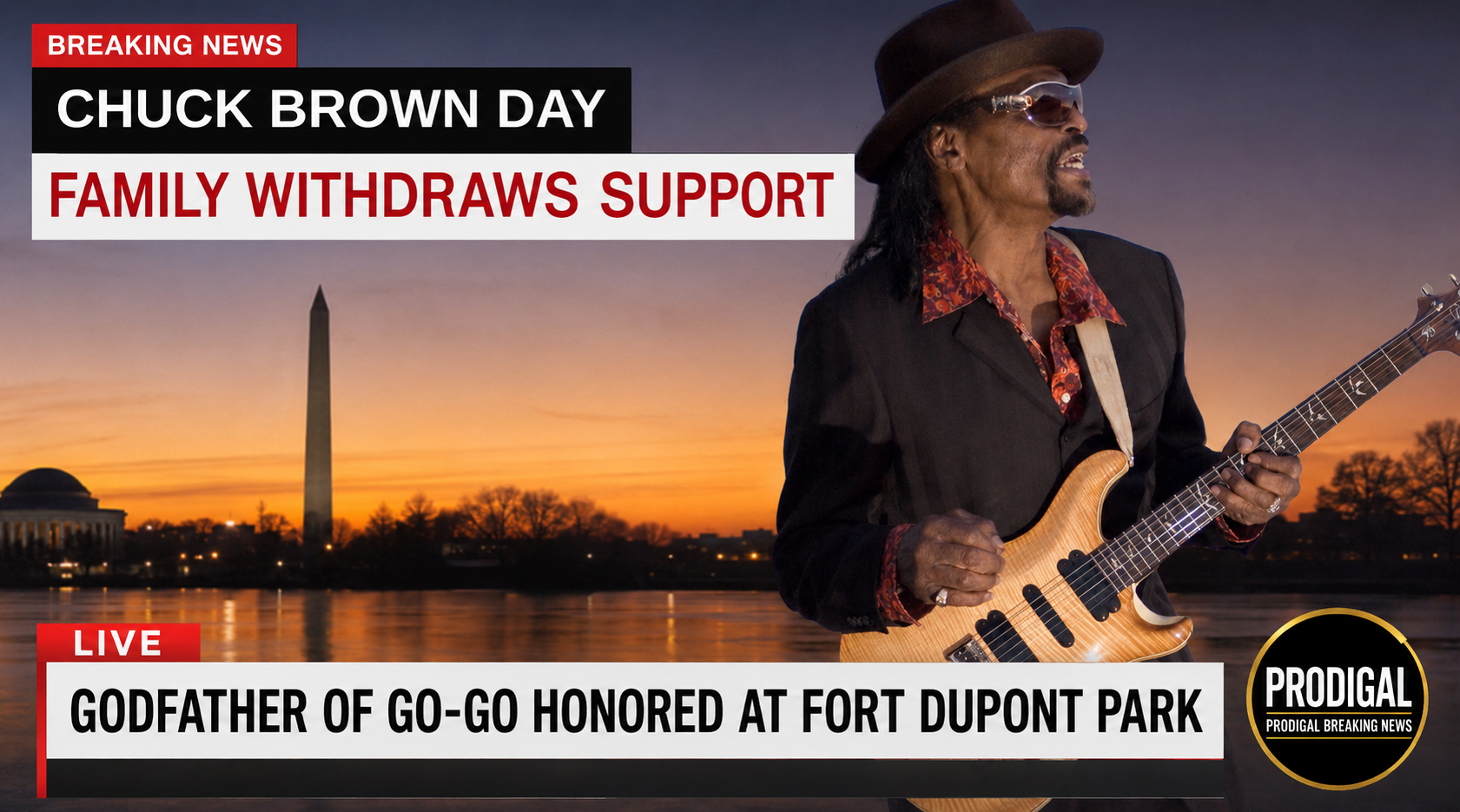
The Godfather of Go-Go's Own Family Just Walked Away From Chuck Brown Day — and the Reason Traces Back to the Fight That Saved Go-Go in the First Place
Culture & Resistance
The Godfather of Go-Go's Own Family Just Walked Away From Chuck Brown Day — and the Reason Traces Back to the Fight That Saved Go-Go in the First Place
By DRE ESSENCE — Lead Cultural Anchor
2026-08-21
Chuck Brown's family has publicly withdrawn support from Chuck Brown Day — the 12th annual tribute to the "Godfather of Go-Go," happening this Saturday at Fort Dupont Park — citing three years of being marginalized by D.C.'s Department of Parks and Recreation. It's the first time in the event's history it will run without the family's blessing.
The Godfather of Go-Go's Own Family Just Walked Away From Chuck Brown Day
Surface Story
This Saturday, the 12th annual Chuck Brown Day will go on at Fort Dupont Park in Southeast D.C. — the outdoor tribute to the man they called the Godfather of Go-Go, the architect of the city's only homegrown music. For the first time in the event's history, it will run without the blessing of Chuck Brown's own family.
His family has publicly withdrawn their support, citing three years of being marginalized by D.C.'s Department of Parks and Recreation — the city agency that now stages the day bearing his name. They say they have been cut out of the planning, sidelined in the programming, and reduced to a name on a flyer while the institution that once had to be pushed into honoring go-go at all decides how that honor looks.
It is, in the family's telling, not a fight over a concert. It is a fight over who gets to steward a legacy once the person who built it is gone — and whether the institutions that profit from a culture have any obligation to the family that produced it.
The Pattern
There is a reason this withdrawal traces back to the fight that saved go-go in the first place. Go-go was never supposed to survive. It is the only music America ever produced inside the borders of a city that did not want to claim it — a sound born in Southeast D.C. in the 1970s, built on congas, horns, and a beat that does not stop, and treated for decades by the city's institutions as a nuisance to be managed rather than a culture to be protected.
That fight came to a head in 2019, when a Metro PCS store in Shaw that had played go-go from its speakers for 24 years was told to turn the music down after a noise complaint from a new resident in a luxury apartment next door. The city did not rise up to defend a genre. It rose up to defend the idea that a culture cannot be muted because someone with more money moved in next door. They called it "Don't Mute DC." And the movement won — not because the institutions loved go-go, but because the people forced them to act.
Go-go was designated the official music of Washington, D.C. in 2020. But designation is not respect. A city can put a culture on a seal and still treat the people who made it as an afterthought. That is what the family says has happened to them — three years of being made an afterthought by the same Department of Parks and Recreation that, a decade ago, had to be pressured into honoring Chuck Brown Day in the first place.
The pattern is precise: an institution is forced to recognize a culture it ignored; the institution absorbs the culture's legitimacy; the institution then sidelines the very people whose culture it is. The fight that saved go-go from being muted in 2019 is the same fight the family is now waging against being erased from the day that carries their father's name.
What This Reveals
This is the thing Prodigal Breaking News keeps returning to, the thing we mean when we say notice the pattern. Recognition without relationship is extraction. A city can throw a festival in a man's name and still be extracting from him — using his legacy for civic branding, tourism, and political goodwill while the family that holds that legacy is shut out of the room where the decisions get made.
What the Chuck Brown family is describing is not unique to them. It is the architecture of how institutions handle Black cultural inheritance in this country: the originator is celebrated in death and managed in life, the family is invited to the photo and excluded from the planning, and the culture is declared "official" only after the people who could claim it have been stripped of the authority to do so.
The family did not ask for the day to be canceled. They asked for it to be honest — to be a tribute they helped shape, not a branding exercise performed in their father's name without their input. The city's answer, across three years, was to keep the day and lose the family. That answer is the pattern.
Movement Sign-Off
Chuck Brown built a sound that refused to stop. The least an institution can do is refuse to stop listening to the people who gave him to us.
If you are in D.C. this Saturday, go to Fort Dupont Park. Hear the music. But hear it clearly — as a culture that had to be fought for, by a family that is still fighting, against institutions that keep confusing a plaque for a relationship.
Notice the pattern. Then break it.
Process This Deeper
Prodigal AI's Story Companion Guide explores the institutional pattern, consciousness framework, community insights, transformation practices, and action opportunities related to this story.
Open the Companion Guide