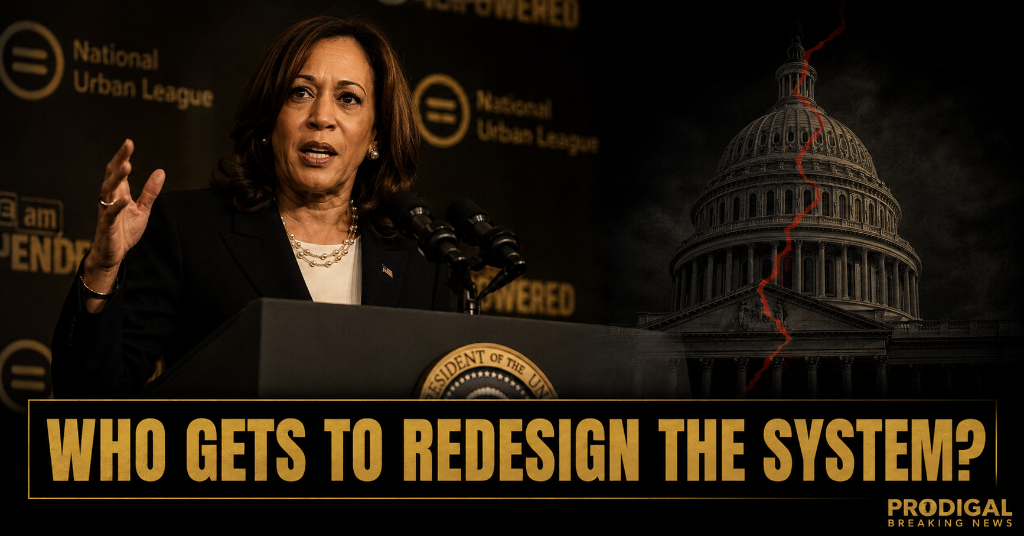
KAMALA HARRIS WANTS TO REBUILD THE COURT, KILL THE ELECTORAL COLLEGE, AND ADD TWO STATES — AND SHE SAID IT TO THE NATIONAL URBAN LEAGUE ON PURPOSE
Politics
KAMALA HARRIS WANTS TO REBUILD THE COURT, KILL THE ELECTORAL COLLEGE, AND ADD TWO STATES — AND SHE SAID IT TO THE NATIONAL URBAN LEAGUE ON PURPOSE
By Daniel Ward — Political Anchor
August 4, 2026
Speaking at the National Urban League's annual conference in Nashville on July 31, 2026, former Vice President Kamala Harris called for expanding the Supreme Court from nine to 13 justices, eliminating the Electoral College, and granting statehood to Puerto Rico and Washington, D.C. — while leaving open whether she'll run in 2028.
THE SURFACE STORY
On July 31, 2026, former Vice President Kamala Harris spoke at the National Urban League's annual conference in Nashville and called for three of the most structurally consequential changes to the American constitutional order a major-party figure has proposed in a generation: expanding the Supreme Court from nine to 13 justices, eliminating the Electoral College, and granting statehood to Puerto Rico and Washington, D.C.
She said it on purpose. This was not a gaffe, not a leaked aside, not a hypothetical floated to a friendly interviewer. It was a prepared address, to a legacy civil-rights organization, on the record, in a room full of cameras. Each of the three proposals is, on its own, a proposal to change the rules of American democracy in a way that would shift who holds federal power and how that power is exercised. Taken together, they amount to a single argument: that the current architecture of American government is not neutral, was never neutral, and cannot be reformed from within — only redesigned.
The Supreme Court expansion proposal would add four justices to the current nine, returning the Court to a size last seen before the Judiciary Act of 1869. The Electoral College proposal would replace the state-by-state, winner-take-all mechanism that has elected two presidents who lost the popular vote in the 21st century alone. The statehood proposals would add two new states — and with them, four new senators and several new House seats — to a union that has not admitted a new state since Hawaii in 1959.
And Harris left open whether she will run for president again in 2028. That is the part that makes the speech more than a policy lecture. She is not in office. She is not currently a candidate. But she is the most recent person to hold the office one heartbeat from the presidency, and she chose, in a room organized around Black political power, to put structural constitutional reform at the center of whatever comes next.
THE PATTERN
This is not a story about Kamala Harris. This is a story about the moment when a major political figure decides to stop arguing about outcomes and start arguing about rules.
Notice the shift. For most of the last two decades, the argument inside the Democratic Party has been about outcomes — who won, who lost, which policy passed, which policy was blocked. Harris's speech changes the subject. It is not about who wins the next election. It is about who designs the system the next election is run inside. That is a different argument, and a more dangerous one — for the person making it and for the country. Once you argue about the rules, you are arguing about legitimacy. And once you argue about legitimacy, you are arguing about whether the current system, as built, can produce outcomes the majority of the country will accept.
The three proposals are not random. They are the three places where the current system most visibly diverges from majority rule. The Supreme Court, with lifetime appointments and a 6-3 conservative majority built through two norm violations (Merrick Garland's stolen seat and the rushed Amy Coney Barrett confirmation), is the place where minority rule is most durable — a 6-3 majority that may hold for a generation, regardless of who wins elections. The Electoral College is the place where minority rule is most quantifiable — two presidents who lost the popular vote in 16 years, and a structural bias toward rural, white, conservative states that grows every cycle. And the Senate — which statehood for D.C. and Puerto Rico would begin to rebalance — is the place where minority rule is most extreme, where a senator from Wyoming represents 580,000 people and a senator from California represents 39 million, and both get one vote.
Harris did not invent these arguments. Court expansion has been a live Democratic debate since the Barrett confirmation. Electoral College abolition has been a progressive priority since 2000. D.C. and Puerto Rico statehood have been House-passed bills. What is new is the packaging. She put all three in the same speech, to the same audience, on the same day — and framed them not as three separate reforms but as one project: the redesign of a system that, in her telling, was built to produce a specific kind of winner and has been producing that winner ever since.
And notice the audience. She did not say this to a think tank. She did not say it to a donor retreat. She said it to the National Urban League — a Black civil-rights organization, in a room full of Black voters and Black organizers, in a city in the South. That is a choice about who the argument is for. The argument for structural reform is, in the American tradition, an argument that has been made most forcefully by Black political actors — from Reconstruction to the Voting Rights Act to the current fight against gerrymandering and suppression. Harris placed herself in that tradition. She did not argue that the system is broken. She argued that the system is working — working for the people who designed it, and not for the people in the room.
WHAT THIS REVEALS
This story reveals the emergence of a Democratic position that has moved, quietly but decisively, from defending institutions to redesigning them. For most of the post-Trump era, the Democratic argument has been institutionalist: defend the norms, defend the courts, defend the guardrails. Harris's speech is a break with that posture. It says, in effect, that the institutions are not worth defending as they are — that the norms produced the norm violations, that the guardrails failed to guard, and that the answer is not to restore what was but to build something different. That is a minority position in the party today. It may not be a minority position for long.
It also reveals the calculation about 2028. Harris did not announce. But she did something more useful: she staked out a position that no other prospective Democratic candidate has occupied. Court expansion, Electoral College abolition, and statehood are popular with the Democratic base and radioactive with the median voter. By taking them, Harris signaled which primary she is running in — not the centrist primary, not the "electability" primary, but the base-energizing, structural-reform primary. That is a bet that the 2028 Democratic primary will be fought over who is willing to change the system, not who is willing to work within it. It is a bet on the mood of the party after two terms of a system that, from the Democratic perspective, has produced minority rule twice and may produce it again.
And it reveals the Republican counter-argument that is already forming. Within hours of the speech, the framing from the right was not policy disagreement but legitimacy crisis — that Harris was proposing to "pack the Court," "abolish the way we elect presidents," and "add two Democratic states to rig the Senate." This is the argument that any structural reform is, by definition, a power grab. It is the argument that the system is neutral and that any attempt to change it is an attempt to cheat. It is the argument that the current rules are the rules, and that changing them is illegitimate. That argument will be the Republican argument for the next two years. It is the argument Harris chose to provoke.
MOVEMENT SIGN-OFF
Prodigal does not cover this story to tell you whether Kamala Harris should be president, or whether court expansion, Electoral College abolition, or statehood are good ideas. We cover it to show you that a major political figure just said, on the record, that the system is not neutral — and that the argument in American politics is moving from who wins inside the system to who gets to design it.
Notice the pattern. The outcomes have been contested for two decades. The rules are now contested. The Court, the College, and the Senate are the three places where the design of American democracy is most visible — and the three places where the current design most clearly diverges from the will of the majority. Harris named all three. She named them to the audience most affected by the divergence. And she left open whether she will be the one to carry the argument into the next election.
The question is not whether these reforms will pass. Most of them will not pass soon. The question is whether the argument that the system is designed — and therefore redesignable — has now entered the mainstream of a major party. It has. And once that argument is in the mainstream, it does not leave. The next two years will be a fight over whether the current design is the permanent design, or whether the people who have been losing inside it will get to rebuild it.
Notice the pattern. Then notice who is defending the rules — and who is finally arguing about who made them.
— Daniel Ward, Political Anchor, Prodigal Breaking News
Process This Deeper
Prodigal AI's Story Companion Guide explores the institutional pattern, consciousness framework, community insights, transformation practices, and action opportunities related to this story.
Open the Companion Guide