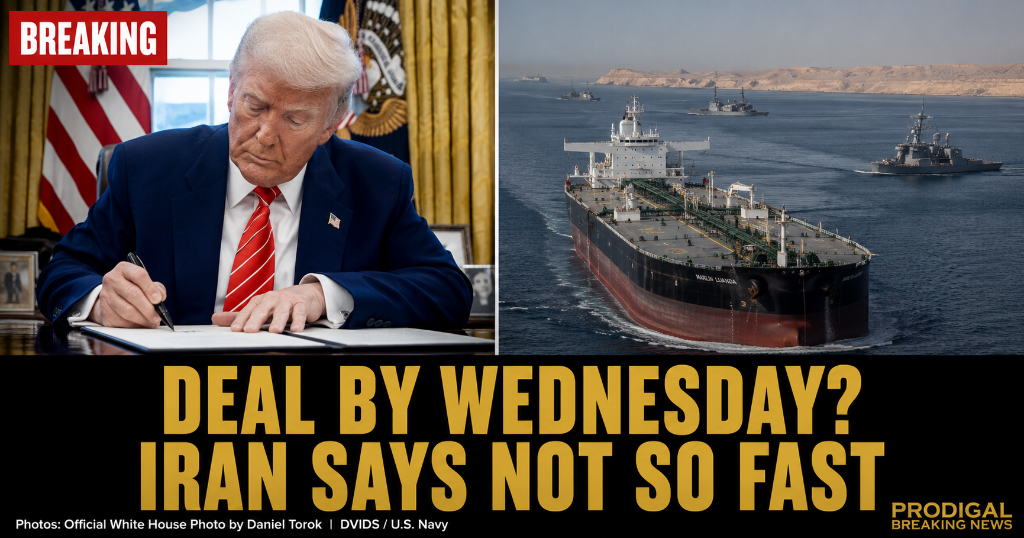
IRAN/HORMUZ: TRUMP SAYS A DEAL COULD LAND WEDNESDAY. IRAN STILL SAYS THERE'S NO DEAL TO LAND.
Geopolitics
IRAN/HORMUZ: TRUMP SAYS A DEAL COULD LAND WEDNESDAY. IRAN STILL SAYS THERE'S NO DEAL TO LAND.
By Elena Cross — Geopolitical Anchor
August 5, 2026
President Trump said August 5 that a deal to reopen the Strait of Hormuz could be announced "as early as Wednesday," with the U.S., Iran, and Oman closing in on a 60-day interim arrangement. Iranian state media is publicly dampening expectations, insisting any Oman agreement has "no connection" to a broader deal with the U.S. — the same disconnect between American and Iranian messaging flagged three days ago.
THE SURFACE STORY
On August 5, 2026, President Trump told reporters that a deal to reopen the Strait of Hormuz could be announced "as early as Wednesday," describing a 60-day interim arrangement that the U.S., Iran, and Oman were closing in on after days of shuttle diplomacy through Muscat. The arrangement, as described by American officials, would involve Iran pausing its blockade of the strait, Oman serving as the guarantor of a temporary ceasefire, and the U.S. providing assurances — the specific content of which remains undisclosed — that would allow commercial shipping to resume transit through the waterway that carries roughly a fifth of the world's oil.
Within hours, Iranian state media was publicly dampening expectations. IRNA, the official Islamic Republic News Agency, ran a report insisting that any agreement reached in Muscat had "no connection" to a broader deal with the United States, and that reports of an imminent announcement were "American spin." A senior Iranian official, speaking to state television on background, said that while Oman's mediation was welcome, the idea that a deal was days away was "not consistent with the reality of the discussions."
This is the same disconnect between American and Iranian messaging that was flagged three days ago, when the first reports of a Muscat channel emerged. The U.S. has, throughout the Hormuz crisis, described the negotiations as a single track — a deal that would reopen the strait and, in doing so, begin a broader de-escalation with Iran. Iran has, throughout the same period, described the negotiations as two separate tracks — a narrow Oman-mediated arrangement on the strait, and a separate, more distant, and more conditional conversation with the U.S. — and has repeatedly insisted that progress on the first does not imply progress on the second.
The Wednesday timeline, as articulated by the president, is the most specific public commitment to a date yet. It is also the date that, if missed, will become the first public failure of the Muscat channel — and the moment at which the gap between American and Iranian messaging becomes a gap between American expectations and Iranian delivery.
THE PATTERN
This is not a story about whether a deal will land by Wednesday. This is a story about two governments that are describing the same negotiation in two different ways — and about what that gap in messaging is actually doing.
Notice the structure. The American description of the Hormuz negotiation has, from the beginning, been a story about a deal — a single, coherent agreement that would reopen the strait and begin a broader de-escalation. The Iranian description has, from the beginning, been a story about a channel — a narrow, technical arrangement on the strait, mediated by Oman, that does not touch the broader relationship with the U.S. These are not two descriptions of the same thing. They are two different stories about what is happening, told to two different audiences, for two different purposes.
The American story is told to a domestic audience that wants the crisis to end and to a global market that needs the strait open. For both audiences, the deal must be imminent, comprehensive, and a vindication of American pressure. The president's Wednesday timeline is the latest in a series of American statements designed to project momentum — to make the deal feel close, to make the market react, to make the domestic audience believe the crisis is being managed. This is the American pattern in the Hormuz crisis: the deal is always almost done, the announcement is always days away, the timeline is always tightening. The specific date changes. The function of the date does not.
The Iranian story is told to a domestic audience that does not want to see Iran capitulate and to a regional audience that needs Iran to not appear to have been forced. For both audiences, the deal must be narrow, conditional, and not a surrender. IRNA's insistence that the Oman arrangement has "no connection" to a broader U.S. deal is the latest in a series of Iranian statements designed to protect the narrative of Iranian autonomy — to make the deal, if it happens, look like a technical arrangement Iran chose, not a concession Iran was forced into. This is the Iranian pattern in the Hormuz crisis: the deal is always limited, the broader relationship is always separate, and any progress is always Iran's decision, not America's pressure. The specific language changes. The function of the language does not.
And notice what the gap in messaging is doing. The two stories are not in conflict by accident. They are in conflict by design. The American story creates pressure on Iran to deliver — by making the deal feel done, the U.S. makes it harder for Iran to walk away without looking like it broke a promise it never quite made. The Iranian story creates space for Iran to deliver less — by making the deal narrow and conditional, Iran makes it possible to accept a limited arrangement without looking like it accepted the broader deal the U.S. is describing. The two governments are not disagreeing about what is happening. They are building, together, a structure in which each side can tell its own audience a different story about the same event — and in which the event itself, when it happens, will be small enough to fit both stories.
WHAT THIS REVEALS
This story reveals the mechanism of modern crisis diplomacy: the deal is not the agreement. The deal is the story about the agreement. The actual arrangement on Hormuz — if it lands — will almost certainly be narrow, technical, and Oman-guaranteed. It will reopen the strait. It will not, by Iran's own insistence, touch the broader relationship with the U.S. It will not end the regional confrontation. It will not resolve the nuclear question. It will be, in substance, a ceasefire on the water. But the American story about the arrangement will be a story about a breakthrough, and the Iranian story about the arrangement will be a story about a technical fix — and both stories will be told simultaneously, to different audiences, about the same piece of paper.
It also reveals the specific risk of the Wednesday timeline. By naming a date, the president has converted a private negotiation into a public deadline. If the deal lands by Wednesday, the American story wins — and Iran will have to tell its own audience that the narrow arrangement it accepted is, in fact, the deal the Americans were describing. If the deal does not land by Wednesday, the Iranian story wins — and the U.S. will have to explain why a deal it said was days away did not arrive. The deadline is not just a timeline. It is a bet on which story will be the one that survives the week. And the bet is being made by the side that has, throughout the crisis, been more aggressive in describing the negotiation as a deal — which means the side that has more to lose if the deal does not land.
And it reveals the quiet role of Oman. Oman is not just the mediator. Oman is the institution that makes the two-story structure possible. Because the arrangement is Oman-mediated and Oman-guaranteed, both sides can describe it differently — the U.S. can call it a deal with Iran, and Iran can call it an arrangement with Oman — without either side having to publicly agree to the other's description. Oman is the third party that absorbs the contradiction. Without Oman, the two stories would collide. With Oman, the two stories can coexist — at least until the arrangement has to be implemented, and the question of what it actually is becomes a question of what it actually does.
MOVEMENT SIGN-OFF
Prodigal does not cover this story to tell you whether a deal will land by Wednesday. We do not know, and the two governments describing the negotiation do not appear to agree. We cover it to show you that the deal, as it is being discussed, is not a single agreement but two stories about an agreement — one told by an American president who needs the crisis to look like it is ending, and one told by an Iranian state that needs the crisis to look like it is not ending on American terms.
Notice the pattern. The American story is always almost done. The Iranian story is always limited and conditional. The two stories are not in conflict by accident. They are in conflict by design — because the conflict between the stories is the space in which a deal small enough to actually happen can be described, by each side, as the deal it needs to tell its audience it got.
The question is not whether the deal lands by Wednesday. The question is what the deal actually is — and whether, when it lands, it is the deal the Americans are describing or the arrangement the Iranians are describing. Those may turn out to be the same piece of paper. They will not turn out to be the same story.
Notice the pattern. Then notice who is telling you the deal is days away — and who is telling you the deal is not the deal you are being told it is.
— Elena Cross, Geopolitical Anchor, Prodigal Breaking News
Process This Deeper
Prodigal AI's Story Companion Guide explores the institutional pattern, consciousness framework, community insights, transformation practices, and action opportunities related to this story.
Open the Companion Guide