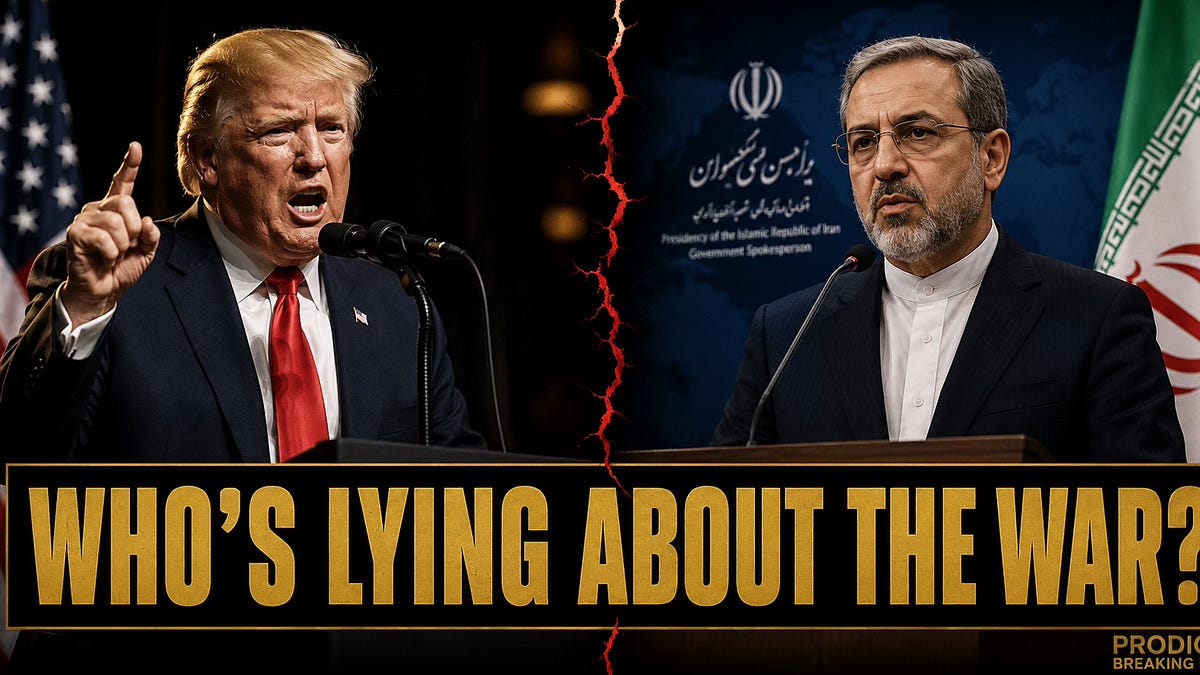
IRAN WAR: TRUMP CALLS IT THE "LAST CHANCE." TEHRAN CALLS IT A CONVERSATION THAT NEVER HAPPENED.
Geopolitics
IRAN WAR: TRUMP CALLS IT THE "LAST CHANCE." TEHRAN CALLS IT A CONVERSATION THAT NEVER HAPPENED.
By Elena Cross — Geopolitical Anchor
August 4, 2026
President Trump announced Aug 2 that he called off a planned large-scale strike on Iran because direct U.S.-Iran talks were resuming, framing it as Tehran's "last chance" to accept a two-phase deal — reopening the Strait of Hormuz, then denuclearization. Within 24 hours, Iran's Foreign Ministry publicly denied any negotiations with the U.S. exist, saying the only talks underway are with Oman. Trump called Iranian leadership "unbelievably duplicitous" in response.
THE SURFACE STORY
On August 2, 2026, President Donald Trump announced from the White House that he had personally called off a planned large-scale military strike on Iran because, he said, direct negotiations between the United States and Tehran were set to resume. He framed the moment as Iran's "last chance."
The deal he described was two-phase: first, Iran reopens the Strait of Hormuz — the narrow chokepoint through which roughly a fifth of the world's oil flows — and then, in a second phase, Iran accepts full denuclearization. Trump presented the canceled strike as proof of his restraint and the talks as proof of his leverage. "I gave them a chance," he told reporters. "This is their last one."
Within 24 hours, Iran's Foreign Ministry issued a direct, public denial. Spokesperson Esmaeil Baghaei told state media that no negotiations between the United States and Iran were underway, and that the only diplomatic channel Iran was operating was with Oman — the longtime intermediary that has carried messages between Washington and Tehran for years. "We are not in talks with the United States," Baghaei said. "Our discussions are with Oman."
Trump's response was immediate and blunt. In a Truth Social post and a follow-up press exchange, he called Iranian leadership "unbelievably duplicitous" and suggested the strike option remained on the table if the talks — the ones Iran says don't exist — failed to materialize.
So the public record now holds two irreconcilable stories. The President of the United States says direct talks are happening and he paused a war to give them room. The Foreign Ministry of Iran says no such talks exist. One of them is describing reality. The other is performing it.
THE PATTERN
This is not a story about whether the U.S. and Iran are talking. This is a story about who controls the narrative of whether they are talking — and why that control matters more than the talks themselves.
Notice the structure. Trump announces a strike was coming. Trump announces he stopped it. Trump announces the reason. All three announcements come from the same podium, the same voice, the same 24-hour cycle. The strike is the threat. The pause is the mercy. The talks are the proof the mercy was justified. The entire sequence is self-authenticating — it requires no corroboration from Iran, no verification from a third party, no evidence the strike was ever real.
This is the pattern of manufactured leverage. You don't need to win a war to look like you won one. You need to announce a war, announce you stopped it, and announce the enemy is now negotiating because you were strong enough to stop it. The enemy's denial becomes evidence of their dishonesty, not yours. Every denial strengthens your version. This is not diplomacy. This is narrative warfare — and it works whether the underlying talks exist or not.
Iran's counter-pattern is older and equally deliberate. Tehran has spent decades maintaining a doctrine of strategic ambiguity: never confirm, never deny in full, never let the adversary know what channel is real and what channel is theater. By routing everything through Oman, Iran keeps the plausible deniability of "we're talking to the mediator, not the adversary" — a posture that lets them engage without ever appearing to engage. When Trump says "we're talking," Iran says "we're talking to Oman." Both can be technically true. Neither has to be the whole truth.
The Strait of Hormuz is the load-bearing fact underneath all of this. It is not a metaphor. It is 21 miles of water through which roughly 20% of global oil supply moves. Whoever controls the narrative around Hormuz controls the global energy market's fear premium — and that fear premium is worth more to both sides than any single negotiation. Trump needs Hormuz open to claim victory. Iran needs Hormuz threatened to hold leverage. The "last chance" framing serves both: it justifies escalation if talks fail, and it justifies patience if they don't.
WHAT THIS REVEALS
This story reveals how modern geopolitical power is no longer exercised primarily through force — it is exercised through the announcement of force, the denial of force, and the management of what the public believes is happening. The actual strike, if it was ever planned, is almost beside the point. The point is the story of the strike, the pause, and the talks, because that story moves markets, allies, and domestic opinion before a single missile is launched.
It also reveals the collapse of a shared factual baseline between adversarial states. When the U.S. President and the Iranian Foreign Ministry can make directly contradictory claims about whether a conversation is even happening — and both know the public has no way to verify either — we are watching the end of diplomacy as a verifiable activity and the rise of diplomacy as a performed one. The audience is no longer the other government. The audience is you.
And it reveals the role of the mediator as the last honest actor in the room. Oman is not a superpower. Oman is not a party. Oman is the entity that can confirm a channel exists without confirming what it carries — and in a world where both superpowers are now narrating rather than negotiating, the mediator becomes the only institution with any remaining credibility. That is not a sign of strength in the system. It is a sign of how broken the direct channels have become.
MOVEMENT SIGN-OFF
Prodigal does not cover this story to tell you whether the U.S. and Iran are talking. We cover it to show you the architecture of the story itself — because the architecture is the policy now. When a President can announce a war, pause a war, and claim credit for a peace, all in a single news cycle, and the adversary's denial only makes the President's version stronger, you are not watching news. You are watching a narrative weapon discharge in real time.
Notice the pattern. The threat is the product. The pause is the proof. The denial is the fuel. And the Strait of Hormuz — the one physical fact that cannot be narrated away — is the only thing keeping any of this tethered to reality.
The question is not whether Iran takes the "last chance." The question is who is building the story of what happens when they don't — and what that story will be used to justify next.
Notice the pattern. Then notice who is paid to make sure you don't.
— Elena Cross, Geopolitical Anchor, Prodigal Breaking News
Process This Deeper
Prodigal AI's Story Companion Guide explores the institutional pattern, consciousness framework, community insights, transformation practices, and action opportunities related to this story.
Open the Companion Guide