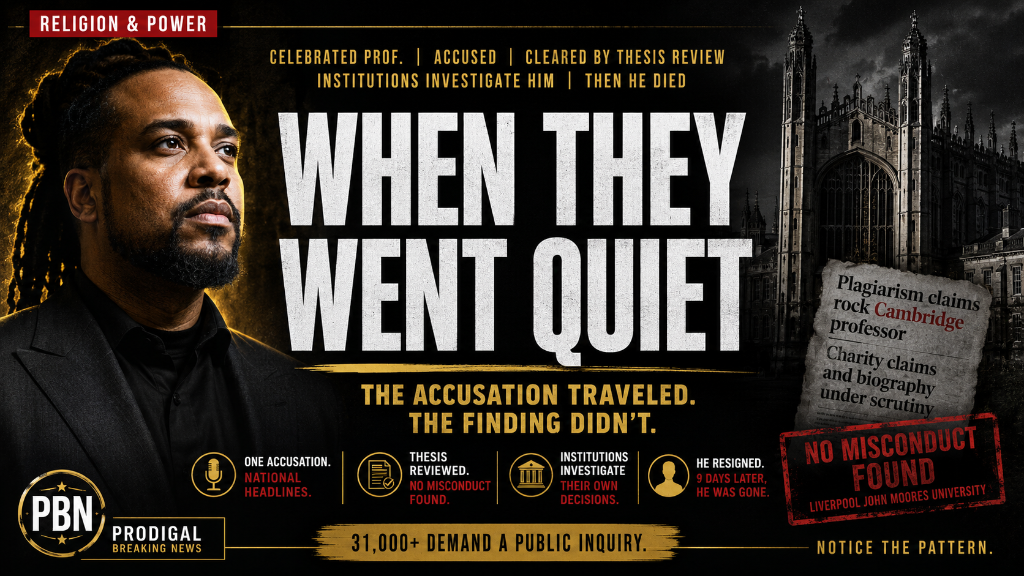
JASON ARDAY: WHEN THE INSTITUTIONS THAT CELEBRATED HIM WENT QUIET
Religion & Power
JASON ARDAY: WHEN THE INSTITUTIONS THAT CELEBRATED HIM WENT QUIET
By Latisha Sky — Human Interest Anchor
August 17, 2026
Jason Arday, one of Cambridge's youngest-ever Black professors, resigned on Aug 5 after weeks of press scrutiny over plagiarism claims that his own PhD university found no evidence for. Nine days later he was found dead. Now 31,000+ people and multiple MPs are demanding a public inquiry into whether the press campaign against him was racially driven — and whether it killed him.
THE SURFACE STORY
On August 5, 2026, Professor Jason Arday — one of the youngest Black professors ever appointed at the University of Cambridge — resigned from his post at Gonville and Caius College. Nine days later, on August 14, he was found dead. He was 38 years old.
The resignation came after weeks of sustained press scrutiny in the British media over allegations of plagiarism in his academic work and questions about biographical claims in his public profile. The allegations were first surfaced by a national newspaper, amplified across social media, and picked up by multiple outlets in the weeks that followed. The coverage was intensive, personal, and — by the assessment of those who knew him — unrelenting.
The finding that the press coverage did not lead with was this: the institution that awarded Jason Arday his PhD, Liverpool John Moores University, conducted a formal review of his doctoral thesis in response to the plagiarism allegations and found no evidence of research misconduct. The review concluded that the thesis met the standards required for the award. The finding was made known. It did not travel as far as the accusation.
In the days following his death, a petition calling for a public inquiry into the press treatment of Jason Arday — and into whether that treatment was racially motivated — gathered over 31,000 signatures. Multiple Members of Parliament have called for the same inquiry. The Good Law Project, a UK-based legal advocacy organization, has indicated it is considering formal action. The central question being asked is not whether Jason Arday was a perfect man. It is whether the press campaign against him was a campaign that would have been run against a white academic with the same record — and whether that campaign, and the silence of the institutions that celebrated him, contributed to his death.
THE PATTERN
This is not a story about plagiarism. This is a story about the asymmetry between an accusation and a finding — and about what that asymmetry does to a person who is caught inside it.
Notice the structure. An accusation is made. The accusation is public, loud, and fast. It travels through a national newspaper, through social media, through the commentariat, through the outrage cycle. It does not wait for verification. It does not wait for the institution that holds the relevant evidence to review that evidence. It does not wait, because the accusation is a story — and a story does not need to be true to travel; it only needs to be tellable. The accusation against Jason Arday was tellable. It had a protagonist, a villain, an institution, and a stakes. It could be headlined. It could be shared. It could be the thing that a person scrolling a feed would stop on. And so it traveled.
A finding is made. The finding is private, quiet, and slow. It travels through a university committee, through a review process, through a formal conclusion that is published — but published in the language of institutions, which is the language of restraint. The finding that Liverpool John Moores University found no evidence of research misconduct in Jason Arday's thesis was made. It was made in the way institutions make findings: carefully, with qualification, and without the volume that the accusation had. The finding did not have a protagonist or a villain. It had a conclusion. And a conclusion, in the attention economy, does not travel the way a story does. It does not stop a feed. It does not headline. It does not share. And so it did not travel.
This is the pattern of institutional asymmetry in cases of public accusation: the accusation outruns the finding, always. The finding, when it arrives, cannot catch the accusation, because the accusation has already become the story people believe, and the finding has become a footnote to that story. The person who is accused lives in the gap between the accusation and the finding — a gap that is measured not in days but in reach. The accusation reached everyone the person knows. The finding reached almost no one. And the person is left to live in a world in which the public version of them is the accused version, and the corrected version — the version that says the accusation was not substantiated — is a version that most people will never see.
And notice the specific silence of the celebrating institutions. Jason Arday was celebrated. He was appointed to Cambridge at a young age. He was profiled. He was invited. He was the story that institutions tell about themselves when they want to tell a story about progress — the story of the young Black scholar who broke through. And when the accusation came, the institutions that had celebrated him did not, in public, defend him. They did not repeat his achievements. They did not amplify the finding when it arrived. They went quiet. This is the institutional pattern: the institution celebrates the person when the person is a story the institution wants to tell, and the institution distances itself from the person when the person becomes a story the institution does not want to tell. The celebration is conditional. The silence is structural.
WHAT THIS REVEALS
This story reveals the mechanism by which a press accusation becomes a death — not through a single act, but through a structure in which the accusation is loud, the finding is quiet, the institutions are silent, and the person is alone.
It reveals the specific vulnerability of the public Black academic in the British press. The press campaign against Jason Arday was not, on its face, a campaign about race. It was a campaign about plagiarism, about biography, about the integrity of a scholar's record. But the question the petition asks — the question 31,000 people and multiple MPs are asking — is whether that campaign would have been run, with that intensity, with that volume, with that personal focus, against a white academic with the same record. The question is not whether the allegations were racial in content. The question is whether the treatment was racial in pattern — whether the press, in choosing whom to investigate, whom to headline, whom to follow for weeks, whom to treat as a story worth sustaining, applied a standard that was different in practice for a young Black professor than it would have been for a white one. That is the question a public inquiry is meant to answer. It is the question the institutions that celebrated him did not, in public, ask.
And it reveals the cost of the gap between accusation and finding. Jason Arday lived for nine days after his resignation, and in those nine days the finding that his thesis had been reviewed and cleared was already known — but it had not become the public version of him. The public version of him was still the accused version. The finding existed, but it did not, in the time he had, become the story. And then he was gone. The finding, for him, came too late — not because it was made too late, but because it did not travel fast enough to reach the world that had reached him with the accusation. This is the cost of the asymmetry: the finding does not have to be wrong. It only has to be slow. And slow, in the attention economy, is the same as absent.
MOVEMENT SIGN-OFF
Prodigal does not cover this story to tell you that the press killed Jason Arday. We do not know what killed him. We know that he was accused, that the accusation traveled, that his thesis was reviewed and cleared, that the finding did not travel as far as the accusation, that the institutions that celebrated him went quiet, and that nine days after he resigned he was dead. We cover it to show you the structure: an accusation that is loud, a finding that is quiet, an institution that is silent, and a person who is alone in the gap between them.
Notice the pattern. The accusation travels. The finding does not. The institution celebrates the person when the person is a story it wants to tell, and the institution goes quiet when the person becomes a story it does not want to tell. The person lives in the gap. And the gap, in this case, was nine days wide.
The question is not whether Jason Arday was a perfect man. He was not. The question is whether the press campaign against him was a campaign that would have been run against a white academic with the same record — and whether the institutions that celebrated him were willing, in public, to treat him the way they treated him when they appointed him. The 31,000 people asking that question are asking it because the answer, in the pattern, is already visible.
Notice the pattern. Then notice who was investigated — and who was not. Notice who was celebrated — and who was defended. Notice how far the accusation traveled — and how far the finding did not.
— Latisha Sky, Human Interest Anchor, Prodigal Breaking News
Process This Deeper
Prodigal AI's Story Companion Guide explores the institutional pattern, consciousness framework, community insights, transformation practices, and action opportunities related to this story.
Open the Companion Guide