JOAN SEBASTIÁN DURÁN GUERRERO: HE WASN'T EVEN WHO THEY WERE LOOKING FOR
Justice & Reparations
JOAN SEBASTIÁN DURÁN GUERRERO: HE WASN'T EVEN WHO THEY WERE LOOKING FOR
By Grant Keller — Investigative Anchor
August 4, 2026
On July 13, 2026, ICE officer David Brouillette shot and killed 26-year-old Joan Sebastián Durán Guerrero in Biddeford, Maine, after agents rammed his car while executing a warrant for someone else. Durán Guerrero — a cleaner and food-delivery driver with a partner and 3-year-old daughter — may have been legally authorized to work in the U.S., directly contradicting ICE's "illegal alien" framing. No body cameras were running when the shots were fired.
THE SURFACE STORY
On July 13, 2026, in Biddeford, Maine, ICE officer David Brouillette shot and killed 26-year-old Joan Sebastián Durán Guerrero. The agents were executing a warrant — for someone else.
According to the official account, ICE agents rammed Durán Guerrero's car during the operation. What happened in the seconds after is the part the government cannot, or will not, fully explain. Brouillette fired. Durán Guerrero was killed. He was 26 years old. He had a partner. He had a 3-year-old daughter.
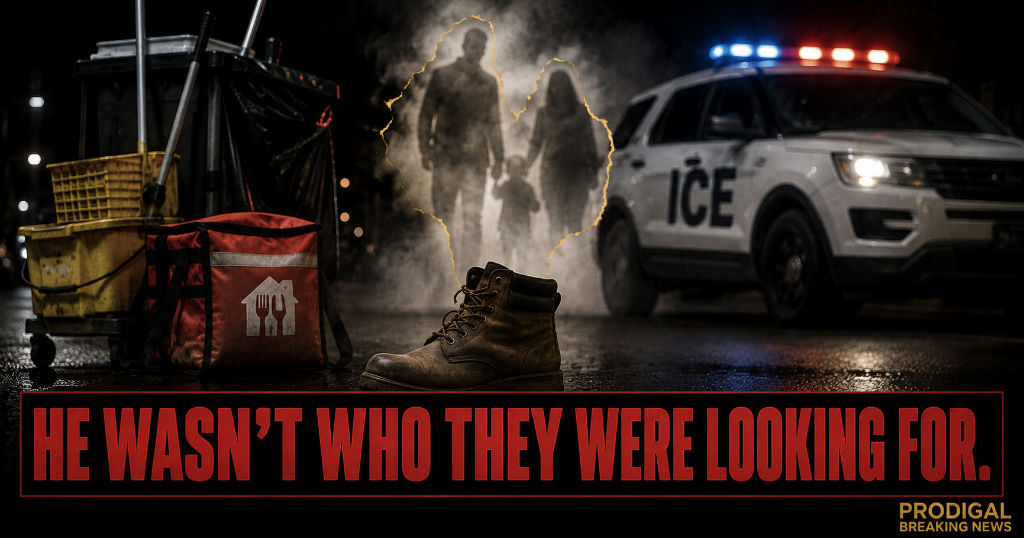
He was a cleaner. He was a food-delivery driver. The objects of his labor — a work boot, a red insulated delivery bag, a yellow cleaning cart — are the artifacts of a man who worked two and three jobs to keep a family alive. They are also the artifacts ICE would prefer you not look at, because they make the official framing harder to sustain.
ICE described Durán Guerrero in its initial statements as an "illegal alien." But reporting in the days after the shooting surfaced evidence that Durán Guerrero may have been legally authorized to work in the United States — a status that, if confirmed, directly contradicts the federal government's framing of the man its agent killed. The warrant was not for him. The car they rammed was his. The shots were fired at him. And the label they put on him after death may not even have been accurate.
No body cameras were running when the shots were fired. In 2026, in a country that has spent a decade debating police accountability through the lens of body-worn cameras, the single most consequential moment of this encounter — the moment a federal agent decided to use lethal force against a man he was not looking for — was not recorded. ICE has not explained why.
THE PATTERN
This is not a story about one shooting in one town in Maine. This is a story about the architecture of a system that can kill a man it was not looking for, label him after death, and rely on the absence of footage to make the labeling stick.
Notice the sequence. The warrant was for someone else. The car they rammed was his. The man they killed was not the target. The label they applied — "illegal alien" — was the first frame, issued before the family could speak, before the work records could surface, before anyone could ask whether the man they killed had the legal status they used to justify the killing. The label is not a finding. The label is a defense. It is issued to pre-empt the question.
This is the pattern of post-hoc justification. The force comes first. The rationale comes after. And the rationale is designed not to explain what happened but to make what happened harder to prosecute. When the target is misidentified, the system does not say "we made a mistake." It says "he was illegal" — as though illegality, even if true, would make a wrong-target killing lawful. It would not. But the framing does not need to win in court. It needs to win in the first 48 hours of news coverage, and it usually does.
The absence of body cameras is not an accident. It is a feature. A body camera is a witness that cannot be cross-examined into changing its story. When the cameras are off, the only surviving account of a lethal encounter is the account of the people who fired the shots. Every gap in footage is a space the official narrative gets to fill unchallenged. In Biddeford, the gap is the entire encounter. The government's version is the only version, because the government made sure no other version could exist.
And notice the labor. The boot. The delivery bag. The cleaning cart. These are not props. They are the record of a life the official framing tried to erase. A man who works two and three jobs is not a man hiding from the system. He is a man operating inside the system — paying taxes he may never benefit from, holding jobs the economy depends on, raising a daughter in a country whose agents killed him while looking for someone else. The artifacts of his work are the counter-evidence to the label. That is why they matter. That is why they are in the thumbnail.
WHAT THIS REVEALS
This story reveals how immigration enforcement has become a system in which lethal force, misidentification, and post-hoc labeling operate as a single integrated workflow. The warrant does not need to be correct. The target does not need to be the right person. The status does not need to be verified before the label is issued. The camera does not need to be on. Each failure is, from the system's perspective, not a bug — it is a layer of insulation. Wrong target, no footage, contested status, delayed accountability: every layer makes prosecution harder and public memory shorter.
It also reveals the collapse of the distinction between enforcement and punishment. When an agent can kill a man who was not the target of the warrant, and the agency's first public act is to label that man with a status that may be false, enforcement and punishment have fused. The warrant was the pretext. The killing was the act. The label was the cover. There is no step in this sequence where the system treats the dead man as a person entitled to due process — only as a body to be categorized after the fact.
And it reveals the role of the family as the last line of accountability. Joan Sebastián's partner and his 3-year-old daughter are not abstractions. They are the people who will grow up in the gap the camera left. They are the ones who will carry the question ICE will not answer: why was a man who was not the target the one who ended up dead? The system counts on families being too small, too grieving, too undocumented-adjacent to force the question. The pattern relies on their silence.
MOVEMENT SIGN-OFF
Prodigal does not cover this story to tell you whether Joan Sebastián Durán Guerrero was legally authorized to work in the United States. We cover it to show you that the question of his status is being used to answer a question it cannot answer: whether a federal agent was justified in killing a man he was not sent to find.
Notice the pattern. The warrant was for someone else. The car was his. The shots were his. The label was theirs. The camera was off. And the boot, the bag, the cart — the proof that this man worked, that this man lived, that this man had a family — are the only evidence the official framing cannot narrate away.
The question is not whether ICE made a mistake. The question is whether a system that can kill the wrong man, label him after death, and lose the footage is a system that can be held accountable at all — or whether accountability, in 2026, is something families have to build themselves, one artifact at a time.
Notice the pattern. Then notice who is paid to make sure the camera is off when it matters.
— Grant Keller, Investigative Anchor, Prodigal Breaking News
Process This Deeper
Prodigal AI's Story Companion Guide explores the institutional pattern, consciousness framework, community insights, transformation practices, and action opportunities related to this story.
Open the Companion Guide