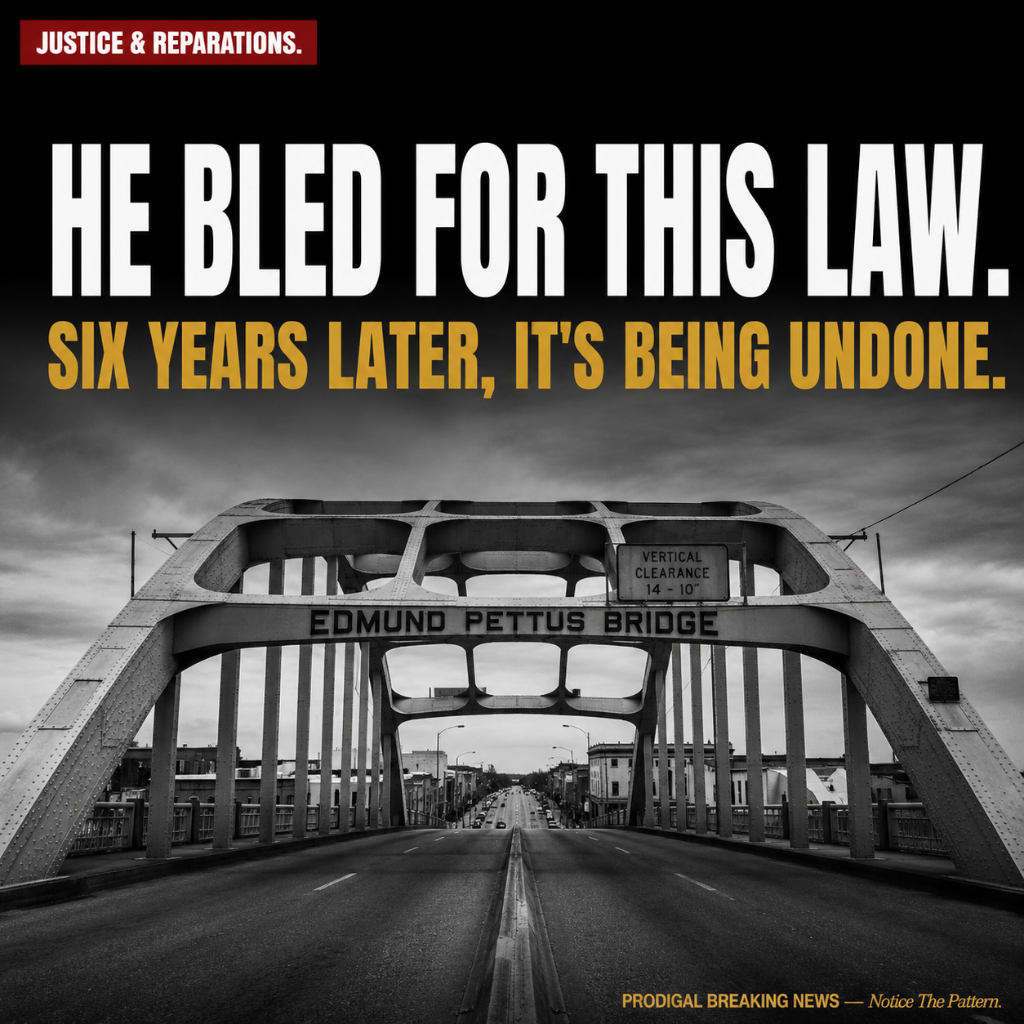
John Lewis Bled for This Law. Six Years After His Death, It's Being Undone.
Justice & Reparations
John Lewis Bled for This Law. Six Years After His Death, It's Being Undone.
By DON JACKSON — Founder & Host
July 17, 2026
Tomorrow marks six years since John Lewis died — the man beaten unconscious on the Edmund Pettus Bridge for demanding the right to vote, who spent the next 55 years in public life making sure that right survived. In 2026, the Supreme Court has weakened the Voting Rights Act he bled for, the president fired the commission that oversees election security, and a coalition is marching on Washington again to defend the vote.
John Robert Lewis was born February 21, 1940, in Troy, Alabama, the son of sharecroppers. By 1960, at 20 years old, he was leading sit-ins at segregated lunch counters in Nashville. By 21, he was a Freedom Rider, beaten in Rock Hill, South Carolina and again in Montgomery, Alabama for the crime of sitting on a bus. By 23, he was chairman of the Student Nonviolent Coordinating Committee and the youngest of the "Big Six" organizers of the 1963 March on Washington — his original speech was rewritten hours before he delivered it because organizers found it too radical.
On March 7, 1965 — Bloody Sunday — Lewis led roughly 600 marchers across the Edmund Pettus Bridge in Selma, demanding the right to vote. Alabama state troopers attacked the marchers with clubs and tear gas. Lewis's skull was fractured. Images of the assault, broadcast nationally, helped push Congress to pass the Voting Rights Act of 1965 five months later.
Lewis was elected to represent Georgia's 5th congressional district — anchored in Atlanta — in 1986, and served 17 terms, until his death from pancreatic cancer on July 17, 2020. He became known as "the conscience of the Congress," coined the phrase "good trouble, necessary trouble" to describe the obligation to disrupt injustice, and remained active until weeks before his death, visiting the Black Lives Matter Plaza near the White House in June 2020.
Six years later, the law he was beaten for is under direct pressure. The Supreme Court weakened Section 2 of the Voting Rights Act earlier this year, striking at the same legal foundation Lewis's activism helped build. On July 9, 2026, President Trump fired the three remaining bipartisan members of the U.S. Election Assistance Commission. One week later, in a primetime address, Trump declassified intelligence he said proved "shocking vulnerabilities" in American elections — a claim his own administration's 2021 declassified reports had already investigated and found no evidence to support. Federal investigations into 2020 election records remain open in Georgia, Arizona, Wisconsin, and Texas. In direct response, a coalition led by Rev. Al Sharpton's National Action Network, Martin Luther King III, and the NAACP announced a new March on Washington — "Defend the Vote" — scheduled for August 28, 2026, sixty-three years to the day after the original march Lewis helped organize.
Pattern: Institutional Accountability × Narrative Control × The Unfolding. A right won through Lewis's blood in 1965 is being narrowed through legislative and executive action in 2026 — the same law, the same states, a fight that never actually ended, just changed its methods.
What This Reveals: Lewis's core argument was that rights require permanent defense, not a one-time victory. Sixty-seven Black Americans now serve in Congress, a number that didn't exist in his era of struggle — proof the fight moved the needle. But proof of progress isn't the same as protection from reversal, and the same institutions now being hollowed out are the ones that made that progress durable in the first place.
Movement Sign-Off: Notice the pattern — and then, unlike most of what gets noticed online, actually move on it. Contact your representatives. Show up. Lewis didn't call it "good trouble" so it could stay a hashtag.
Process This Deeper
Prodigal AI's Story Companion Guide explores the institutional pattern, consciousness framework, community insights, transformation practices, and action opportunities related to this story.
Open the Companion Guide