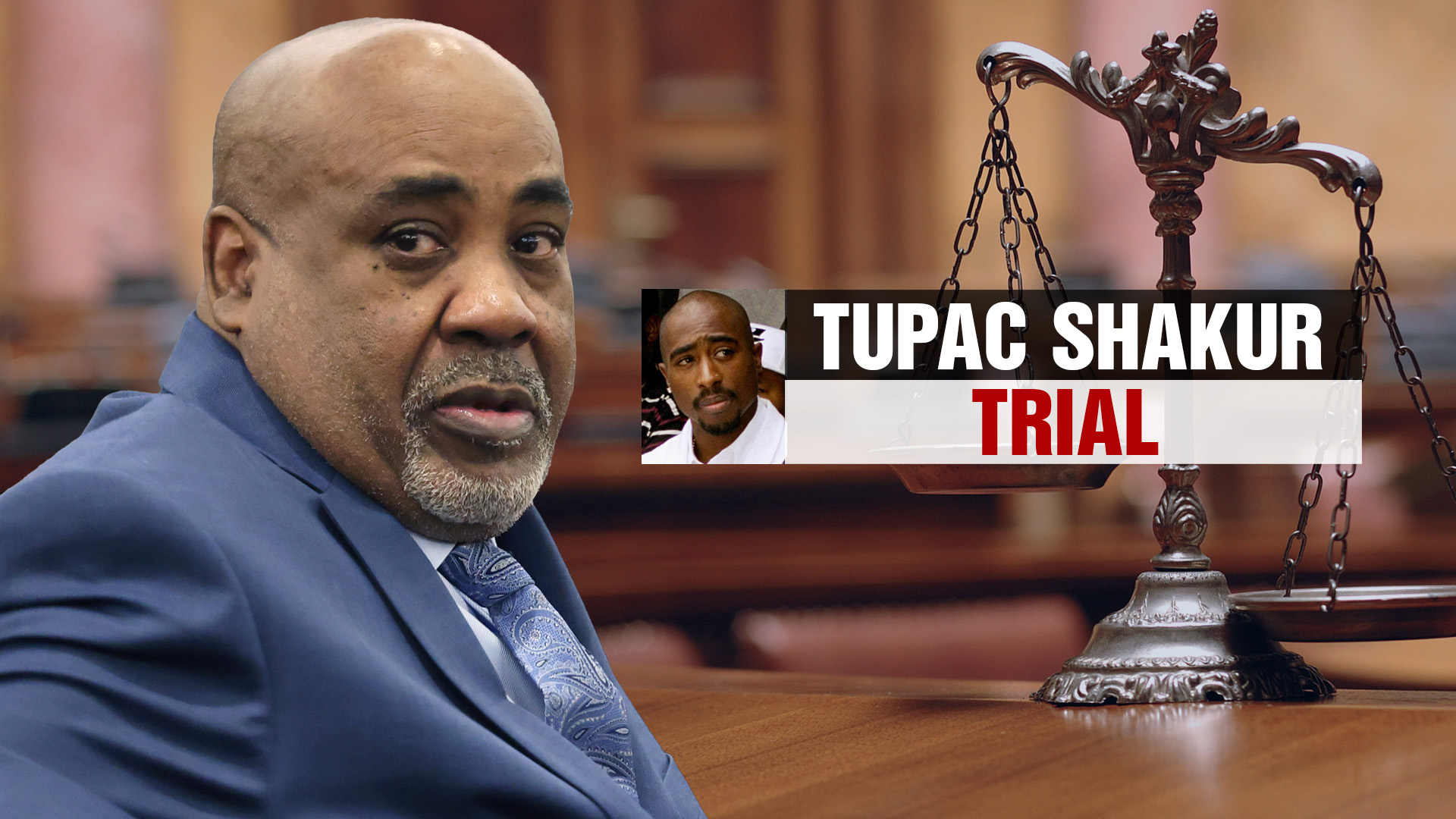
Keffe D's Own Words Become the Evidence: Inside Day 3 of the Tupac Murder Trial
Justice & Reparations
Keffe D's Own Words Become the Evidence: Inside Day 3 of the Tupac Murder Trial
By Grant Keller — Investigative Anchor
August 19, 2026
On day three of Duane "Keffe D" Davis's murder trial, investigators testified to the wide gap between what Davis told the FBI in 1998 and what he volunteered a decade later — a shift from claiming he was in his hotel room all night to describing handing off the gun that killed Tupac Shakur. An unproven allegation tying Sean "Diddy" Combs to a payment for the killing also surfaced in testimony.
Almost thirty years after Tupac Shakur was shot four times on the Las Vegas Strip, someone is finally standing trial for it. Duane "Keffe D" Davis — the man prosecutors say ordered the hit, even though he didn't pull the trigger himself — has been in a Clark County courtroom since Monday, and three days in, the case is already delivering the kind of testimony that turns a three-decade cold case back into a live wire.
Here's where things actually stand.
The case, in brief
Davis, a former Southside Compton Crips figure, was arrested in September 2023 after decades of public statements — interviews, a 2019 memoir — in which he described, with varying levels of detail, his own role in the September 7, 1996 drive-by that killed Shakur. He's pleaded not guilty. Prosecutors' theory is that Davis orchestrated the shooting in retaliation for his nephew, Orlando "Baby Lane" Anderson, being beaten by Shakur and members of Death Row Records' entourage hours earlier at the MGM Grand — and that Anderson, who died in 1998 and was never charged, was the actual shooter.
Day 1 — Monday, August 17: Opening statements and the first eyewitnesses
Chief Deputy District Attorney Binu Palal opened by telling the jury plainly that Davis "did not pull the trigger" — but argued he set the shooting in motion and provided the gun. The defense, led by attorney Michael Sanft, called the state's account "fiction," pointing to missing investigative documents and questioning whether witnesses can be trusted on events from thirty years ago.
The state's first witnesses were law enforcement and bystanders rather than insiders: retired officer Garry Dale, who had stopped Shakur's car for a traffic violation shortly before the shooting, and Detective Brent Becker, who testified about how difficult it was for investigators to get witnesses to talk in the aftermath. Ingrid Stokes, who was near Shakur's vehicle when the shots were fired, described her fear of retaliation for coming forward — a theme that's likely to recur, since the state has reportedly listed 35 to 45 witnesses and expects the trial to run roughly a month.
Day 2 — Tuesday, August 18: The forensic testimony
This was the hardest day in the courtroom by any account. Clark County medical examiner Dr. Lisa Gavin walked the jury through Shakur's autopsy: three bullet wounds, one of which passed through his chest and a lung, causing it to collapse; other rounds damaged his intestines and other organs. Doctors removed the damaged lung trying to save him.
Some of Shakur's family members left the courtroom rather than see the autopsy photos; others stayed. His cousin, Zayd Akinyela, told reporters afterward that hearing the clinical detail actually helped — after thirty years, he said, "you can't really grieve" without understanding exactly what happened. Davis himself reportedly sat still through the testimony, occasionally leaning over to confer with his attorney. Surveillance footage from the MGM Grand showing the earlier altercation was also introduced.
Day 3 — Wednesday, August 19: Keffe D's own shifting story becomes the evidence
Wednesday's session may end up being the most consequential so far, because the witnesses were the investigators who spent years listening to Davis contradict himself. Former FBI Special Agent Wade Lee and retired LAPD Detective Daryn Dupree both testified to the gap between what Davis said in 1998 and what he said a decade later.
In a 1998 interview, Davis claimed he and his nephew Anderson spent the rest of the night in their hotel room after the MGM Grand beating — and he floated a theory that corrupt Compton police officers working for Death Row's Suge Knight might have been behind the shooting. By 2008, his story had changed entirely: in an interview investigators say he volunteered without being asked, Davis said "we did the other one," describing how he'd handed a gun to an associate in the back seat, Dre Smith, who got cold feet — so Anderson took it and fired instead.
Dupree also testified to something prosecutors reportedly told him during the investigation: an allegation that Sean "Diddy" Combs had money delivered to a man named Zip Martin, intended as payment to Davis connected to the murder — and that Davis was sent to New York to meet Martin, though the meeting apparently fell through. It's an explosive claim, and notably it hasn't been established as proven fact in the trial record — it's testimony about what prosecutors told an investigator, not a piece of physical evidence, and it's the kind of thread the defense is likely to attack hard given Combs isn't on trial here.
What to watch next
The prosecution is leaning almost entirely on Davis's own words — the 1998 and 1999 FBI interviews, a 2009 Las Vegas police interview, and his own 2019 memoir — to build a timeline of a confession that got more detailed, not less, the more times he told it. That's a real strength for the state, but it's also exactly where the defense is aiming: thirty years, multiple retellings, and a man who by his own admission lied to investigators at least once. Expect Sanft to spend real time on the 1998-to-2008 gap when cross-examination ramps up.
With 35 to 45 witnesses expected and a trial timeline of about a month, this is still early — Day 3 of what could be Day 20-plus. We'll keep tracking it.
Process This Deeper
Prodigal AI's Story Companion Guide explores the institutional pattern, consciousness framework, community insights, transformation practices, and action opportunities related to this story.
Open the Companion Guide