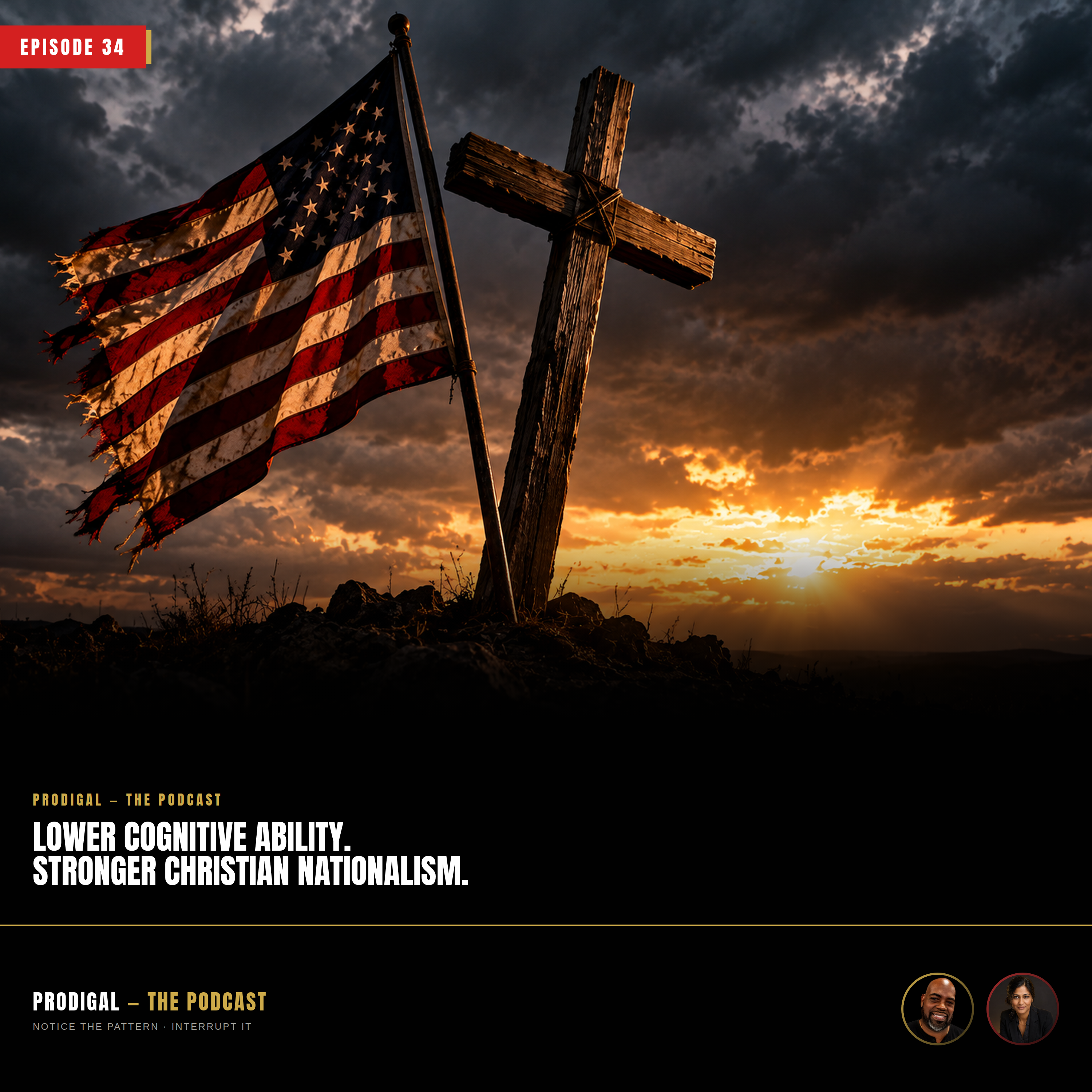
Lower Cognitive Ability Linked to Stronger Christian Nationalism — Here's the Part the Headline Leaves Out
Religion & Power
Lower Cognitive Ability Linked to Stronger Christian Nationalism — Here's the Part the Headline Leaves Out
By Don Jackson | Prodigal Breaking News | prodigalbreakingnews.com
October 3, 2026
A new peer-reviewed study found that people who score lower on a cognitive ability test are significantly more likely to hold Christian nationalist beliefs — and it holds up even after controlling for education. That's the headline everyone's going to share. It's also only half the study: the pattern disappears completely for people who never finished high school, and the researcher's own interpretation isn't "they're dumb" — it's that intelligence doesn't protect anyone from ideology, it just arms whatever side already holds it.
A new peer-reviewed study found something that's about to get repeated everywhere, usually missing its own punchline.
Sociologist Samuel Perry — one of the most cited researchers studying Christian nationalism in the country — just published a study in the Journal for the Scientific Study of Religion with a finding that's exactly as blunt as it sounds: people who score lower on a cognitive ability test are significantly more likely to hold Christian nationalist beliefs. Not a little more likely. Significantly. And it holds up even after controlling for education.
That's the headline everyone's going to share. It's also only half the study.
What Perry Actually Measured
Perry used decades of General Social Survey data — one measure going back to 1996, another going back to 1989 — and a validated ten-word vocabulary test as a proxy for cognitive ability. He tracked two things: how strongly people believe being Christian is required to be "truly American," and how strongly people support state-mandated religious practice, like school prayer.
He controlled for education, religious affiliation, political ideology, income, race, age, and region. The pattern held across all of it. People with lower vocabulary scores were consistently more likely to hold both beliefs — independent of how much school they'd completed.
That's a real finding, from a real researcher, in a real journal. We're not here to soften it.
The Detail That Changes the Story
Here's what the viral version leaves out, and it's not a minor footnote — it restructures the whole finding.
The relationship disappeared entirely for people who never finished high school. It only shows up among people who had at least some formal education. Whatever's actually happening here, it isn't simply "less schooling produces more extreme belief." It's something more specific, happening somewhere inside the system of formal education itself — not outside it.
And Perry is upfront that causality isn't settled. His own words: the correlation could run either direction. Someone who adopts a fundamentalist worldview early could become less engaged with the kind of open-ended reasoning that builds vocabulary and abstract thinking in the first place. The test isn't catching "smart people resist this, dumb people don't." It might be catching something that happens after a worldview is already locked in.
The Sentence That Should Actually Worry You
Buried past the headline is the sentence that matters more than the stat. Perry's interpretation isn't "Christian nationalists are unintelligent." It's that cognitive sophistication doesn't protect anyone from ideology — it just makes people better equipped to defend whatever their in-group already believes. He says this isn't unique to Christian nationalism. More sophisticated reasoners, across ideologies, tend to hold their side's positions more fiercely, not more skeptically.
Read that again. That's not a story about one group being less intelligent. That's a story about intelligence getting rented out to tribal loyalty — in every direction, including yours, including ours.
That's the actual pattern. Not "they're dumb." "Nobody's reasoning is as independent as they think it is, and the smarter you are, the better you get at not noticing."
Why This Still Belongs in the Conversation
None of this makes the original finding less real or less worth talking about. Christian nationalism — the belief that American identity and Christian identity should be fused, backed by the machinery of the state — has measurable, documented effects on law, on education policy, on who gets treated as a "real" American. That's not in dispute, and Perry's broader body of work has been establishing exactly that for years.
What's worth getting right is which pattern we're actually naming. Not "our side has better brains." The harder, more honest pattern: cognitive ability is a tool. Tools don't come with a conscience installed. They get used in service of whatever the user already believes — and the sharper the tool, the more convincingly it gets used.
Notice the pattern. Interrupt it. Including — especially — in yourself.
Sources: Samuel L. Perry, "Cognitive Ability and Christian Nationalism," Journal for the Scientific Study of Religion, 2026, DOI: 10.1111/jssr.70101; PsyPost, "Lower cognitive ability is linked to stronger Christian nationalist views, even after accounting for education" (2026 coverage of the study, including direct researcher quotes).
Process This Deeper
Prodigal AI's Story Companion Guide explores the institutional pattern, consciousness framework, community insights, transformation practices, and action opportunities related to this story.
Open the Companion Guide