The Last Card: Why the Insurrection Act Is Really About November
Politics
The Last Card: Why the Insurrection Act Is Really About November
By Don Jackson | Prodigal Breaking News | prodigalbreakingnews.com
October 2, 2026
Three things are true at once: a war with Iran with no end in sight, the worst approval rating of his presidency, and a president who has now twice threatened to turn the military on American citizens. In 200-plus years, the Insurrection Act has never once been invoked around a federal election — until now it might be.
Three things are true at the same time right now, and none of them are speculation.
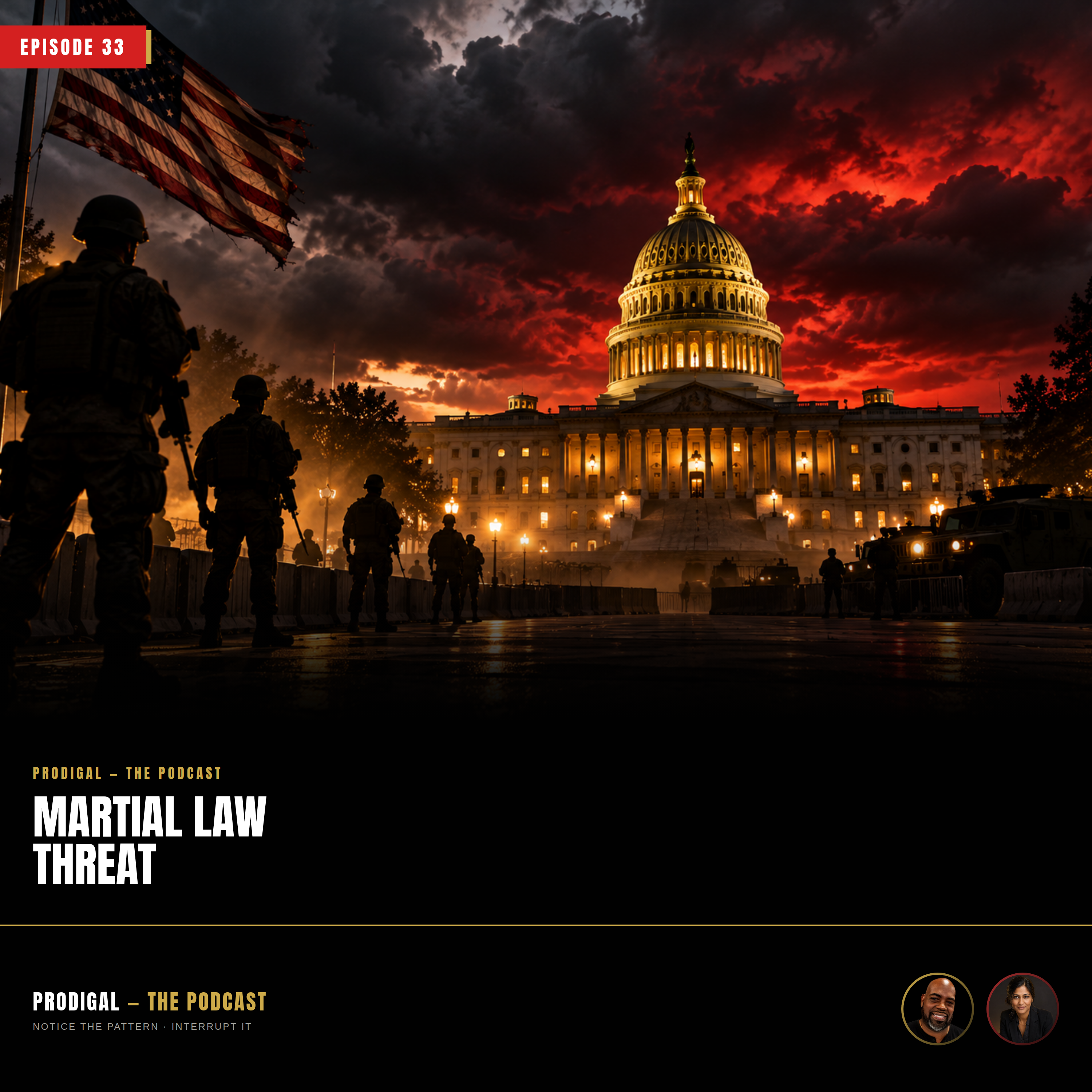
The United States is six months into an active war with Iran, with American strikes continuing as recently as this month. The president's approval rating just hit the lowest point of either of his two terms in the Oval Office. And for the second time this year, he has publicly threatened to invoke the Insurrection Act — the law that lets a president turn the U.S. military loose on American citizens, on American soil.
Taken one at a time, these are three news stories. Taken together, they're a pattern. And the pattern points at one date: November.
The War and the Collapse Are the Same Story
Reuters/Ipsos polling from mid-August put the president's approval at 33 percent, disapproval at 64 percent — the lowest of his combined two terms, and the poll's own analysis ties the decline directly to the escalation with Iran. This isn't a war that quietly faded into the background. U.S. forces hit Iranian targets again in early September, six months into a conflict the administration has shown no interest in ending, with the president vowing more strikes in response to Tehran's retaliation.
A war with no exit and an approval rating in freefall is not a stable position heading into a midterm election. It's a desperate one.
Minneapolis Was the Dry Run
In January, after ICE agents fatally shot 37-year-old Renee Good in Minneapolis and a second shooting followed days later, protests erupted. The president's response, posted directly to Truth Social: "I will institute the INSURRECTION ACT...and quickly put an end to the travesty."
He didn't do it that week. But watch who lined up on which side when he said it. The Lincoln Project — Republicans, not Democrats — called it "the plan all along," warning he intended to "Declare Martial Law. Suspend elections." Illinois Governor JB Pritzker said the Act "should not be used as an excuse to send armed troops into our streets." Minneapolis Mayor Jacob Frey asked for ICE to leave rather than escalate further. And Homeland Security Secretary Kristi Noem didn't walk it back — she defended it as the president's "constitutional authority."
That split is the tell. One side treated the threat as rhetoric. The other side treated it as a plan with a date still to be determined.
This Isn't Just Our Read on It Anymore
By September, the conversation had moved well past this show. NPR reported that election-security experts now fear the president may deploy the National Guard around the midterms. The Hill ran a piece laying out, point by point, why he might invoke the Insurrection Act before, during, or after the election. Multiple outlets reported he has refused to rule out invoking it around the vote, and refused to rule out declaring a state of emergency before Election Day.
When the warning moves from an opinion podcast to NPR's newsroom and a sitting governor's press office, it has stopped being a hot take. It's a documented risk being tracked by people whose job is tracking exactly this.
The Insurrection Act Has Never Once Been Used This Way
Here's what almost nobody is saying out loud: in the full history of the Insurrection Act, it has never been invoked in connection with a federal election. Not once. It's been used to put down Reconstruction-era violence under Grant and Hayes. It's been used to break up railroad and mining strikes under Hayes and Harding. It's been used by Eisenhower, Kennedy, and Johnson to force school desegregation past governors who refused the law. Its last use was the Los Angeles riots in 1992.
Every single one of those was a response to unrest already happening. If this administration invokes it in the window around a federal election — not to respond to a riot already underway, but as a preemptive tool aimed at the vote itself — that would be the first time in the law's entire 200-plus-year history it's been used that way. That's not a pattern repeating. That would be a new and specific escalation, and it's exactly the scenario reporters and election-security experts are now naming out loud.
The Blueprint Was Already Published
None of this requires guessing at hidden intentions, because the plan was printed and distributed in advance. Project 2025, the Heritage Foundation's governing blueprint, calls for reclassifying tens of thousands of career civil servants as political appointees — including the scientists, engineers, and attorneys whose independence is supposed to be the point — and reportedly includes a database built to help replace them with loyalty-pledged replacements. It calls for ending the independence of the FBI and Department of Justice, handing a president the power to direct investigations and prosecutions at whoever he chooses, opponents included. It calls for stripping independence from regulatory agencies like the FTC and SEC. And it's operating in a legal environment reshaped by the Supreme Court's Trump v. United States ruling, which grants a president broad immunity for official acts — removing one of the few remaining checks that might otherwise apply.
A war that won't end. The worst approval numbers of his presidency. A law he's already threatened once and that experts now say he may use again around the vote. And a written plan for what to do with that power once it's consolidated. None of these facts needs embellishing. They are the pattern.
What We Do With That
Here's where this show has always landed, and it isn't despair. An administration that has to consider martial law to survive an election is not a strong administration — it's one that already knows it's losing the argument with the public and is looking for a way around having to accept that. The only thing bigger than a government willing to do that is the organized, sustained force of tens of millions of people who refuse to let it happen: at the ballot box, in the courts, in the streets, in every statehouse, in every precinct, every single time it's tried. That's not a threat. That's math. It's always been bigger than any one administration — they just need enough of us distracted or discouraged to forget it.
We are not powerless in this. We are Source. The same system that extracts and hoards is the system we get to rebuild once it's done extracting — into something that actually distributes what this country produces, instead of funneling it upward into fewer and fewer hands while the machine tells us there isn't enough to go around. There's enough. There has always been enough. What's missing is the will to redistribute it, and that will has to come from outside the people currently holding the power.
When you see something, say something. Document it. Organize around it. Show up for it. That's not a slogan — it's the only thing that has ever actually worked.
Sources: Reuters/Ipsos poll, Aug. 14–17, 2026 (33% approval / 64% disapproval, lowest of Trump's combined two terms); AZPBS Horizon and Nashua Telegraph reporting on continued U.S. strikes on Iran, six months into the conflict (Sept. 2026); Newsweek, "Donald Trump's Insurrection Act Threat Sparks Dire Warnings From Critics" (Jan. 2026, Minneapolis); NPR, "Experts fear Trump may deploy National Guard ahead of elections" (Sept. 23, 2026); The Hill, "Why Trump might invoke the Insurrection Act before, during, or after the midterms"; Yahoo News/Reuters reporting on Trump declining to rule out invoking the Insurrection Act or declaring a state of emergency around the midterms; Wikipedia, "List of invocations of the Insurrection Act" (historical record, 1871–1992); Center for American Progress, "Project 2025: The Plan to Seize Power by Gutting America's System of Checks and Balances."
Process This Deeper
Prodigal AI's Story Companion Guide explores the institutional pattern, consciousness framework, community insights, transformation practices, and action opportunities related to this story.
Open the Companion Guide