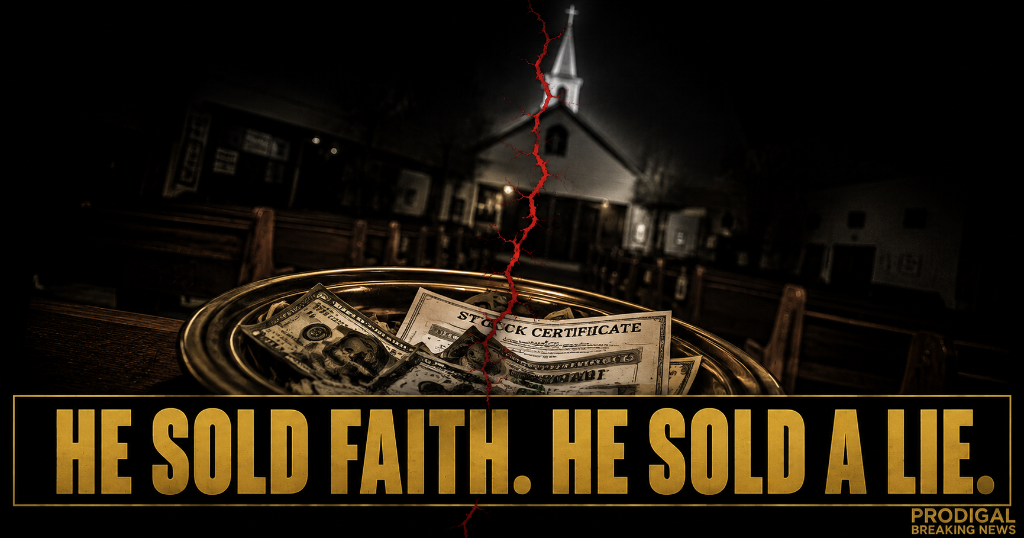
PASTOR RICHARD GARCIA: HE SOLD 50 PEOPLE ON FAITH — AND A FAKE 55% RETURN
Religion & Power
PASTOR RICHARD GARCIA: HE SOLD 50 PEOPLE ON FAITH — AND A FAKE 55% RETURN
By Grant Keller — Investigative Anchor
August 4, 2026
A federal grand jury indicted 53-year-old Richard Reinaldo Garcia, senior pastor of Garcia Church in Arlington, Texas, on wire fraud, conspiracy, and aggravated identity theft charges, accusing him of defrauding more than 50 investors of over $3.2 million between 2021 and 2025 through fake church-renovation and "Christian concert" investment pitches. His trial is scheduled for October 13, 2026.
THE SURFACE STORY
A federal grand jury in the Northern District of Texas has indicted 53-year-old Richard Reinaldo Garcia, senior pastor of Garcia Church in Arlington, Texas, on charges of wire fraud, conspiracy, and aggravated identity theft. The indictment, unsealed in mid-July 2026, accuses Garcia of defrauding more than 50 investors of over $3.2 million between 2021 and 2025 through a series of fake investment pitches marketed inside his own congregation.
According to federal prosecutors, Garcia solicited funds from church members and others under the guise of two recurring pitches: church-renovation projects that never broke ground, and "Christian concert" events that never took place. Investors were promised returns as high as 55% — a number that, in any legitimate financial context, would have been a red flag the size of a church steeple. In a sanctuary, framed as a blessing, it read as a promise.
The government alleges Garcia used the money not for renovations or concerts but for personal expenses and to pay earlier investors in a pattern consistent with a Ponzi-style scheme. The aggravated identity theft counts indicate prosecutors believe Garcia used other people's identifying information without consent — meaning some of the people whose names appear on documents in this case may not have known they were involved until the FBI told them.
His trial is scheduled for October 13, 2026. He has not yet been convicted. The charges are accusations, and Garcia is entitled to the presumption of innocence until a jury says otherwise. But the structure of the allegation — a pastor, a pulpit, a promised return, and a congregation that paid — is the part worth examining, because it is the part that keeps repeating.
THE PATTERN
This is not a story about one pastor in one church in Arlington, Texas. This is a story about the architecture of trust inside religious institutions, and about what happens when that architecture is repurposed as a sales channel for fraud.
Notice the mechanism. The pitch was not delivered in a boardroom. It was delivered in a sanctuary. The promised return was not framed as an investment yield. It was framed as a blessing. The investors were not clients. They were congregants. Every element of the transaction was wrapped in the language and social fabric of faith — the one context in which people are explicitly taught to give without demanding a receipt, to trust without verifying, and to treat skepticism as a spiritual failure. That is not a bug in the system. That is the system. And when a pastor chooses to exploit it, the system does not need to be broken for the fraud to work. It only needs to function exactly as designed.
The 55% return is the tell. No legitimate investment product offers a guaranteed return of more than half your principal. The number is absurd on its face. But inside a church, framed as a divine multiplication, the absurdity is the point. A 55% return sounds like a miracle, and miracles are the category of outcome congregants have already been trained to expect. The fraud does not require the victim to suspend disbelief. It requires the victim to apply the exact same faith they bring to the altar — to the offering plate. The scheme works because the congregation is already practicing the muscle the scheme needs: give first, ask questions never.
And notice the identity theft. The aggravated identity theft counts are the part of this story that extends beyond the congregation. Garcia is accused not only of taking his members' money but of using other people's names — potentially without their knowledge — to construct the appearance of legitimacy around the scheme. This is the second pattern: the fraud does not stay inside the room where it was pitched. It spreads. It requires documents, signatures, names, identities — and when the pastor is willing to forge those, the circle of victims expands past the congregation into people who never set foot in Garcia Church.
WHAT THIS REVEALS
This story reveals how religious authority functions, in practice, as an unregulated financial intermediary. A pastor who solicits investments from the pulpit is operating as an unlicensed broker-dealer whose sales floor is a tax-exempt sanctuary. The same architecture that makes a church effective at collecting tithes — trust, hierarchy, social pressure, the moral weight of giving — makes it effective at collecting fraudulent investments. There is no structural difference between the offering plate and the pitch deck once the pastor decides to use one for the other. The IRS does not audit the sermon. The SEC does not sit in the pew. The gap between the two is where the scheme lives.
It also reveals the cost of the presumption of faith. Congregations are taught that doubt is a spiritual deficiency. Financial fraud inside a church relies on that teaching being internalized before the pitch is made. The victim who asks for a prospectus is not just a cautious investor — in the social economy of the church, they are a bad Christian. That social cost is the enforcement mechanism. It is what keeps the 55% return from being laughed out of the room. It is what keeps the renovation that never breaks ground from being questioned for three years. The fraud is not a failure of faith. It is a weaponization of faith.
And it reveals the role of the pulpit as an unaccountable platform. A pastor who stands in front of a congregation on Sunday and solicits money on Tuesday is using the moral authority of the first to shield the financial conduct of the second. When that authority is exploited, the congregation has no internal mechanism to detect it — because the same authority that is being abused is the authority they would need to invoke to challenge it. You cannot question the man who tells you questioning is a sin. That circularity is not an accident of church governance. It is the design.
MOVEMENT SIGN-OFF
Prodigal does not cover this story to tell you whether Richard Garcia is guilty. A jury will decide that on October 13, 2026. We cover it to show you that the structure of the allegation — a pastor, a pulpit, a promised return, a congregation that paid — is a structure that has produced the same outcome in church after church, decade after decade, and that the structure is the problem, not the man.
Notice the pattern. The offering plate became a pitch deck. The blessing became a return. The congregation became a client base. The pulpit became a sales floor. And the faith that was supposed to protect the people in the pews became the mechanism used to take their money.
The question is not whether this pastor is a fraud. The question is why the architecture of the modern church makes this kind of fraud not just possible but repeatable — and what it would take to build a congregation where a 55% return from the pulpit would be met, not with a check, but with a question.
Notice the pattern. Then notice who is standing between you and the answer.
— Grant Keller, Investigative Anchor, Prodigal Breaking News
Process This Deeper
Prodigal AI's Story Companion Guide explores the institutional pattern, consciousness framework, community insights, transformation practices, and action opportunities related to this story.
Open the Companion Guide