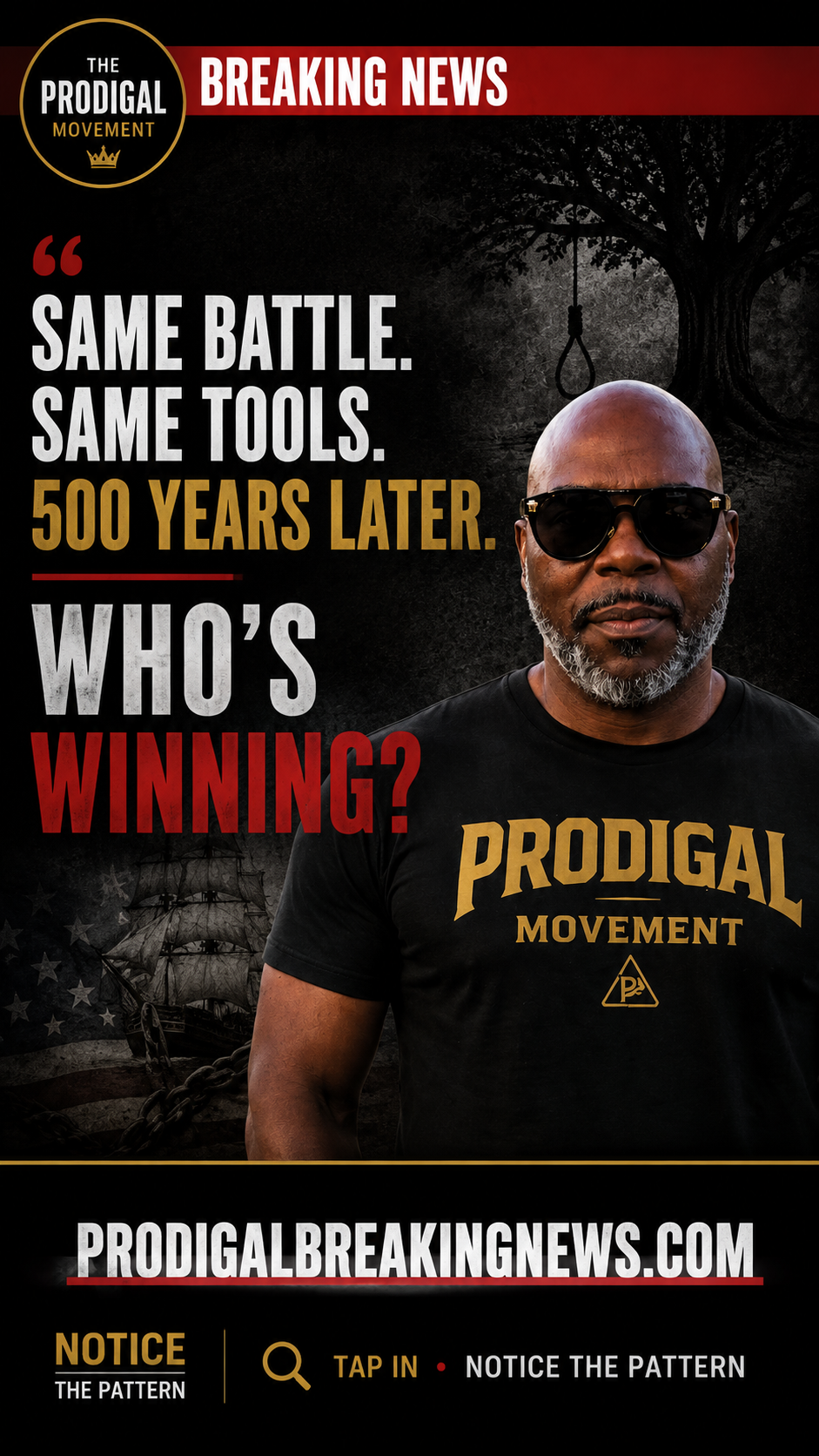
SAME BATTLE. SAME TOOLS. 500 YEARS LATER. WHO'S WINNING?
WHO'S WINNING?
Same Battle. Same Tools. 500 Years Later. Who's Winning?
By DON JACKSON — Founder & Host
August 23, 2026
A historically-grounded deep dive tracing how Christianity was deliberately edited and weaponized to control enslaved people — centered on the real, museum-documented 1807 "Slave Bible" — how that architecture of obedience still echoes today, and how the same tradition also produced its own resistance, from Hush Harbor worship to the founding of the AME Church.
Same Battle. Same Tools. 500 Years Later. Who's Winning?
The Surface Story
There is a book. It's real. It's in a museum.
It's called the "Slave Bible," published in 1807, and it was printed specifically for use on plantations in the British West Indies. It is a Bible with the inconvenient parts cut out. The Exodus — gone. The deliverance of an enslaved people — gone. Moses leading Israel out of bondage — gone. Anything that might give a human being in chains the idea that God hears the oppressed and moves against the oppressor — edited out.
What was left was a Bible built for obedience. "Servants, obey your masters." "Be subject to the governing authorities." The verses that could be bent toward control were kept. The verses that could be bent toward freedom were removed. This was not an accident. It was an architecture.
And it worked. For generations, the version of Christianity handed to enslaved Black people in this country was a version engineered to produce compliance. The same faith that was used to break them was also — and this is the part the story usually leaves out — the faith they turned into a weapon of their own.
The Pattern
The pattern is this: the tool of control and the tool of resistance are often the same tool. The Slave Bible was built to make enslaved people obedient. But the people it was meant to break took the parts that were left — the Exodus they were denied, the God of the oppressed they were never supposed to find — and rebuilt the forbidden story in secret.
Hush Harbors were the first response. In the woods, at night, out of earshot of the enslaver, enslaved people gathered to preach the Gospel the Slave Bible tried to erase — the God who hears the cry of the captive, the God who brings down Pharaoh. The very tradition weaponized against them became the tradition they used to survive.
The second response was institutional. The African Methodist Episcopal Church, founded in 1816 by Richard Allen, was the first independent Black denomination in the United States — built because Black Christians were not allowed to worship as equals in white churches. The AME Church took the weaponized faith and turned it into an institution Black people controlled. The pattern repeats across history: the oppressor hands you a tool meant to keep you still, and you learn to use it to move.
This is not a story about Christianity being good or bad. It's a story about a tool. A tool is neutral. The architecture around it is not. The Slave Bible was an architecture of obedience. The Hush Harbor was an architecture of resistance. Same text. Different architecture. Different outcome.
What This Reveals
What this reveals is that the battle was never really about the Bible. The battle was about who got to decide what the Bible meant — which verses were read aloud, which were cut, which were preached, which were forbidden. Control the selection and you control the meaning. Control the meaning and you control the people.
That architecture didn't end in 1807. It evolved. The same instinct — curate the text, curate the meaning, curate the obedience — shows up wherever power meets faith and decides to make faith useful. The verses that justify hierarchy get amplified. The verses that threaten hierarchy get quieted. The pattern is 500 years old and it is still running.
But here's the other thing the pattern reveals: the resistance is also 500 years old, and it is also still running. Every time the architecture tried to lock the meaning down, somebody built a Hush Harbor. Every time the institution tried to gatekeep the faith, somebody founded an AME Church. The tool of control keeps getting handed down. The tool of resistance keeps getting picked back up.
The question "Who's winning?" is the wrong question, because the battle isn't over. The right question is: which architecture are you standing in right now — the one built to keep you obedient, or the one built to set you free? Because both are still standing. Both are still open. And both are still using the same text.
The Movement Sign-Off
Same battle. Same tools. 500 years later. The Slave Bible tried to edit freedom out of the faith. The Hush Harbor preached it back in. The AME Church institutionalized it. The pattern didn't end — it just changed shape.
Notice the architecture you're standing in. If it's telling you to obey and be still, it's the old one. If it's telling you that the God of the Exodus is still the God of the Exodus, it's the one your ancestors built in the woods at midnight, out of earshot of anyone who meant to keep them quiet.
Same battle. Same tools. The question was never who's winning. The question is which side of the tool you're holding.
Process This Deeper
Prodigal AI's Story Companion Guide explores the institutional pattern, consciousness framework, community insights, transformation practices, and action opportunities related to this story.
Open the Companion Guide