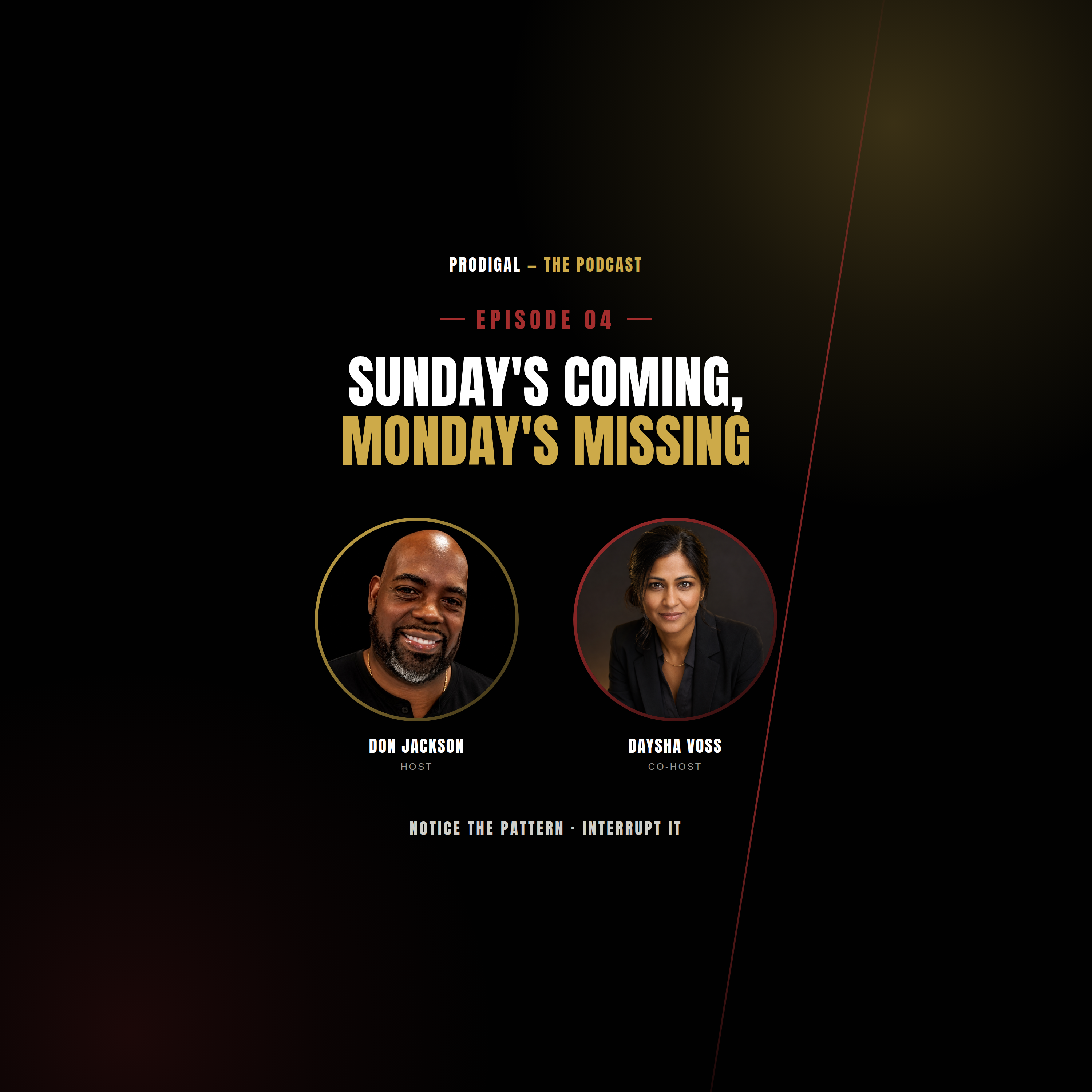
Sunday's Coming, Monday's Missing: The Fifty-Year Head Start Nobody Wants to Talk About
Religion & Power
Sunday's Coming, Monday's Missing: The Fifty-Year Head Start Nobody Wants to Talk About
By By Don Jackson | Prodigal Breaking News
September 4, 2026
Every Sunday, a nation gathers inside a nation — 7.5 million members under one Black denomination alone. Meanwhile, a fifty-year-old think tank an hour from the National Mall has been writing the other side's agenda since 1973. This piece sits with the uncomfortable question: what has our consistency built that is still standing, still compounding, and still training the next generation?
Sunday's Coming, Monday's Missing: The Fifty-Year Head Start Nobody Wants to Talk About
Every Sunday, in nearly every city in this country, a nation gathers inside a nation.
Under the National Baptist Convention, USA, Inc. alone, there are roughly 30,000 congregations and 7.5 million members — and that's one denomination, out of at least seven historically Black traditions in America. Pew Research's 2023–24 Religious Landscape Study puts real numbers on the scale of the whole: 71% of Black American adults identify as Christian, and within that, "Historically Black Protestant" traditions are the single largest category at 44% — bigger than Evangelical Protestant (15%), Mainline Protestant (6%), and Catholic (4%) combined. A full quarter of all Black adults in America identify specifically with the Baptist tradition. Add the AME (roughly 3.5 million members), the AME Zion (over 1.2 million), the CME (3,000-plus churches), the Church of God in Christ (5.5 million members), and the roughly 3,500 majority-Black congregations inside the United Methodist Church, and you are not looking at a religious minority. You are looking at one of the largest, most consistent, most disciplined mass gatherings of people in the history of this country — assembled, same time, same place, every single week, for over a hundred years.
So here is the question this piece exists to sit with, uncomfortably, on purpose: what has that consistency built that is still standing, still compounding, and still training the next generation, the way a fifty-year-old think tank an hour from the National Mall still is?
Because that think tank exists. And its receipts are public record.
THE FIFTY-YEAR MACHINE
In 1973, two men — Edwin Feulner and Paul Weyrich — founded the Heritage Foundation. Not a church, not a movement, not a rally. A think tank, built with a single, patient purpose: have the policy already written before the politician needs it.
That's not a metaphor. It's the literal operating model. In 1981, Heritage's "Mandate for Leadership" became the operational blueprint for the incoming Reagan administration. Forty-two years later, in 2023, Heritage published the sequel — "Mandate for Leadership: The Conservative Promise" — and that document became Project 2025.
Here's what that machine looks like today, in dollars, from its own most recent public tax filings: in fiscal year 2024, the Heritage Foundation reported $133.9 million in revenue and $142.2 million in total expenses, sitting on $333.6 million in net assets — institutional wealth built up over five decades of continuous operation. The year before, 2023, it pulled in just over $101 million. This is not a scrappy operation running on passion and prayer. This is a permanent, professionally staffed, continuously funded institution that has now outlived its own founders and is still writing the agenda.
Fifty years. Same organization. Still the blueprint.
THE SECOND MACHINE, BUILT IN A THIRD OF THE TIME
If Heritage is the patient, decades-long build, Turning Point USA is proof of how fast the same model moves once it's copied.
Founded in 2012, Turning Point USA raised $389 million total between its founding and mid-2023 — starting from just $79,000 in its first year. By 2022, it was pulling in $80 million annually. By 2024, that number had climbed to $85 million in revenue for the year alone, a 142% increase over five years, with 99.2% of that money coming from charitable contributions and roughly 350,000 small-dollar donors feeding the pipeline.
And the institution isn't just raising money — it's building permanent infrastructure inside the American education system. Over 1,000 TPUSA chapters are already placed inside U.S. high schools, with a 48-person staff whose sole job is expansion. Founder Charlie Kirk went further, launching Turning Point Academy, a private school network built explicitly to operate outside the public system entirely.
Then, in September 2025, Kirk was killed. What happened next is the part that should stop you cold, regardless of how you feel about the man or his politics: within 48 hours, Turning Point reported over 32,000 inquiries from people wanting to start new chapters. Within days, organizational reporting put the total north of 54,000 inquiries. Texas and Oklahoma both launched statewide plans to place a TPUSA chapter in every public high school in the state. The U.S. Department of Education announced it would partner directly with the organization on educational programming.
Sit with that. A grief event — a real death, a real tragedy, no punchline in either direction — became a recruitment surge measured in tens of thousands of new local chapters in a matter of days. That's not an accident of virality. That's what happens when the underlying institutional architecture is already built to receive and channel that energy the moment it arrives. The machine didn't have to improvise. It just had to open the intake form.
WHAT THE OTHER SIDE OF THE LEDGER ACTUALLY LOOKS LIKE
Here's where this piece has to slow down and be honest, because "gut-punch" and "accurate" both matter, and one of the most-repeated numbers in this conversation does not hold up.
You have probably seen the claim that Black churches have collected $420 billion in tithes and offerings since 1980. It shows up constantly in social commentary, and it traces back to a "LiveSteez research" figure cited in a mid-2010s investigative piece — one that, by its own framing, presented the number as the starting point for an investigation, not a confirmed total. Nobody has produced the underlying methodology, and no credible follow-up has verified it. Repeating it as fact would be doing exactly what this piece is trying to hold institutions accountable for: stating a number because it feels true, not because it's been shown to be true.
What is documented: researcher Henry E. Felder calculated Black church per-capita giving at roughly $508 per year in 2009 dollars. Separately, Tyler Media Services estimated total Black church revenue at approximately $17 billion for the year 2006. That figure is nearly two decades old and almost certainly understates today's number — but even taking it as a conservative floor, it describes an annual river of resources in the tens of billions of dollars, arriving with the same reliability as Sunday morning, every year, for generations. For scale: total U.S. church giving across all denominations combined has been documented at over $50 billion a year.
The honest version of the question is not "where did $420 billion go." It's this: whatever the real number is — and by any credible estimate it is a great deal of money, moving with total predictability, decade after decade — where is the fifty-year think tank it built? Where is the standing legal defense fund, still active, still training new lawyers, the way Heritage has trained three generations of policy writers? The absence of an answer is the finding.
WE HAVE DONE THIS BEFORE — AND IT WAS TAKEN FROM US
The fair pushback to all of this is: Black America has built durable institutions before. That's true, and it deserves its full weight, not a dismissive footnote.
Between 1888 and 1930, Black communities organized and operated over 100 Black-owned banks, alongside thousands of other Black-owned financial institutions, insurance companies, and mutual aid societies. Tulsa's Greenwood District — Black Wall Street — was the most famous expression of that build: by 1921, it held 191 documented Black-owned businesses inside a 35-block district generating enough independent wealth that a dollar was said to circulate within the community dozens of times before leaving it.
On June 1, 1921, a white mob burned it to the ground. Over 1,000 homes destroyed. The entire business district leveled. The New York Times' original accounting put the property loss at $1.8 million in 1921 dollars — which a simple inflation calculator renders as $27 million today. But economic historians at MeasuringWorth argue that comparison badly understates the real damage, because a straight inflation adjustment ignores how much larger the economy — and Greenwood's relative share of Black economic activity — actually was. Using an output-based method that accounts for the destroyed district's true economic weight, the same loss is valued at roughly $534 million in today's terms.
It took 104 years for any formal reckoning to arrive. In 2025, Tulsa's mayor announced a $105 million trust — split across housing, cultural preservation, and a legacy land fund — to begin addressing the impact. Notice the math: the institutional response, over a full century later, is still smaller than the low-end inflation-adjusted value of what was destroyed in a single day in 1921.
And Greenwood wasn't an isolated wound — it was a preview. That peak of 100-plus Black-owned banks didn't hold. The number of Black-owned financial institutions declined by more than 50% between 2001 and 2018 alone. As of recent counts, only 21 Black-owned banks remain in the entire United States.
This is the piece that changes the whole conversation: the failure to build a lasting institutional counterweight isn't proof that the will or the capability was never there. It's proof that every time it was there, at scale, it became a target — and that the rebuilding since has never been resourced at anywhere close to the level of what was taken, or at the level the other side has been patiently, continuously funding itself for fifty straight years.
THE HYPOCRISY STACK
None of this is an argument that the church itself is the enemy, or that faith is the problem. It's an argument about priority and nerve.
The same pulpit that will spend forty-five minutes on somebody's sexuality will spend four minutes, if that, on a man killed in the street by somebody wearing a badge. More outrage gets spent on who somebody loves than on who's dying. That's not a coincidence of scheduling — it's a measure of what feels safe to confront versus what doesn't. It is easier, and lower-risk, to police your neighbor from the pulpit than it is to name power from it. Heritage Foundation staff don't spend their fifty years litigating each other's personal lives. They spend it building outward, at power, without flinching, year after year, regardless of who's watching.
THE ACTUALIZATION
This isn't a "burn it all down" piece, and it was never going to be one. It's a "wake up" piece.
Before anything gets built on the outside, there's work to do on the inside — deconstructing what colonization and what the master's house taught an entire people to believe about themselves. Not that we needed saving from somewhere outside ourselves. Not that we were ever broken, waiting on rescue. We were always Source. That's not a metaphor to make you feel better — it's a memory that got buried under three hundred years of somebody else's story about who gets to build and who's just supposed to show up and be grateful.
Part of remembering it means actualizing the feminine — the creative, intuitive, nurturing force that held communities and economies together long before anyone's colonizer showed up on this continent. That's not separate from institution-building. It's the engine underneath it.
But a vision, on its own, has never moved a single brick. The work now is turning the imagining into the actual: the land purchase. The school. The fund that outlives the person who started it. The legal defense apparatus that's still standing in fifty years, the way Heritage's is right now. The organizing meeting nobody wants to sit through but everybody needs to be at.
On one accord — because that's the only way change actually reaches the system, and the environment, and everything outside of us. It starts within. You go within first. Then your family catches it. Then your community catches it. And it moves outward from there until it touches everything it was always meant to reach.
Notice the pattern. Interrupt it. Then build something they can't take back down — and this time, fund it like you intend to still be standing in fifty years, because the other side already is.
Process This Deeper
Prodigal AI's Story Companion Guide explores the institutional pattern, consciousness framework, community insights, transformation practices, and action opportunities related to this story.
Open the Companion Guide