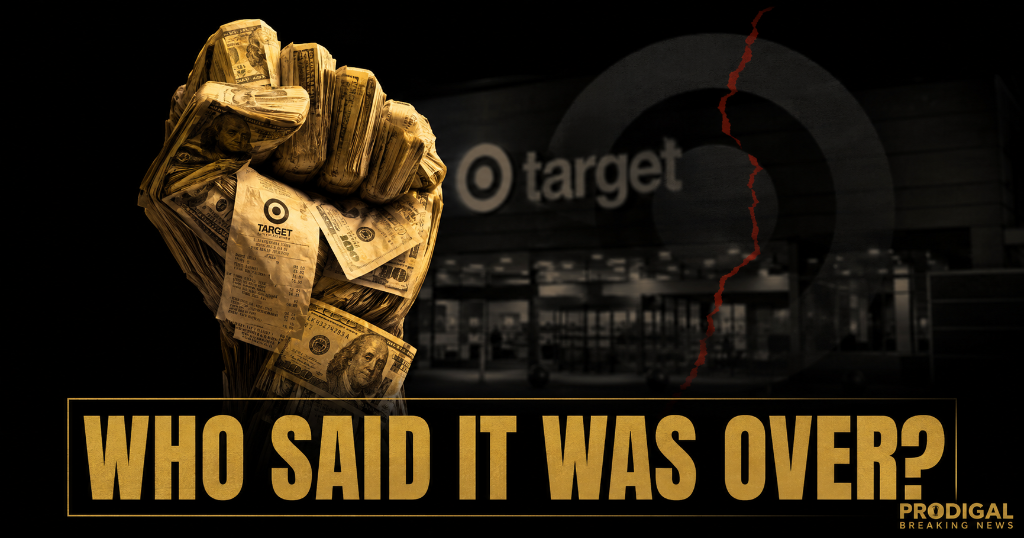
THE TARGET BOYCOTT "ENDED" IN MARCH. A LOT OF BLACK WOMEN NEVER STOPPED.
Culture & Resistance
THE TARGET BOYCOTT "ENDED" IN MARCH. A LOT OF BLACK WOMEN NEVER STOPPED.
By Dre Essence — Culture & Resistance Anchor
August 4, 2026
The year-long "Target Fast" boycott officially ended in March 2026 after Target agreed to honor a $2 billion commitment to Black-owned businesses, and its stock had already dropped roughly 30% in 2025. But many Black women and independent faith leaders never stopped boycotting individually, Black Target employees report ongoing layoffs and reduced hours, and August's arrival as National Black Business Month is renewing the question of whether the "win" actually changed anything.
THE SURFACE STORY
The "Target Fast" — the year-long boycott launched in early 2025 after Target rolled back its DEI commitments — officially ended in March 2026. The organizers declared victory: Target had agreed to honor a $2 billion commitment to Black-owned businesses, and the company's stock had already dropped roughly 30% over the course of 2025. By the metrics the campaign set for itself, it worked.
But a lot of Black women never stopped.
In the months since the official "win," a quieter, leaderless continuation of the boycott has kept going — not as a campaign, but as a practice. Individual shoppers, many of them Black women, have simply not returned. Independent faith leaders who never joined the formal organizing effort have continued to tell their congregations to spend elsewhere. There is no press release announcing this. There is no coalition. There is no end date. There is just a growing number of people who decided, on their own, that the question was never whether Target met a commitment — it was whether Target was a place they wanted to give their money at all.
Meanwhile, inside the stores, the picture is different. Black Target employees report ongoing layoffs, reduced hours, and the kind of schedule cuts that precede a quiet exit. The same company that announced a $2 billion commitment to Black-owned businesses on the outside is reducing the hours of Black workers on the inside. The boycott, for the customer, may be over. For the employee, it never stopped costing.
And now August has arrived — National Black Business Month — and with it a renewed question: did the "win" actually change anything? If the commitment was honored, why are the workers still being cut? If the stock recovered, why did the shoppers never come back? If the campaign ended, why does the practice continue?
THE PATTERN
This is not a story about Target. This is a story about the difference between a campaign and a practice — and about what happens when a movement wins on paper but loses in the body.
Notice the structure. The official boycott had a demand, a target, a metric, and an end date. When the demand was met, the campaign ended. That is how campaigns work. But the people inside the campaign were never only inside the campaign. They were also inside a relationship with a company they had decided to stop trusting — and that relationship does not end when a press release says it does. The practice of not shopping at Target became, for many, a habit. And a habit does not require an organization to sustain it. It only requires a decision, made once, and then honored every day after.
This is the pattern of the post-campaign era. The organizers declare victory and go home. The participants keep going — not because they did not hear the victory, but because the victory did not address the reason they joined. The $2 billion commitment was a metric. The reason was a feeling: that a company that had promised to see them had decided not to. A commitment to Black-owned businesses does not undo a rollback of DEI. It does not restore the trust that was broken when the rollback happened. And so the practice continues, quietly, in the absence of any organization asking it to.
And notice the workers. The Black employees inside Target are the part of this story that the campaign metrics never measured. The boycott counted stock price, commitment dollars, and public statements. It did not count hours, shifts, or layoffs. So when Target honors a $2 billion commitment to Black-owned businesses while cutting the hours of Black workers, it is not contradicting itself. It is operating on two separate tracks — the public track of commitments and the private track of labor — and only one of those tracks was ever under pressure. The boycott moved the public track. It did not touch the private one. That is why the workers are still being cut while the commitment is being celebrated.
And notice the timing. August is Black Business Month. The month is not a coincidence. It is the moment when the question of where Black money goes becomes, for a few weeks, a national conversation. The continuation of the Target boycott — the quiet, leaderless, unorganized practice of not returning — is the part of that conversation that does not have a spokesperson. It is the part that happens in the car, in the parking lot, in the decision to drive past one store to get to another. It is the part that cannot be negotiated with, because there is no one to negotiate with. You cannot end a practice by meeting a demand. You can only end a practice by changing a relationship. And Target has not changed the relationship. It has only met the demand.
WHAT THIS REVEALS
This story reveals the limit of the campaign model. A campaign is designed to be winnable — which means it is designed to be endable. It sets a metric, meets the metric, and declares victory. But the conditions that produced the campaign — distrust, betrayal, the lived experience of being seen and then unseen by a corporation — do not end when the metric is met. They end when the relationship changes. And a relationship cannot be changed by a commitment alone. It can only be changed by conduct. Target made a commitment. It has not changed its conduct toward the workers inside its stores. So the relationship has not changed. And the practice — the quiet, unorganized, unending practice of not returning — continues.
It also reveals the split between Black capital and Black labor inside the same corporate accountability frame. The $2 billion commitment flows to Black-owned businesses — entrepreneurs, suppliers, vendors. The layoffs and hour cuts fall on Black workers — employees, hourly staff, people who do not own the business. These are two different groups of people, and a framework that celebrates the first while ignoring the second is not a framework of accountability. It is a framework of optics. The boycott, in its official form, won for Black capital. It did not win for Black labor. And the people who noticed are the people who are still not shopping — and the people who are still losing hours.
And it reveals the emergence of the post-organizational movement. The continuation of the Target boycott is not organized. It has no leaders, no demands, no end date, no coalition. It is a practice sustained by individual decision. This is the part of the movement that cannot be negotiated with, because there is no one at the table. A corporation can meet with organizers. It cannot meet with a habit. The only way to end a habit is to give the person holding it a reason to stop — and that reason, for a lot of Black women, is not a commitment. It is a change in how they are treated, as shoppers and as workers, every time they walk through the door. That change has not happened. So the habit has not broken.
MOVEMENT SIGN-OFF
Prodigal does not cover this story to tell you whether the Target boycott was a success. By its own metrics, it was. We cover it to show you that the metrics measured the campaign and missed the practice — and that the practice is the part that is still going, in parking lots and checkout lines and the quiet decisions of Black women who were never asked to stop and never decided to start again.
Notice the pattern. The campaign ended. The practice did not. The commitment was made. The conduct did not change. The stock was measured. The hours were not. And the people who were supposed to be the beneficiaries of the win are the same people who are still being cut inside the stores that were supposed to be held accountable.
The question is not whether the boycott worked. The question is what "working" means when the metric is a commitment and the experience is a layoff. Black Business Month is the moment to ask it. The answer, for a lot of people, is already being lived — in the car that drives past the Target, in the shift that gets cut, in the practice that has no end date because no one gave it a beginning.
Notice the pattern. Then notice who is still inside the store when everyone else has left.
— Dre Essence, Culture & Resistance Anchor, Prodigal Breaking News
Process This Deeper
Prodigal AI's Story Companion Guide explores the institutional pattern, consciousness framework, community insights, transformation practices, and action opportunities related to this story.
Open the Companion Guide