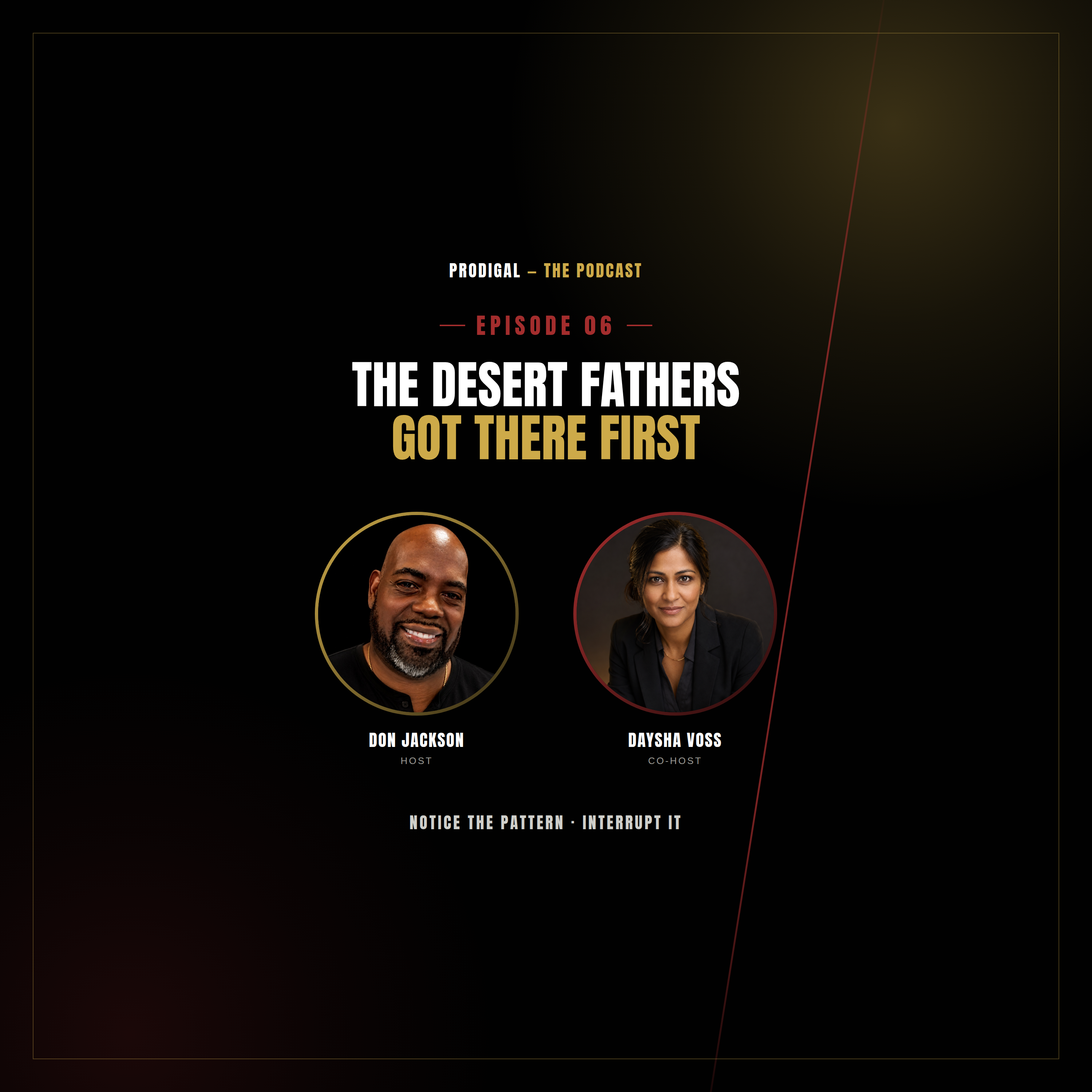
THE DESERT FATHERS GOT THERE FIRST
What They Erase About Who Taught the World to Look Within
The Desert Fathers Got There First: What They Erase About Who Actually Taught the World to Look Within
By Don Jackson | Prodigal Breaking News | prodigalbreakingnews.com
September 9, 2026
A Prodigal Breaking News Deep Dive — companion piece to Episode 6 of Prodigal — The Podcast. The contemplative tradition being sold back to you as a hidden discovery was built, disciplined, and passed down by African Christians a thousand-plus years before anyone monetized it into a subscribe button.
🎧 Listen to the full episode on Substack: The Desert Fathers Got There First
There's a claim moving through timelines and group chats right now: everything you were taught about Jesus is only the surface, and underneath it is a hidden teaching about consciousness itself — one that's been misunderstood, simplified, and in many cases forgotten. It strings together real names — Elaine Pagels, Carl Jung, Meister Eckhart, Alan Watts, Krishnamurti — to build the case that Jesus wasn't founding a religion at all, but pointing people toward an inner awakening. And it almost always ends the same way: subscribe, like, comment, before the argument's even finished.
Here's what this piece needs to say up front: there is something real being pointed at. Contemplative, inward-looking Christianity is not a myth. But the story of who actually built it, and who's currently selling it back to you as a discovery, is where the truth-telling has to start — same as it did with Neville Goddard.
What This Claim Gets Right — and Where It Quietly Overreaches
Elaine Pagels is a real, serious scholar. Her 1979 book The Gnostic Gospels won the National Book Award, and it does argue that some early Christian communities emphasized gnosis — direct, experiential inner knowing — over doctrine and obedience. That part is fair.
What doesn't get said is that this reading comes largely from Gnostic texts written in the second through fourth centuries — a hundred-plus years after Jesus, often further from the historical record than the four canonical gospels. Presenting "Jesus was secretly teaching consciousness, not religion" as an uncovered fact skips over an entire field of scholarship. Mainstream historical-Jesus research — the work of scholars like Bart Ehrman — has long argued that the Jesus of history was most likely a Jewish apocalyptic prophet, someone who believed an actual, imminent Kingdom of God was about to break into the world, not a teacher of individual nondual awareness. That's not a fringe objection. It's closer to the scholarly center of gravity than the claim lets on. (Bart Ehrman — Jesus: Apocalyptic Prophet of the New Millennium)
None of that makes the "inner knowing" reading worthless. It means one side of a real, unresolved argument keeps getting presented as if the debate is already over.
The Translation Trick: "Within You" Isn't as Settled as You're Told
The whole argument leans hard on one line — "the kingdom of God is within you" — as if it's a plain, literal statement about individual consciousness. It's translated from a Greek phrase, entos hymōn (Luke 17:21), and biblical scholars have argued over it for a long time. Most modern translations actually favor "among you" or "in your midst" — a claim about Jesus's presence in a community, not a statement about a private inner dimension. Serious scholars still defend "within you," including the translator David Bentley Hart — but this is a live, genuine disagreement, not settled ground. (Richard Beck — The Kingdom of God is Within You)
That matters, because a contested translation keeps getting treated as if it were an obvious hidden meaning nobody else caught. That's not revelation. That's cherry-picking.
The Neuroscience Oversell
Then comes the science flex: mirror neurons, offered up to back the idea that we're biologically "wired to resonate with the experiences of others" — scientific proof, supposedly, of unity and oneness. Mirror neurons are real, but the sweeping claims made about them in the 2000s — that they explain empathy, altruism, language, and more — have taken a serious beating in neuroscience since. Researchers like Gregory Hickok have shown that damage to the brain regions in question doesn't actually impair people's ability to understand others' actions, which directly undercuts the theory as an explanation for empathy. Published papers invoking mirror neurons for social claims have dropped by more than half since their peak. (Quanta Magazine — Overexposure Distorted the Science of Mirror Neurons)
We don't need to borrow science's authority dishonestly to make a spiritual case. That was true when we said it about quantum physics in Episode 5. It's still true here.
The Real Root Is Older Than Any of This — and It's Ours
Here's what never gets said, because it would mean crediting people who never get named.
Go back to the third century, to the deserts of Egypt — North Africa — and you find the Desert Fathers, led by Anthony the Great. These were African Christians who left the cities to live in radical, sustained inner silence: watching their own thoughts, confronting the self, pursuing direct experiential knowledge of God rather than secondhand doctrine. Historians of Christianity are explicit that this movement became, in their words, "the template" for Western monasticism and contemplative practice — meaning the entire tradition of inward-looking Christian spirituality that later mystics like Meister Eckhart drew from didn't originate with them. It originated in Egypt, in African hands, centuries earlier. (Wikipedia — Christian Mysticism in Ancient Africa)
Read that again next to the framing that's spreading right now. The idea that looking inward, watching the self, dissolving false identity is some forgotten secret Western teachers are just now rediscovering — it isn't a secret, and it isn't Western. It's African. It was lived, practiced, and disciplined into a tradition by people whose names rarely get said out loud.
This isn't a claim that Jesus secretly taught African spirituality, or that Origen and the Desert Fathers "stole" anything — there's no need to invent a conspiracy where a documented, parallel truth already stands on its own. The point is sharper: the contemplative tradition currently being sold as a hidden discovery was built, disciplined, and passed down by African Christians a thousand-plus years before anyone monetized it into a subscribe button.
Notice the Pattern, Even Here
Look at how this genre of content always gets built. An emotional hook about a lifetime of searching. Real philosophers and real scholars strung together to borrow their credibility. And a request to subscribe, like, and comment before the case is even finished — because the algorithm rewards early engagement, not because your interaction was actually needed to "help the message reach those who are ready."
That's not an accident, and it's not unique to any one piece of content. It's the same machine this show has been naming all season: package what people are spiritually hungry for, borrow just enough real scholarship to sound credible, and monetize the packaging. Wrapping paper changes — a podcast, a church building fund, an audio subscription, a channel. The mechanism underneath stays the same.
The Actualization
This isn't a call to throw out contemplative Christianity because it's being oversold right now. The tradition of looking inward, of confronting the self, of pursuing direct experience over blind obedience — that's real, and it deserves better sourcing than whatever's chasing watch time this week.
Deconstructing what colonization taught us about ourselves means deconstructing this too: the quiet assumption that Christianity's deepest, most sophisticated spiritual insight had to come from Europe, or from an algorithm, rather than from the African hands that actually built it. We were never just recipients of this faith, handed something finished to memorize. We were architects of some of its oldest and most demanding spiritual disciplines.
And actualizing that memory means the same thing it's meant all season: not just feeling the truth of it, but doing something with it. Knowing the Desert Fathers built this doesn't replace picking up the actual discipline — the silence, the self-examination, the confrontation with your own ego — that they practiced for decades in real deserts, not fifteen-minute clips. Remembering the root doesn't replace organizing, funding, and building the institutions that would let this history actually get taught instead of erased.
On one accord — because that's how memory turns into something that outlasts a single algorithm, a single subscription pitch.
Notice the pattern. Interrupt it. Remember what was never lost — only buried. Then build something they can't sell back to you.
Sources
Process This Deeper
Prodigal AI's Story Companion Guide explores the institutional pattern, consciousness framework, community insights, transformation practices, and action opportunities related to this story.
Open the Companion Guide