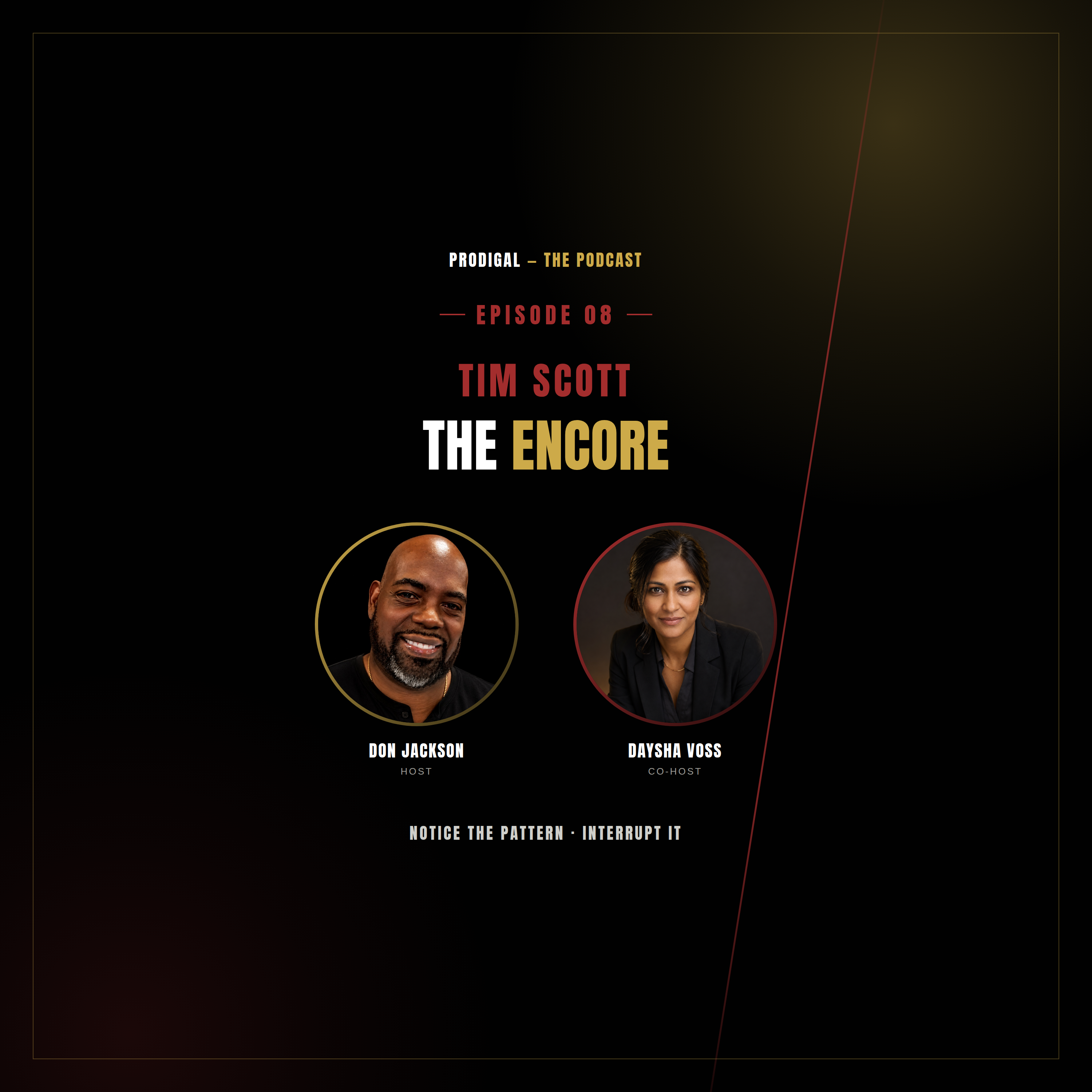
THE ENCORE: TIM SCOTT
Politics
The Encore: Tim Scott, the Oldest Performance in American Politics, and Why the Screaming Gives It Away
By Don Jackson | Prodigal Breaking News | prodigalbreakingnews.com
September 10, 2026
A Prodigal Breaking News Deep Dive — companion piece to Episode 8 of Prodigal — The Podcast
🎧 Listen to the full episode on Substack: The Encore: Tim Scott — Episode 8
Wednesday night in Dallas, at the Republican Party's midterm convention — the one even conservative outlets are calling "Trump-a-Palooza" — Senator Tim Scott stepped onstage and delivered a speech that split the room in exactly the way it was built to. Delegates gave him a standing ovation. Liberal commentators called it a "meltdown." Conservative media called the backlash proof of the very bigotry Scott says he's lived through. Almost nobody, on either side, named what was actually happening in front of them: a performance this country has been watching, in one form or another, since before the Civil War.
What He Actually Said
Scott's speech wasn't quiet. He opened by celebrating "the most transformational two years of any presidency in our lifetime," led the delegate floor in "Let's keep the majority" chants, then moved through a list of nine Democratic Senate candidates by name — Talarico in Texas, Ossoff in Georgia, Sherrod Brown in Ohio, Roy Cooper in North Carolina, and five others — branding all of them "dangerous, radical and frankly weird" and declaring "they hate our culture, they hate what it means to be American."
One line deserves its own paragraph. Attacking Michigan candidate Abdul El-Sayed, Scott claimed he "panders with terrorists." No evidence was offered, because none exists in the reporting on this speech — it's an assertion, made about a Muslim candidate, in a room that cheered it. That's not a policy critique. That's a specific kind of accusation aimed at a specific kind of person, and it landed exactly where it was aimed.
Then came the part that actually went viral: Scott, yelling, arms out, "But Texas, we know who God is. We're talking about Jesus" — attacking his Texas opponent's supposed religious views with the kind of preacher-cadence intensity that had social media replaying it by morning. Commentators on both sides used the same word for it, even when they meant it differently: unhinged.
The Diagnosis, On the Record
The most interesting reaction to Scott's speech didn't come from a script writer. It came the next morning, live, from Reverend Al Sharpton, responding to the same clip everyone else was mocking. Sharpton didn't call it strange for the sake of being strange. He named a mechanism: he said the intensity read as "overcompensation," and — this is the line worth sitting with — "you would only do that if you were in fear."
That's not this show's interpretation. That's a specific, named, on-the-record diagnosis from someone who has spent forty years studying exactly this performance. We're borrowing his word for it, not inventing our own.
1963, Still Running
Because here's what "overcompensation" and "fear" actually describe, and it has a name that's sixty-three years old.
November 1963, Detroit. Malcolm X, "Message to the Grassroots": "The house Negroes — they lived in the house with master, they dressed pretty good, they ate good, 'cause they ate his food, what he left. They loved their master more than the master loved himself. They would give their life to save the master's house quicker than the master would." Compare that to what he says about the other half of that divided house: "When the house caught on fire, he didn't try and put it out; that field Negro prayed for a wind, for a breeze."
That speech wasn't about loyalty to a political party. It was about a psychological position — proximity to power purchased by defending that power more fiercely than the people who actually hold it need you to. Scott didn't just disagree with nine Democrats Wednesday night. He auditioned. He threw an unsubstantiated "terrorist" accusation at a Muslim opponent in a room that needed to hear it from a Black man's mouth to feel comfortable cheering it. That's not incidental to the performance. That's the job.
The Trap Set Around the Criticism — And Why It Doesn't Hold
We're not going to pretend the obvious counter-argument isn't already out there, because it is, and it's worth naming directly instead of dodging it. Conservative media's read on this — Fox News ran it within a day — is that Scott delivered his speech "with grace and charm," that he was talking about his own "trials, pain, and faith," that he said plainly he gets called slurs "by progressives, by liberals," and that the backlash against him proves the left can't tolerate a Black conservative who rejects the systemic-racism narrative on his own terms. Frame it that way, and criticizing Scott looks like punishing a Black man for having the wrong opinion.
Here's the difference, and it matters: nobody's saying Scott isn't allowed to hold conservative views. Plenty of Black conservatives hold those views without auditioning for anyone. What we're naming is a specific pattern of behavior in one specific speech — the screaming, the unsubstantiated accusation aimed at the one Muslim name on the list, the performance calibrated for a room that needed permission it could only get from him. That's not "disagreeing while Black." That's the house Negro's proof of loyalty, delivered live, to a standing ovation. The content of his politics isn't what we're diagnosing. The shape of the performance is.
Same Building, Different Address
And here's where this gets bigger than one senator, because the shape doesn't stay in politics. Walk into a lot of Black churches on a Sunday and you'll find the same architecture Malcolm X was describing in 1963, just wearing different clothes: a hierarchy you don't question, a synergy between pulpit and institution that positions the pastor as the authority standing between you and whatever you're seeking, a methodology built to be received, not interrogated. It isn't that the faith itself is the problem — plenty of what happens in that room is real. It's that the structure underneath it is the same structure Scott performed onstage in Dallas: an external authority you answer to, because you've been taught the answer doesn't live in you.
That's the actual throughline. Not "Tim Scott bad." The same engineered shape — obedience dressed up as belonging, an outside authority standing in for your own — showing up on a convention stage and in a sanctuary, in a boardroom and in a pulpit, because it was never really about the building. It's about where you've been trained to look for permission.
Notice the Pattern
The pattern doesn't change. Something real — faith, politics, community — gets engineered into a structure that rewards proximity to power over the truth of your own position, and it survives long after the moment it was built for, because most people never get shown the architecture clearly enough to see it as a choice. Tim Scott onstage Wednesday night wasn't an aberration. He was the pattern, live, in HD, with a standing ovation.
The Actualization
Naming the performance isn't the same as being free of the instinct to perform it yourself. That takes more than watching someone else do it and shaking your head. It takes noticing every place in your own life where you've been auditioning for an approval you were never actually required to seek — a boss, a room, an institution, a version of yourself built to be acceptable to somebody else's comfort. The source of the answer was never in that room. It was never in the pulpit, either.
Notice the pattern. Interrupt it. You were never waiting on permission. You were always Source.
Sources
- Tim Scott fires up Republicans with passionate midterm convention speech — ABC News 4
- Sen. Tim Scott Says Democratic Senate Candidates "Hate" American Culture — Washington Sun
- Tim Scott speech triggers radical reaction from liberal media mob — Dan Gainor, Fox News Opinion
- Tim Scott Screams about Jesus in Convention Speech — Joe.My.God.
- Morning Joe hosts prayer circle after 'weird' Tim Scott speech — Raw Story
- Message to the Grassroots — Malcolm X, full transcript — The Melanin Project
Process This Deeper
Prodigal AI's Story Companion Guide explores the institutional pattern, consciousness framework, community insights, transformation practices, and action opportunities related to this story.
Open the Companion Guide