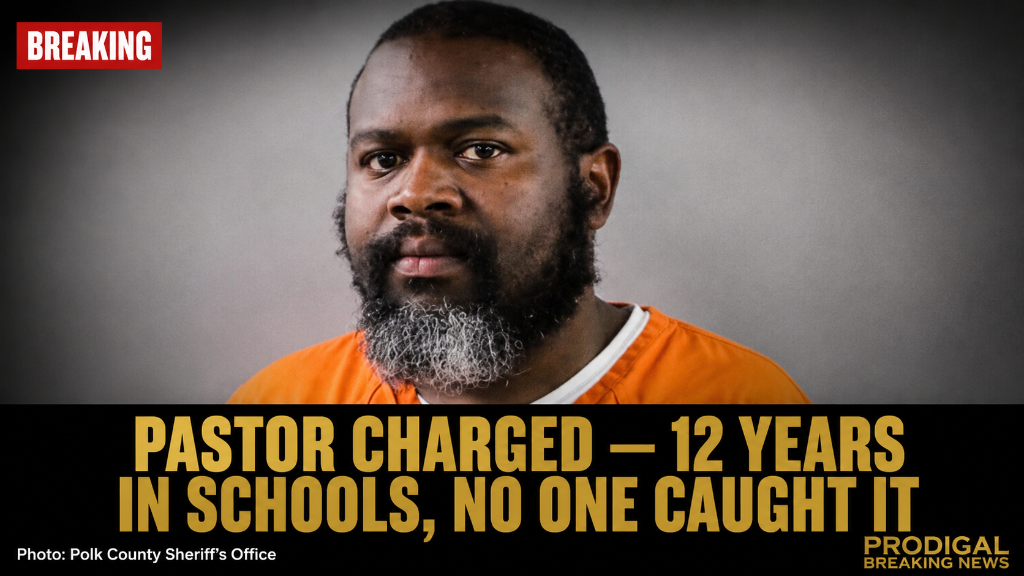
THE PASTOR WORKED IN SCHOOLS FOR 12 YEARS. NEITHER INSTITUTION CAUGHT WHAT A CYBER TIP DID IN DAYS.
Religion & Power
THE PASTOR WORKED IN SCHOOLS FOR 12 YEARS. NEITHER INSTITUTION CAUGHT WHAT A CYBER TIP DID IN DAYS.
By Grant Keller — Investigative Anchor
August 5, 2026
Timothy Chaneyfield, 42, pastor of St. James United American Free Will Baptist Church in Winter Haven, Florida, was arrested August 4 on charges including lewd battery of a minor, traveling to meet a minor, and multiple counts of failing to disclose his HIV status during sex with a minor — after a NCMEC cyber tip led detectives to a 14-year-old victim he met on a dating app. Chaneyfield picked the teen up three consecutive days and assaulted him each time; he also spent 12 years working in Polk County public schools, including a middle school, until 2024.
THE SURFACE STORY
On August 4, 2026, the Polk County Sheriff's Office arrested Timothy Chaneyfield, 42, the pastor of St. James United American Free Will Baptist Church in Winter Haven, Florida, on charges that read like a system failure in three parts.
The first part is the cyber tip. The National Center for Missing and Exploited Children received a tip from a dating app platform that flagged a conversation between an adult user and a minor. That tip was forwarded to PCSO, whose detectives traced the account to Chaneyfield and identified the minor — a 14-year-old boy — within days.
The second part is the conduct the tip uncovered. According to the arrest report, Chaneyfield picked the 14-year-old up three days in a row and assaulted him each time. He is charged with lewd or lascivious battery of a minor, traveling to meet a minor for unlawful sexual activity, and multiple counts of failing to disclose his HIV-positive status to a sexual partner — a partner who was, in this case, a child.
The third part is the 12 years. Before his arrest, Chaneyfield had worked in Polk County public schools for over a decade — including at a middle school — until 2024. He was a pastor the entire time. He was a school employee the entire time. He was, by the allegations in the report, assaulting a child during that time. And neither the church nor the school system caught him. A dating app algorithm flagged a conversation, and a cyber tip did in days what two institutions did not do in twelve years.
THE PATTERN
This is not a story about one pastor. This is a story about the two institutions that were supposed to catch him — and the third institution that did.
Notice the structure. There were three institutions in Timothy Chaneyfield's life for over a decade: a church that called him pastor, a school system that employed him, and a dating app that flagged him. The church and the school are the institutions we have built, over centuries, to protect children — the spiritual community that knows a man's character, the school system that runs background checks and trains staff on mandatory reporting. The dating app is an institution we built to help adults find each other. And yet it was the dating app — through NCMEC's cyber tip line — that caught what the church and the school did not. The institution designed for connection caught the predator. The institutions designed for protection did not.
This is the pattern of institutional failure in abuse cases: the institution closest to the abuser is the institution least likely to report him. The church had the most access to Chaneyfield's life — his character, his family, his time, his trust. It also had the most to lose by seeing him clearly. A pastor is not just an employee; he is a representation of the church's authority and legitimacy. To accuse the pastor is to accuse the church that ordained him. And so the church, structurally, is built to not see. The school system had less to lose, but it also had less access — Chaneyfield was one employee among thousands, and the background check that cleared him on his hire date could not see what he did on his own time, in his own car, with a child he met on an app. The school's system is designed to screen at the door, not to watch inside the building. It caught nothing because it was not built to catch what happened outside the building.
And notice the timing. Chaneyfield left the school system in 2024. He was arrested in 2026. The two-year gap is the gap between the institution that employed him and the institution that caught him — and it is the gap in which the cyber tip system, not the school and not the church, finally did the work. If the dating app had not flagged the conversation, there is no public evidence that either the church or the school would have ever reported him. He could have remained a pastor. He could have remained, in the record, a former school employee with a clean file. The system that was supposed to protect children — the church that knew him and the school that employed him — was the system that would have let him retire.
WHAT THIS REVEALS
This story reveals the limit of the institution as a protection mechanism. We have built, in the church and the school, two of the most powerful child-protection institutions in human history — and in this case, as in many others, they did not protect. They did not fail because the people inside them were bad. They failed because the institutions are structured to not see what their own people do. The church is structured to protect its authority. The school is structured to screen at hire. Neither is structured to watch, over years, what a trusted person does when no one is looking. And the person who is trusted, in both institutions, is the person who has the most access to the people the institution is supposed to protect.
It also reveals the quiet emergence of a third child-protection institution: the cyber tip line. NCMEC's CyberTipline, and the platform reporting that feeds it, has become the detection system that the church and the school do not have. It does not know the abuser. It does not trust the abuser. It does not have a relationship with the abuser. It has an algorithm, a flag, and a report — and in this case, that was enough. The institution that caught Timothy Chaneyfield was the institution that had no relationship with him. That is not a coincidence. It is the reason it worked.
And it reveals the specific failure of the church in cases of pastoral abuse — the structural inability to see the pastor as a suspect. The church that ordained Chaneyfield, that called him pastor, that gave him authority over a congregation — that church is not built to investigate him. It is built to defend him, because defending him is defending itself. The same structure that makes a pastor a spiritual authority makes the pastor, when accused, a liability the church is structured to minimize. This is not a failure of this church. It is the design of the church as an institution. The church that knows its pastor best is the church that is least able to report him.
MOVEMENT SIGN-OFF
Prodigal does not cover this story to tell you that Timothy Chaneyfield is guilty. That is for a court to decide, and the charges are allegations at this stage. We cover it to show you that a man worked inside two institutions — a church and a school system — for over a decade, and the institution that caught him was a dating app he used to meet a child. The institutions we built to protect children did not protect this child. The institution we built to help adults find each other did.
Notice the pattern. The church had the relationship and did not report. The school had the screening and did not watch. The dating app had no relationship and no screening — and it had a flag, and the flag worked. The institution that caught the pastor was the institution that had nothing to lose by seeing him clearly.
The question is not whether this pastor is guilty. The question is why the two institutions that knew him best — the church that ordained him and the school that employed him — were the two institutions least likely to catch him. And the answer is that we have built institutions that are better at protecting themselves than at protecting the people inside them. A dating app caught what a church and a school did not. That is not a story about technology. That is a story about the limit of every institution that is structured to trust the person it should be watching.
Notice the pattern. Then notice which institution caught him — and which two did not.
— Grant Keller, Investigative Anchor, Prodigal Breaking News
Process This Deeper
Prodigal AI's Story Companion Guide explores the institutional pattern, consciousness framework, community insights, transformation practices, and action opportunities related to this story.
Open the Companion Guide