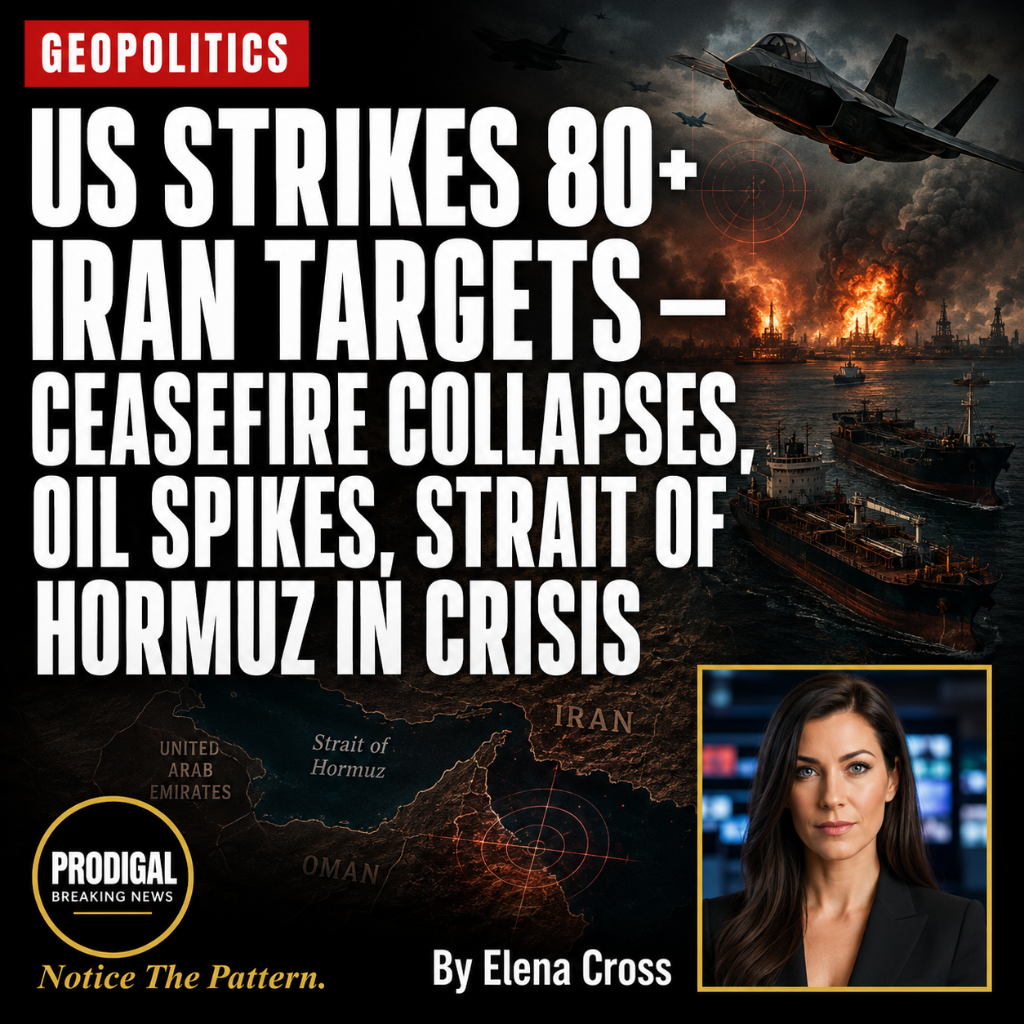
US STRIKES 80+ IRANIAN TARGETS — CEASEFIRE COLLAPSES AFTER 20 DAYS AS TRUMP DECLARES DEAL "OVER" FROM NATO SUMMIT
Geopolitics
US STRIKES 80+ IRANIAN TARGETS — CEASEFIRE COLLAPSES AFTER 20 DAYS AS TRUMP DECLARES DEAL "OVER" FROM NATO SUMMIT
By ELENA CROSS — Investigative Correspondent
July 7, 2026
The US military launched strikes against over 80 Iranian targets on July 7, 2026, and the Trump administration revoked a sanctions waiver on Iranian oil in retaliation for Iranian attacks on three commercial vessels in the Strait of Hormuz. Iran's Islamic Revolutionary Guard Corps responded by launching missiles and drones at 85 US military sites across Bahrain and Kuwait. Trump declared the ceasefire agreement with Iran to be "over," telling reporters at the NATO summit in Turkey that he considers the memorandum of understanding a "waste of time." The fragile peace that lasted less than 20 days has collapsed into military escalation, with global oil markets spiking and the Strait of Hormuz — through which 21% of the world's oil passes — now a war zone. This is what happens when empires test each other's resolve.
Here's what just happened, and what it reveals about where this conflict is actually heading: On June 17, the US and Iran signed a Memorandum of Understanding. It was supposed to extend the ceasefire and open negotiations toward a final settlement. The US agreed to waive sanctions on Iranian oil for 60 days — until August 21. The deal was framed as progress. Peace talks would continue. The Strait of Hormuz would stay open. Shipping would flow. Oil markets would stabilize. On July 7 — 20 days later — the Trump administration revoked the oil sanctions waiver. Why? Because Iran attacked three commercial vessels in the Strait of Hormuz. The Qatari tanker Al Rekayyat caught fire. A Saudi tanker was struck. A Liberian-flagged vessel was hit. The US called it "unwarranted aggression" and a "clear violation of the ceasefire." So the Trump administration did what empires do when they want to assert dominance: it struck back. Over 80 targets. Air defense systems. Command and control networks. Coastal radar sites. More than 60 Islamic Revolutionary Guard Corps small boats. All in approximately four hours. A US official told CNN this was "punishment." The words matter. "This is punishment. It won't be over for a bit." Then Iran did what Iran does: it responded. The Islamic Revolutionary Guard Corps launched missiles and drones at 85 US military sites in Bahrain and Kuwait. They targeted the Sheikh Isa airbase in Bahrain. They targeted Camp Buehring, Camp Arifjan in Kuwait. The message was clear: we can reach you. We can strike back. And where was Trump while all this was happening? At the NATO summit in Ankara, Turkey. Negotiating with Erdogan over F-35 fighter jets to Turkey — which Israel opposes because it threatens military balance in the region. Managing the Ukraine war. Trying to project strength to NATO allies. Then he made a statement. He told reporters the ceasefire with Iran was over. The memorandum of understanding? Over. A waste of time. He called Iran leadership "scum." Brent crude rose 6 percent to $78 a barrel. European stocks fell 1.6 percent. Here's the pattern: a ceasefire that was supposed to last 60 days lasted 20 days. Why so fragile? Because the fundamental conditions that created the conflict haven't been resolved. Iran controls the Strait of Hormuz — one of the most critical shipping lanes in the world. 21 percent of global oil passes through those waters. That gives Iran leverage that no amount of military strikes can fully eliminate. The US can strike 80 targets. But as long as Iran controls the strait, Iran can hold the world's energy supply hostage. The Trump administration's strategy seems clear: demonstrate overwhelming military power, revoke the oil waiver, declare the deal over, and hope Iran backs down. But Iran has already responded with 85 attacks on US military sites. This isn't backing down. This is escalation. The ceasefire is over. Oil prices are spiking. The Strait of Hormuz is a war zone. And Trump is at NATO trying to manage multiple crises simultaneously — Ukraine, Turkey, F-35 sales, now a full-scale escalation with Iran. Watch what happens next. Watch whether this becomes a regional war or a global one. Watch whether the Strait of Hormuz closes again, sending oil prices to levels that destabilize global markets. Watch whether Trump's military-first approach actually achieves the diplomatic goals he claims to want. The empire struck. The adversary struck back. The ceasefire that was supposed to last 60 days lasted 20 days. And the fundamental question remains: can military power alone resolve a conflict where leverage comes from controlling critical global infrastructure? Notice The Pattern. 📩 Full deep dive, sources, and analysis: https://substack.com/@prodigalbreakingnews — Don Jackson, Prodigal Breaking News 👁 YouTube: https://www.youtube.com/@ProdigalBreakingNews 👁 TikTok: https://www.tiktok.com/@prodigalbreakingnews 👁 Instagram: https://www.instagram.com/prodigalbreakingnews/ 👁 Substack: https://substack.com/@prodigalbreakingnews
Process This Deeper
Prodigal AI's Story Companion Guide explores the institutional pattern, consciousness framework, community insights, transformation practices, and action opportunities related to this story.